
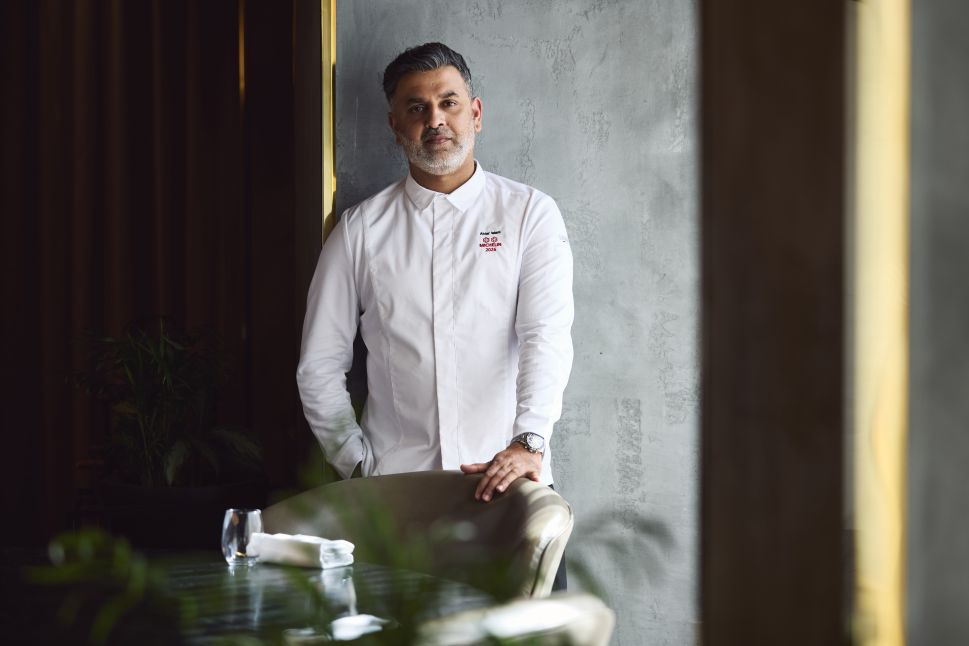
For Aktar Islam, cooking is a process of discovery. Each dish on the expansive tasting menu at his two-Michelin-starred restaurant, Opheem, is the result of years of curiosity and cultivation—something you can taste in each course. The restaurant, a calm oasis off a busy street in central Birmingham, showcases the breadth of Indian cuisine across 10 courses, from an elevated take on Delhi’s aloo tuk to a West Bengal-inspired fish broth called amla tok.
Instead of focusing on a particular region, as many Indian restaurants do, Opheem tells the story of a British chef who grew up in a multicultural city with immigrant parents. Islam, 46, has spent his entire career exploring the possibilities of Indian flavors, ingredients and traditions.
“My parents are from Bangladesh and West Bengal, and I had cultural delicacies I was brought up with and I understood,” he tells Observer, speaking from the dining room of his more casual London restaurant, Oudh 1722, which opened in April. “But I was able to also experience so much more, which led me to be curious about cooking from other parts of India and the Indian diaspora. My approach and understanding of Indian food is very wide and varied.”
Islam grew up in the Aston area of Birmingham, a diverse neighborhood near the soccer stadium. His parents owned a restaurant, India Palace, but his mom also often watched the long-running BBC Two culinary show Food and Drink and copied the recipes, which meant Islam learned about more than just Indian cuisine. His neighbors would also trade dishes, exposing the chef to food from all over the world.
“We got a little bit of everything,” he says. “People ask why the cooking at Opheem is so broad, and it’s because I’m a Brummie, born and bred. I don’t actually have any cultural ties or biases. I enjoy everything just as much.”
Since then, Islam has eagerly studied Indian culinary traditions and cooking styles. He’s built a library of hundreds of books, some of which are on display in Opheem’s lounge, while others are at his home or in the test kitchen downstairs. But a lot of his knowledge comes from firsthand experience. He travels frequently and always spends time cooking with locals—that’s where the nuance comes from.
“It’s great reading recipes, but to actually cook with someone from that part of the world and have them explain certain things is best,” he says. “Books are great because they are factual—everything’s written down in black and white. But with Indian food, recipes are guidelines. It’s how you cook and the reactions happening in the pan or with the spices. It’s a very personal thing. To cook alongside someone and hear their stories, you get the full essence of what they’re trying to do.”
Islam began cooking as a teenager. At 13, he worked in his parents’ restaurant and later branched out to other eateries around England’s Midlands region. He opened his first restaurant in his 20s, but it wasn’t until he debuted Opheem in 2018 that Islam really hit his stride as a chef. The elegant, modern space (a former nightclub) was the ideal forum to showcase his own take on Indian dishes, regardless of region. It was an opportunity to put his vision at the forefront of his work.
“I remember being 13 or 14 and being very opinionated,” he says. “When I started cooking, I would try to tell these older curry chefs what to do. Early on, I realized what we thought of as Indian food in England wasn’t true Indian food. We have this model for British curry houses, but the dishes there had very little to do with the root recipes or root inspirations. I wanted to fight that standard.”
Those older chefs usually told Islam to shut up and keep chopping onions. “I would sit there muttering to myself, ‘Someday I’ll show you,’” he says. “I’ve spent most of my life learning and then teaching people and trying to encourage the curry industry to come along on that journey with me. And that journey isn’t always about moving forward. It’s about looking to the past and to our roots.”
Opheem earned its first Michelin star in 2019, becoming the first Indian restaurant in the U.K. outside of London to do so. “It was a massive moment,” Islam remembers. “It was something I’d worked towards my whole life. At my [former] restaurants, I was involved with other people with so many opinions. One of them had said to me, ‘Nobody wants your fancy plates of shit.’ With Opheem, I could do whatever I wanted to do, irrespective of anyone’s opinion. Plus, I had enlisted a really young team, so when I got the star, I did it with a bunch of 19-year-olds.”
In 2024, Opheem received a second star, becoming the first restaurant in Birmingham to achieve the honor. Although Islam won’t specifically say if he’s aiming for a coveted third star, it’s clear from the experience at Opheem that he and his team—now all grown up—are operating at an elite level. The service is precise, the experience is refined but not stuffy, and the dishes reflect years of detailed evolution. Certain plates, like the Orkney scallop and the aloo tuk, have been constants on the menu, continually tweaked to near perfection. Other dishes shift with the seasons—I had a beautifully presented iteration of asparagus in late May that had already been replaced with a tomato dish by mid-June.
The fish broth, augmented with Cornish sea bass and gooseberries, initially seems like an unusual course. The fruity, slightly tart broth tasted like nothing I’d ever had in an Indian restaurant. But Islam says it’s actually one of the most traditional dishes he does.
“People look at us and say that we’re very progressive, which we are, and they assume that the mainstream curry restaurant is what’s more authentic,” he says. “But in reality, Opheem is more authentic than any of those. That broth is cooked exactly how it would be in a home in a village somewhere in Bangladesh. All we do is we refine it by removing some of the impurities and by heightening the flavor of the acidity, the umami and so on.”
He adds, “In India, would they take a six-kilo bass and dry age it for a week in a salt aging chamber? No, they wouldn’t. But that’s the difference between us and them. But ultimately it’s about the flavor itself. What you had is the purest distillation of that flavor.”
Opheem’s journey concludes with a nod to Birmingham rather than India. One of the desserts is titled “After Eight,” a nod to the British chocolate that is often handed out at the end of a restaurant meal. When Islam worked on Stratford Road, in an area known as the Birmingham Balti Triangle, as a teenager, guests often left with an After Eight in hand. His version is far more elegant and complex, but it hits the exact same chocolate and mint notes.
“It’s an ode to that time and that part of my lived experience,” he says. “I wanted to nod to the traditions of Birmingham that have affected and influenced how I cook and what I cook.”
If Opheem is a personal exploration of Indian cooking, Oudh 1722 is the result of personal interest. The restaurant showcases Islam’s interpretation of Awadhi tradition, a historical cuisine from Lucknow shaped by Persian, Mughal and Central Asian influences. Islam has gotten numerous opportunities over the years to expand Opheem or to open restaurants elsewhere, but he has generally resisted. Oudh 1722 is something else entirely.
“I’ve always wanted Opheem to be a totally unique space in the world,” he says. “It’s food that comes from my heart, and it’s not going to be replicated anywhere else. At Oudh, it’s food I hold dear from a culture I revere, and I’m delivering it with my accent. In Europe, people always gravitate towards classical French as the best. In India, it’s the same with Lucknow.”
It features familiar dishes like biryanis and curries, as well as lesser-seen dishes like gilawat, a finely minced kebab that quite literally melts in your mouth. Islam describes the kebabs, invented in the 18th century, as historically “the height of decadence and sophistication.”
“The Nawab [Wajid Ali Shah] wanted to be able to enjoy all the meaty flavors, but not even have to chew,” he says. “So you ended up with this kebab that’s soft and silky smooth, a bit smoky with all of the aromatic spices—it’s got 32 spices in it. To do that faithfully and do it properly is a lot of work and a lot of tradition. To be able to do that is absolutely awesome.”
Islam’s latest fixation is on Indian tribal cooking, a style of cuisine rarely experienced outside of India. “The Indigenous tribes [in India] are still probably the largest group in the world,” he says. “That’s something that I’m looking into now because I want to learn more. It’s great learning about the royal courts and the finer side of cooking, but to understand something fully, you need to be able to look at everything from every possible angle.”
For Islam, it’s important to differentiate these styles for diners and to celebrate the differences around the country. “It still falls under one banner, but I want to try and break it down more,” he says.
Coming up as a chef, Islam lacked a true mentor. He has primarily taught himself, though he acknowledges that Gordon Ramsay has given him a lot of valuable advice. The chef appeared on Ramsay’s Channel 4 series, The F Word, in 2010, a pivotal moment in his career. “He unlocked my potential,” Islam recalls. “He made me look at food and myself very differently. He told me, ‘If you believe it and invest in it and really put in the hard work, you can make it happen.’”
That’s advice Islam now passes on, both to his team and to other chefs in the U.K. Since Opheem’s success, several other fine-dining interpretations of Indian cuisine, like London’s BiBi, have emerged. He encourages chefs not only to do their own research, but also to find their own voice.
“I’ve always been someone who is very supportive of anyone wanting to better themselves,” Islam says. “Where people get lost is looking at what we’re doing and thinking they can replicate it without fully investing in and understanding the cuisine. I’ve seen restaurants up and down the country emulate us, but a few times I’ve had to say to them, ‘You need to start doing food that represents you. Be on your own journey.’ I know that if you do food that represents you, you will reap the success.”
He adds of his potential legacy, “I’ve been doing this a long time now. I think I was able to help a cuisine mature, and to help a cuisine that I love and respect start its next phase of the journey.”
To do that, Islam has played a long game, always indulging in his curiosity. His long-held sense of discovery means that there’s always something new to learn and always another dish to create.
