
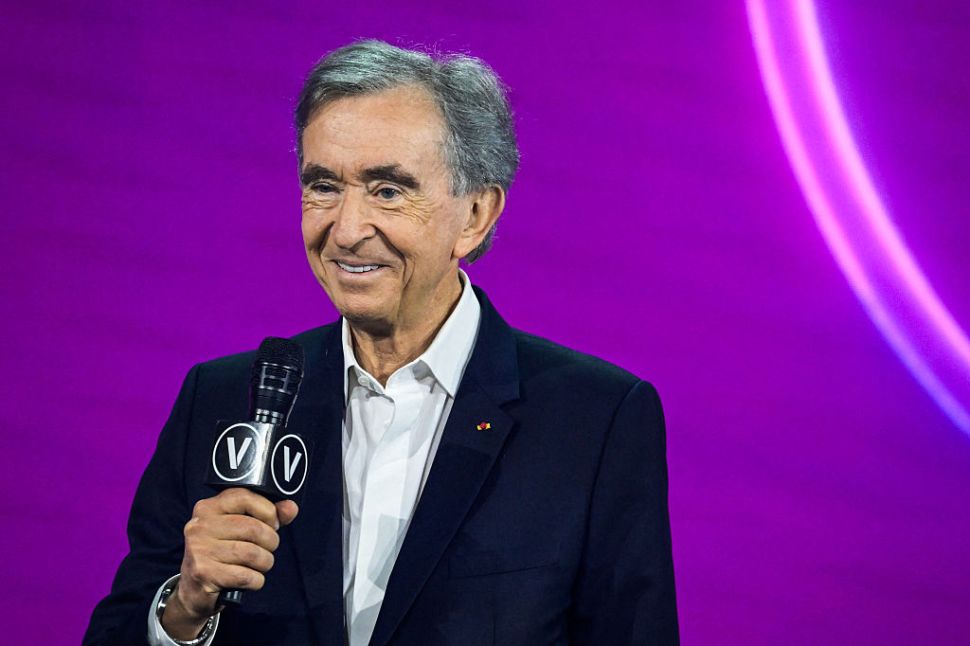
LVMH CEO Bernard Arnault built his luxury conglomerate on heritage brands and centuries-old notions of craftsmanship. But the 77-year-old mogul is now embracing A.I., like many of his peers. Speaking at this year’s VivaTech conference in Paris, Arnault said he personally experiments with A.I.-assisted product design on a regular basis. “Every week, we have a design session with A.I.,” he said during an onstage conversation with VivaTech co-founder Maurice Lévy yesterday (June 17). “With a young guy who is making the program work, and myself, and we design products. And then we make them a reality. And maybe one of them would be a big success.”
The remarks offer a glimpse into how LVMH is engaging with A.I. as the luxury sector adjusts to softer demand following a pandemic-era boom. At VivaTech, LVMH unveiled DreamGallery, an immersive experience showcasing how A.I. is being applied across its value chain, from product creation to traceability and customer experience.
At Louis Vuitton, that includes a partnership with Comelz, an Italian leather-processing machinery specialist. The companies are developing a machine that creates a digital twin of leather hides, then uses A.I. to identify their characteristics and suggest optimal cutting patterns. Artisans can then validate or adjust the suggestions and “retain full control over the final decision,” the company said.
Louis Vuitton designers are also using A.I. tools to test colors, visualize materials and produce e-commerce assets, Soumia Hadjali, a senior digital and client development executive at the brand, said during an NRF event in January. At the same time, the company is drawing a clear boundary around the client relationship, keeping the technology out of direct interactions between client advisers and shoppers.
Céline, meanwhile, has developed Celia, a bespoke A.I. agent powered by MaIA, LVMH’s internal A.I. platform. The tool is designed for retail operations and “supports sales teams, client services, and head office teams in their day-to-day needs, from product knowledge to performance analysis, after-sales support, and internal procedures,” according to LVMH.
Beyond individual brands, the group has been building out a broader A.I. infrastructure. LVMH says its AI Factory, an in-house library of algorithms, works alongside its partnership with Stanford’s Institute for Human-Centered AI to develop tools rooted in “human-centered A.I.” Vogue Business has described the AI Factory as a set of modular algorithms that brands can adapt for e-commerce recommendations, forecasting and client-adviser support. Axel de Goursac, who leads the AI Factory, told the publication the goal is “not automating or replacing humans,” but augmenting employees.
The push comes as growth stalls. In its latest quarter, LVMH reported 19.1 billion euros (about $22 billion) in revenue, with organic sales up 1 percent—a figure the company said would have been 2 percent if not for the conflict in the Middle East. Fashion and leather goods, its largest division and home to Louis Vuitton, Dior and Fendi, declined 2 percent. On an earnings call in April, CFO Cécile Cabanis said store traffic had fallen, but conversion was improving, adding that the group had been “working a lot, especially with A.I.” to drive those gains.
LVMH’s startup pipeline
Arnault has led LVMH for nearly four decades and is also a founding shareholder and co-creator of VivaTech, the Paris tech conference now marking its 10th anniversary.
“I consider my group as a startup, and we are a conglomerate of startups,” he said in his conversation with Lévy. “Each of my brands was, at one point, a startup.”
He added that LVMH has discovered and worked with more than 200 startups through VivaTech since its inception. “I like to meet a lot of startup-ers, to see the interaction between our brands and what they invent, what they think,” he said.
The group engages startups through several channels, including La Maison des Startups, an accelerator program at the Paris startup campus Station F. In 2017, it also launched the LVMH Innovation Award to recognize startups developing new technologies for the luxury sector.
For participating companies, the award can serve as a gateway into LVMH’s ecosystem. Finalists are invited to exhibit at the LVMH Lab during VivaTech and pitch to a jury of digital experts. Winners receive Tiffany & Co.-crafted trophies, along with support from LVMH’s investment specialists and opportunities to develop partnerships with the group’s brands. Both winners and finalists may also join La Maison des Startups.
This year, LVMH named three Innovation Award winners at VivaTech. Paris-based Fairly Made received the Best Impact Prize for its supply chain transparency and environmental impact platform. U.K.-based Synthesia won the Best Business Award for its A.I. video tools, while New York-based Bluefish AI took the Most Promising Award for a platform that tracks brand image and product positioning across A.I. engines. All three companies are already working with LVMH houses, according to Vogue Business.
