
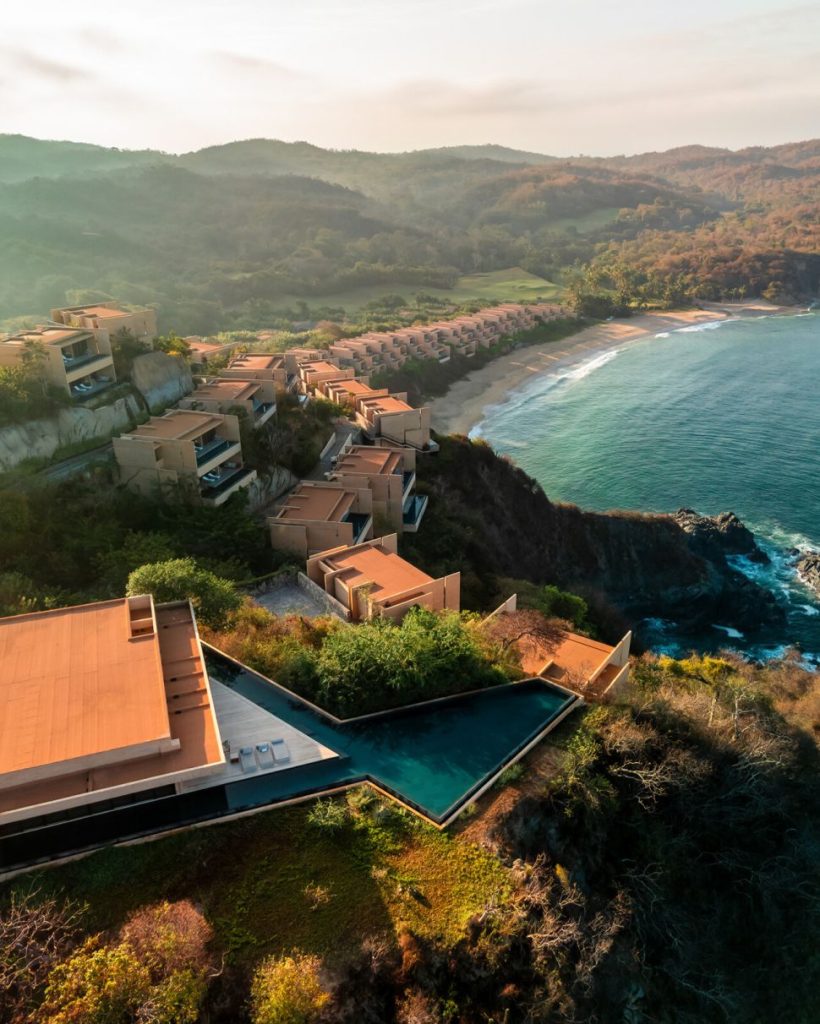
Four Seasons Tamarindo is built into the cliffside, overlooking the ocean.”>
For most of the year, the tropical coast of Jalisco is hot and sticky, with lush jungles growing right up to untouched sandy beaches, and miles of wild Mexican landscape in between. About five hours south of Puerto Vallarta by car, most visitors fly into the Manzanillo airport in Colima instead of PVR, for a much quicker 45-minute car ride to the pristine coastline. The 200-mile coastal stretch of Costalegre, dubbed “the happy coast,” is growing quickly, attracting travelers who prioritize eco-tourism and cultural immersion.
It’s here that the Four Seasons Tamarindo’s Mesoamerican-inspired edifice is built directly into the cliffside overlooking the ocean, surrounded by more than 3,000 acres of nature reserve, protected wildlife, and six miles of beaches. In the three and a half years since the resort opened, the hotel’s pre-Hispanic design, created entirely by a powerhouse team of Mexican architects, has already won a handful of awards, including a spot on the World’s 50 Best Hotels.
Tamarindo’s positioning on Costalegre offers impressive ocean views and privacy, but for guests who travel with an eye constantly attuned to the wine list, the most striking sight comes as the first glass of pale pink rosé wine from Bruma hits the table during dinner. A top producer from Mexico’s foremost wine region, the Valle de Guadalupe, the brand is helmed by acclaimed winemaker Lourdes Martínez Ojeda, who trained for a decade in Bordeaux. Even so, Mexican wine faces all the same stereotypes that all new world regions do, along with a host of others: Domestic taxes are impossibly high, tequila and mezcal have dominated drinking palates for years, and most wine drinkers gravitate toward what they already know.
Four Seasons is among a host of other local boutique hotels and restaurants in the country that are leading the charge in supporting native Mexican winemakers. Over in Cabo, for example, Rosewood’s Las Ventanas al Paraiso has embraced native wines alongside old world counterparts. At Tamarindo, a partnership with award-winning Mexican chef Elena Reygadas for the restaurant Coyul has allowed the resort to take its support a step further.
For Coyul’s prix fixe tasting menu, which is an option alongside à la carte dining, not a single old world wine is included in the wine pairing. Instead, the menu focuses solely on wines of Mexican origin, encompassing additional Guadalupe producers like Lomita and Montefiori, plus a shiraz by Anexlin, a label from the Encinillas Valley in the Mexican state of Chihuahua. This is by design—a choice that reflects a preference for Indigenous ingredients and techniques that have long defined Reygadas’ cooking style, but also a determination to honor local producers at every turn.
“Working with Mexican wines is part of a broader intention to highlight their richness,” Reygadas tells Observer. “Many Mexican wines today have a certain brightness and generosity shaped by the sun. That balance works naturally with our cooking.” The sentiment is growing. A recent story in Bon Appétit questioned why the push to champion local food hasn’t included local wine. Indigenous restaurants and hotels within Mexico have already begun to spotlight native wines, and Tamarindo’s decision speaks to a growing shift.
It’s just over a thousand miles as the crow flies between this beach destination and Valle de Guadalupe, Mexico’s most prominent winemaking region. Though the regions don’t share the same soil or geography, they do share the influence of the Pacific Ocean, meaning crisp, high-acid vintages from Guadalupe are better suited to the food and atmosphere in its sister state than wines from California, Oregon or France. Teresa Ramos Perez, Tamarindo’s director of restaurants, who guides guests through tastings at Coyul, noted that Mexico’s recent viticulture growth has instilled a confidence in producers to pursue their own methods, grapes and expressions.
That experimentation has, for the most part, led directly to higher quality and greater individuality. “Mexican wine is having a very exciting moment,” Perez says. “There’s a new generation of winemakers pushing boundaries and embracing more precise, terroir-driven expressions. At the same time, there’s more confidence, less need to imitate old world styles, and more focus on authenticity. The momentum feels organic but strong. Both locally and internationally, there’s growing curiosity and respect.”
The presence of Mexican wine at the hotel isn’t restricted to pairings at the fine dining level. During a taco tasting at the casual oceanfront eatery, Nacho, a glass of sauvignon blanc from Monte Xanic, one of Guadalupe’s oldest boutique wineries, accompanies a lobster tempura taco drizzled with wasabi and chipotle aioli. Down at the beach, where laidback ceviches and quesadillas are on offer, a draught of 2021 Lágrimas San Vicente Verdejo, a Spanish grape grown in the Valle de San Vicente, was brilliant yellow and tasted of citrus and white fruit. A fitting beach wine, it was another varietal I might never have encountered if it weren’t curated for me.
Guests who prefer formal wine tasting experiences—or want to dig deeper into Mexico’s history—can book a private tasting called The Road to Tierra Adentro. Across four or more glasses of Indigenous wine, this tasting traces the journey of how Spanish vines were originally planted in Mexico during colonization, and unpacks the story behind how almost all of these vineyards were razed after Spain worried Mexico’s wine production would outstrip its own. The oldest winery in the country, Casa Madero, was the sole Mexican producer allowed to keep their vines, a carve out if they agreed to make wine for religious purposes only.
Jose Luis Martinez, assistant director of food and beverage at the property, designed the hotel’s wine experiences to add different layers to the stay. The property focuses on Mexican creators across the board, in disciplines like architecture and design—the wine selection was no different. “From well before we opened, the team wanted to have Mexican wines be part of the culinary experience,” Martinez tells Observer. “For foreign guests discovering Mexican wine, most only know a few labels, and they’re usually from Baja California—our program is centered on Mexico as an entire region.”
It’s simply too hot and sticky to grow grapes on the Costalegre, a humid, tropical strip at the southernmost tip of the state, but elsewhere in Jalisco, a wine region is slowly developing. Martinez and his team opted not to include these local wines in their program for now; production there is quite new, and he thinks the winemakers need more time to learn their terroir and what works best for the area. But across the board, Martinez has brought in wines from Guadalupe, Chihuahua—an area he taps as the next breakout wine-growing scene in Mexico—Coahuila, and Guanajuato, which is best known to American travelers for the city of San Miguel de Allende.
“Most of our wine list is Mexican wines, and we did include international wine, but all of it is based on the flavor profile we want to present: crispness, acidity and salinity,” Martinez says. “We built our wine list on sparkling, whites and rosés mostly, and then of course, included reds. While most guests will already have a wine familiarity, we hope Mexican wine is something they can discover during their stay.”
One of my personal favorites from the Valle de Guadalupe is Vena Cava, a pioneering winery in the region where British-born winemaker Phil Gregory and his wife, Eileen, have worked to establish small production, terroir-driven vintages for over 20 years.
Vena Cava’s extra brut rosé was one of the pairings offered during the prix fixe in Coyul, and several other vintages are on the wine list at Sal, the hotel’s oceanfront dining venue with a seafood focus and a barefoot luxury feel. A bottle of Vena Cava’s orange wine or sauvignon blanc would be an excellent match for Sal’s specialty, a fish charcuterie plate of partially raw, salt-cured slices, similar in texture to sashimi. Normally, I’d pair this plate with a dry German riesling, or my forever go-to, a glass of Sancerre. But that evening, looking out on the ocean as golden hour descended, a Mexican wine fit the moment.
As the country’s wine production continues to grow in stature and technique, there will likely be more and more opportunities for travelers to access the vintages, and they’re already more readily available in Los Angeles than in most other cities. If you happen to spot a glass of Bruma on a wine list in the future, maybe opt for a glass of that rosé instead of a go-to Provençal label? And the next time you’re in Mexico, consider pairing your favorite local cuisine with wine made from grapes that came from the same terroir. It might seem like a small thing in the moment, but wine regions across the world have been built on less.
