
There are as many ways to experience Rome through art as there are layers of history compressed into its streets, with a different few-day journey available for every period that has traversed, or still unfolds within, the city’s dense stratification of human time. If you’re in Italy for the Venice Biennale and want to extend your contemporary research with a fast train ride to Rome, there are museums, galleries and a growing constellation of foundations keeping the Eternal City alive. Note: the best way to move around Rome is on foot, and by following this list more or less in order, you can get your steps in and indulge in a cacio e pepe and a glass of wine with considerably less guilt.
Observer’s Guide to Rome’s contemporary art spaces
Giuseppe Penone’s ‘Foglie di Pietra’
“Like Flowers We Fade” at Fondazione Memmo
Alicjia Kwade’s “INFRASUPRA” at FOROF
Dahn Vo at Fondazione Nicola del Roscio
Minh Lan Tran’s “Choreodrome” at Fondazione Giuliani
Galleries ADA Project, Amanita and Andrea Festa
Tracey Emin’s “There Is A Truth” at Galleria Lorcan O’Neill
Gabriele Silli at Fondazione D’ARC
Latita Weirsch’s “Atlas Studio” at Istituto Svizzero
“The Large Glass” at MAXXI in Rome
Galleria Nazionale d’Arte Moderna e Contemporanea | GNAMC
Miriam Cahn’s “Ciò che mi guarda” at MACRO
Renzogallo’s “Oltre le ceneri” at Mattatoio
Rhinoceros Roma
Via del Velabro, 9, 00186
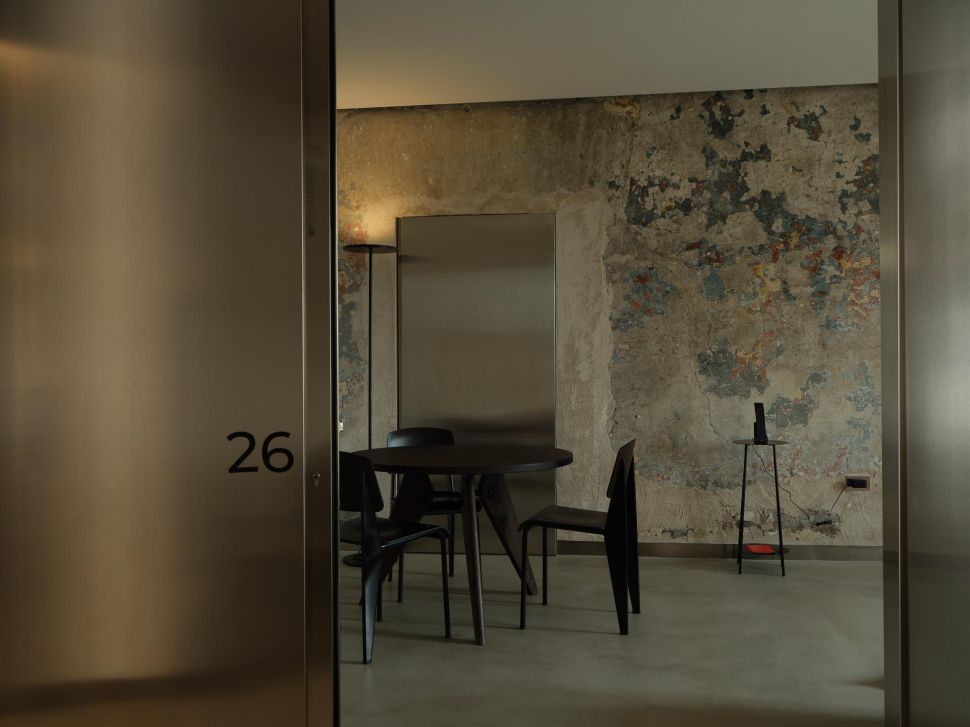
Nothing could be more fitting than making a contemporary art foundation in the very heart of ancient Rome your home base for your contemporary art journey. Rhinoceros is Alda Fendi’s ambitious hybrid art, hospitality and exhibition complex in the Velabro neighborhood, at the archaeological heart of the city near the Arch of Janus and the Forum Boarium. A restoration project led by architect Jean Nouvel and completed in 2018, the complex occupies a group of historic buildings, including a 1900 palazzo, transformed into a luxury hotel and cultural complex with residences, exhibition spaces, rotating galleries, cafés and a rooftop restaurant. Fondazione Alda Fendi – Esperimenti was conceived from the outset not as a conventional private foundation or static collection display but as a platform where visual art, performance, architecture, cinema, literature and hospitality would collide. The building embodies that mission, preserving the rough, ruinous texture of the old popular palazzi while inserting Nouvel’s sharp contemporary language of minimal elegance, with visible traces of the past. On the ground floor, Rhinoceros’s main exhibition spaces host rotating exhibitions in collaboration with galleries worldwide. Currently on view is a presentation by A Gentil Carioca devoted to Brazilian painter Miguel Afa; coming next will be the first solo show in Italy for Brazilian artist Rodrigo Torres, conceived during a two-month residency between c.r.e.t.a. and Rhinoceros. It’s a body of work born from the artist’s encounter with Rome’s cultural landscape, centering on matter, time and transformation as things return to the earth: minerals extracted from the ground are shaped into monumental forms, then fragmented and returned to their essence through the combined action of natural forces and human intervention.
Palazzo Rhinoceros.
©Federico Torra
Giuseppe Penone’s ‘Foglie di Pietra’
Largo Carlo Goldoni 00187
Where there is Fendi in Rome, contemporary art is never far behind. Located in Largo Goldoni, directly in front of Palazzo Fendi, Giuseppe Penone’s permanent public sculpture distills the essence of the artist’s philosophy: nature and culture are not opposites but systems that press into, hold and transform one another. Monumental but strangely airy, two bronze trees rise to support a block of white Carrara marble, turning the language of ruins, columns and archaeological fragments into something suspended by organic growth. The bronze trees evoke time, touch and vegetal memory, while the marble block summons Rome’s classical and archaeological past. Inaugurated on May 22, 2017, as part of a cultural patronage project promoted by Fendi and conceived for this specific site in the heart of Rome’s Tridente, the sculpture was linked to Fendi’s 2017 Penone exhibition, “Matrice,” at the Palazzo della Civiltà Italiana, the house’s Rome headquarters.
Giuseppe Penone, Foglie di pietra, 2015.
Courtesy the artist
“Like Flowers We Fade” at Fondazione Memmo
Via della Fontanella di Borghese, 56/b, 00186
Through November 1, 2026
Founded in 1990 by Roberto Memmo, Fondazione Memmo began as a private foundation dedicated to bringing major historical art exhibitions to the public, often in collaboration with institutions such as the Getty, the British Museum, the Prado, the Louvre and the Met in New York. In its first two decades, it staged blockbuster exhibitions at Palazzo Ruspoli, drawing more than 3 million visitors and helping pioneer a more dynamic model for private cultural programming in Italy. Since 2012, the foundation has shifted toward contemporary art, focusing on international artists, Rome-based cultural exchange and new commissions, with recent solo exhibitions by Sara Vanderbeek, Sterling Ruby, Camille Henrot, Latifa Echakhch, Oscar Murillo, Amalia Pica, Sin Wai Kin and Wynnie Mynerva. For her Italian debut at Fondazione Memmo, Zimbabwean artist Portia Zvavahera presents a new site-specific installation and a body of paintings developed during a residency in Rome. Marking a deeply personal phase in her practice, this new body of work emerges from a cathartic, poetic response to the passing of her mother, moving away from the more visceral narratives of bodies and femininity that define some of the artist’s best-known paintings and channeling grief as a metaphor for rebirth and spiritual transformation. Dreams, memories and emotional states unfold into dense pictorial environments rooted in Shona culture and language, where expressive brushwork, intense color, hand-cut stencils, repeated motifs and printmaking techniques allow spectral figures, floral forms and ornamental patterns to emerge as if from another realm.
Installation view: Portia Zvavahera’s “Like Flowers We Fade” at Fondazione Memmo.
Photo by Daniele Molajoli
Alicjia Kwade’s “INFRASUPRA” at FOROF
Foro Traiano, 1, 00187
Through July 29, 2026
In Rome, every excavation and building plan can become an encounter with another layer of the city’s history, so it was almost expected that when Alda Fendi acquired Palazzo Roccagiovine, directly in front of Trajan’s Column, the past would resurface as soon as renovation began. The building housed a printing workshop for years, but once excavation began, ancient marble flooring emerged. Fendi’s foundation eventually found its home elsewhere, at Rhinoceros, and FOROF now occupies the site that was once an important part of the Basilica Ulpia, one of the central spaces of public life in ancient Rome. Launched in 2022 as a benefit society by Alda’s daughter, Giovanna Caruso Fendi, FOROF is a uniquely hybrid cultural space where contemporary artists are invited to engage with the city’s history, using the archaeological remains of ancient Rome not as a backdrop but as an active interlocutor. Renovated by IT’S Studio, the underground space hosts contemporary art exhibitions featuring both newly commissioned works and recontextualized pieces in dialogue with the remains of the Basilica Ulpia, including ancient flooring and marble fragments. “The result is a space of resonance between different temporalities—archaeological, human and geological—which overlap without canceling one another out,” Fendi told Observer. The current show by Alicja Kwade, “INFRASUPRA,” sees the renowned Polish, Berlin-based artist in a carefully calibrated dialogue with both the history and the essence of the space, staging a confrontation between human and nonhuman time in a theatrical stratification of archaeological, geological and cosmic dimensions, operating across different scales, materials and temporalities.
Installation view: Alicjia Kwade’s ” INFRASUPRA” at FOROF.
Photo: Monkeys video lab
Dahn Vo at Fondazione Nicola del Roscio
Via Francesco Crispi, 18, 00187
Through July 17, 2026
La Fondazione, or Fondazione Nicola del Roscio, was launched in 2019 by art historian, archivist and philanthropist Nicola Del Roscio, president of the Cy Twombly Foundation, as a nonprofit cultural space dedicated to contemporary creativity across visual art, music, cinema, literature and research. Located between Piazza di Spagna and Via del Tritone, it occupies a 1920s building that once housed the Teatro Florida—later immortalized in Vittorio De Sica’s Bicycle Thieves—and now hosts exhibitions by internationally significant artists often connected with Del Roscio’s long-standing commitments to science, biodiversity and environmental research through the Monte Orlando Botanical Garden in Gaeta. Danh Vo’s show fills it with ruins of human civilization scattered as a garden of fragments suspended in time with the possibility of natural life still germinating within them, as in a crucified Christ hanging amid botanical evidence. The exhibition is a greenhouse for nurturing the persistence of images: fragments of famous paintings are isolated and repeated, finding both endurance and a newly precarious condition in today’s hyper-mediation and visual overload. The project, born from an idea by Diego Cassina, brings Vo’s long-standing interest in plants into dialogue with Del Roscio’s own botanical research, particularly his garden in Gaeta, where rare palms gathered through years of travel become living archives of care, time and cultural exchange. Shaped by his farm Güldenhof near Berlin and by the Vietnamese-German family flower shop beneath his apartment, Vo’s blooms carry histories of affection, migration, commerce and colonial inheritance.
Works by Danh Vo at Nicola Del Roscio Foundation.
Courtesy: Nicola Del Roscio Foundation. Photo: Giorgio Benni
Francesca Goodman at Gagosian
Via Francesco Crispi, 16, 00187
Through July 31, 2026.
Gagosian’s Rome outpost is housed in a former bank built in 1921, a space that still carries a distinct architectural authority. Currently on view is a show of Francesca Woodman’s intimate photographs: psychologically charged displacements of bodies staged through private performances that question the position of femininity within physical, social and symbolic space. They play with disappearance as both gesture and condition, and with the woman’s body as something too often absorbed, framed or made vulnerable by the environment around it. Each frame is in a clear dialogue with art history and with timeless archetypes of femininity, revealing Woodman’s almost instinctive and prodigious early awareness of the power of subconscious symbolic language over the ordinary course of things and the performances demanded by society. Over her brief, less than decade-long career, Woodman created a body of work that has become uniquely influential, not only within contemporary photography but in approaching the medium through a specifically feminine lens, turning photography into a tool of self-expression and self-revelation, exposing the dynamics of control and power while questioning the medium’s capacity to invest representation with narrative and allegorical force. Much of Woodman’s oeuvre dates from her years at the Rhode Island School of Design in Providence, which she attended from 1975 to 1978, and the show feels like a homecoming: between 1977 and 1978, Woodman spent time in Rome through RISD’s honors program, exhibiting in 1978 at Libreria Maldoror and in a group exhibition at Galleria Ugo Ferranti.
Francesca Woodman, Untitled or #4 from a Series, “Dissection of a Portrait,” 1976. Gelatin silver print mounted on mat board.
© Woodman Family Foundation/SIAE
Minh Lan Tran’s “Choreodrome” at Fondazione Giuliani
Via Gustavo Bianchi, 1, 00153
Through July 17, 2026
Founded in 2010 by collectors Giovanni and Valeria Giuliani and directed by Adrienne Drake, Fondazione Giuliani has become one of Rome’s most attentive platforms for younger Italian and international artists. While distinct from the Giuliani Collection, the foundation often uses it as a point of departure, treating exhibition-making as a way to open multiple readings of a single work and expand the context of display through additional layers of meaning and interpretation. Here, Minh Lan Tran explores material and affect through a sequence of painterly moments, approaching painting as living matter in which meaning and symbol, body and soul collapse, accumulate, dissolve and reconfigure. Conceived as a constellation of completed works, on-site interventions and choreographic elements, “Choreodrome” unfolds as an environment of unstable and shifting presences at Fondazione Giuliani. At the core of the Hong Kong-born artist’s practice is painting as an active site of transformation: her works are built through layers of natural latex, pigment, paper, chalk, ink and charcoal, with surfaces built up and scraped away, inscribed and obscured, caught between mark-making and erasure, concealment and revelation. Latex, derived from rubber, also subtly references the history of colonial exploitation in Vietnam, while its translucent quality gives the paintings a fragile, unstable presence, allowing light to penetrate and complicate their legibility.
Installation view: Minh Lan Tran’s “Choreodrome” at Fondazione Giuliani.
Photo: Roberto Apa
Galleries ADA Project, Amanita and Andrea Festa
Via dei Genovesi, 35, 00153
Via dei Banchi Vecchi 24, 00186
Lungotevere degli Altoviti, 1, 00186
While Milan remains Italy’s main art market hub, Rome’s contemporary scene has a vibrant group of galleries keeping experimentation and research alive. Now in its 10th year, ADA, founded by Carla Chiarchiaro in 2017, has evolved from an experimental project space into a commercial gallery while maintaining its ethos of prioritizing research-driven solo projects, championing some of the most interesting talents to emerge from the Italian scene in recent years, including the visionary painter Diego Gualandris and Benny Bosetto, whose multilayered practice is currently the subject of a major solo show at HangarBicocca in Milan. Another space worth checking out is Amanita, which carries a direct connection to the city’s art-historical lineage through one of its founders, Caio Twombly, grandson of Cy Twombly, while building a contemporary program across Florence, New York and Rome. Last but not least on the young contemporary side, collector Andrea Festa founded his gallery in 2020 and has quickly become another key young Roman space, with a program focused on emerging and mid-career artists, painting and international exchange.
Andrea Festa.
Photo: Giorgio Benni
Tracey Emin’s “There Is A Truth” at Galleria Lorcan O’Neill
Vicolo de’ Catinari, 3, 00186
Through July 18, 2026
Galleria Lorcan O’Neill was founded in 2003 by Irish-born gallerist Lorcan O’Neill and has become one of the city’s most internationally connected contemporary galleries, moving between established international artists and influential Italian figures, often introducing major names to Italy while maintaining a strong dialogue with Rome’s own artistic scene. Since 2014, the gallery has been based in Vicolo de’ Catinari, a space that helped consolidate its role as a Roman platform for both international contemporary art and Italian postwar and emerging practices. Timed to coincide with the artist’s extensive show at Tate Modern, the gallery is presenting a solo exhibition by British artist Tracey Emin, “There Is A Truth,” featuring all-new works made over the past year in Emin’s studios in London and Margate. Emin has described the title as a metaphor for life and for the directness that art can demand of us—the capacity to see clearly what must be done and to act on it without excuses.
Installation view: Tracey Emin’s “There Is A Truth” at Galleria Lorcan O’Neill.
Courtesy Galleria Lorcan O’Neill
Gabriele Silli at Fondazione D’ARC
Via dei Cluniacensi, 128, 00159
Through September 27, 2026
A recent addition to Rome’s expanding contemporary art ecosystem, Fondazione D’ARC opened in 2024 in the Tiburtino district as a permanent exhibition space and center for contemporary art. Housed in a former cement factory on Via dei Cluniacensi, the Rifugio d’Arte Contemporanea, or Contemporary Art Shelter, is named for its location. Behind it are two prominent Rome collectors, Giovanni and Clara Floridi, whose collecting journey began in the late 1990s. On view at the time of our visit was “All’improvviso,” the first Italian solo exhibition by Polish artist Aneta Grzeszykowska, whose work has been presented at the 59th International Art Exhibition of La Biennale di Venezia and is held in major collections including the Solomon R. Guggenheim Museum in New York and the Centre Pompidou in Paris. Surveying the last 20 years of her practice, the exhibition centered on Daughter, a new photographic series developed during her 2025 residency at Fondazione D’ARC and produced between Italy and Poland. Conceived as a conceptual evolution of MAMA (2018), the work continues Grzeszykowska’s inquiry into simulacrum, identity and memory through performances in which she wears a hyperrealistic mask reconstructing her own face at age 14 and appears alongside her daughter, collapsing adolescent likeness and mature body, past and present, maternal relation and self-image. Currently on view is Gabriele Silli’s “Immenso Spermatozoo Sottomarino,” curated by Giuliana Benassi, with two large site-specific installations and sculptural works that merge with the permanent collection, evoking a grotesque underwater world where life, debris and the subconscious resurface together.
The exhibition centers on Daughter, a new photographic series developed during the artist’s 2025 residency.
Photo: Eleonora Cerri Pecorella
Latita Weirsch’s “Atlas Studio” at Istituto Svizzero
Via Ludovisi, 48, 00187
Through July 7, 2026
Through July, the Swiss Institute in Rome is staging the first monographic exhibition in Italy by Swiss artist Latifa Wiersch: a cacophonic and at times paradoxical mise-en-scène through the rooms of Villa Maraini that becomes a journey through staged histories and unstable identities, where ancient empire, colonial fantasy, Hollywood spectacle and personal memory collapse into one another. The title “Atlas Studios” was inspired by the eponymous studios at the edge of the Moroccan desert, often used by international film productions to recreate imperial antiquity. Playing with enduring stereotypes of exoticism and racial-colonial prejudice, Wiersch raises questions of national and cultural belonging within a context where migration is a structural condition, staging history as an unstable field of projection, rehearsal and role-play. Engaging with popular culture, cinema, television and historical imagery, all filtered through her perspective as a Germany-born artist of Amazigh and Arab descent, the exhibition’s theatrical charge reminds us not only of the enduring violence of representation but of the persistent power of the human creative impulse to restage, unravel and reimagine inherited narratives.
Installation view: Latefa Wiersch’s “Atlas Studios” at Istituto Svizzero.”
© Daniele Molajoli
“The Large Glass” at MAXXI in Rome
Via Guido Reni, 4a, 00196
Through July 31, 2026
MAXXI was the first national museum dedicated to 21st-century art in Italy. Designed by Zaha Hadid and inaugurated in 2010, it unfolds through sweeping concrete curves, suspended staircases and intersecting galleries that feel almost like urban infrastructure turned inward. “The Large Glass,” the current show of MAXXI’s collection curated by Alex da Corte, takes its cue from Luigi Ghirri’s haunting 1978 photograph of a woman’s face seen through glass, glaze, water or nothing at all, using invisible membranes as a metaphor for the fragility between language and nonsense, image and matter, presence and disappearance. Between Kara Walker’s luminous evidence of racism, Alighiero Boetti’s Mappa, Atelier Van Lieshout’s globe and Massimo Bartolini’s revolving reinventions, the exhibition turns the collection into a reflection on transformation, decay, desire and the metaphors of instability and fluidity in our time. Another show, “Tragicomica. Perspectives on Italian Art from the Mid-20th Century to Today,” curated by Andrea Bellini and Francesco Stocchi, is equally brilliant in presenting new readings not only of the collection but of Italian art through what Giorgio Agamben called its “stubborn anti-tragic intention.” Bringing together more than 130 artists, the exhibition frames comedy not as escape from tragedy but as a critical poison slipped into it: a bitter grin through which Italian artists have confronted history, violence, absurdity and social performance.
Installation view: Collezione MAXXI’s “The Large Glass.”
© Musacchio, Pasqualini & Fucilla / MUSA, courtesy Fondazione MAXXI
Galleria Nazionale d’Arte Moderna e Contemporanea | GNAMC
Viale delle Belle Arti 131, 00197
Dedicated to tracing the development of modern artistic languages in Italy, La Galleria Nazionale d’Arte Moderna e Contemporanea is Rome’s official archive of artistic modernity. Founded in 1883 and housed in Cesare Bazzani’s monumental Valle Giulia building since 1911, the museum holds one of Italy’s most important collections of 19th-, 20th- and 21st-century art, bringing Italian modernism, Futurism, abstraction and Postwar experimentation into dialogue with the work of international figures. “Max Peiffer Watenphul. Painter of the Bauhaus,” on view through August 23, spotlights a central but still relatively underexplored figure of 20th-century European art, contextualizing his painting in relation to the Bauhaus and modernist networks. Meanwhile, the museum’s annual artist focus is dedicated through December 31 to Marinella Senatore, one of the most influential figures in contemporary Italian art, whose practice moves between performance, participation, collective action, social ritual and public space.
La Galleria Nazionale d’Arte Moderna e Contemporanea
Courtesy GNAMC
Miriam Cahn’s “Ciò che mi guarda” at MACRO
V. Nizza, 138, 00198
Through November 11, 2026
MACRO (the Museo d’Arte Contemporanea di Roma) is Rome’s municipal contemporary art museum and one of the city’s main public platforms for contemporary practice. Housed in the former Peroni brewery on Via Nizza, a complex dating to the early 20th Century, MACRO launched in 2002 and reopened in expanded form in 2010 after a major intervention by French architect Odile Decq. Now open is the highly anticipated first Italian retrospective dedicated to Swiss artist Miriam Cahn, curated by Cristiana Perrella. Gathering more than 100 works, the show covers the artist’s output from the late 1970s to the present, organized into thematic constellations that explore her intense symbolic lexicon, always in deep conversation with the psyche and the subconscious. Working primarily across painting, drawing and pastel, Cahn has spent more than five decades confronting the human body, violence, desire, vulnerability and war through a language that refuses both the aestheticization of pain and any easy compromise. Large-scale charcoal works on paper from the beginning of her career enter into dialogue with intensely colored watercolors from the 1980s and early 1990s dedicated to the Atombombe, as well as more recent paintings on canvas, confirming the intact radicality of a practice that has lost none of its force. Central to the project are two of Cahn’s room installations, Herumliegen (2022), made in response to Russia’s invasion of Ukraine, and Familienraum (1996-2009), a more inward-looking cycle of paintings and drawings tied to memory, family and private geographies.
The highly anticipated first Italian retrospective dedicated to Swiss artist Miriam Cahn is curated by Cristiana Perrella.
Courtesy the artist and MACRO
Renzogallo’s “Oltre le ceneri” at Mattatoio
Piazza Orazio Giustiniani, 4, 00153
Through August 2, 2026.
Located in Testaccio, Mattatoio is a contemporary art center housed in a former municipal slaughterhouse, built between 1888 and 1891 by Gioacchino Ersoch and considered one of the city’s most significant late-19th-century industrial complexes, its pavilions and La Pelanda spaces still carrying the memory of labor, bodies and urban infrastructure, giving contemporary art a raw architectural frame dense with history. Renzogallo’s “Oltre le ceneri,” curated by Aldo Iori, is conceived specifically for the site, unfolding as a conceptual and poetic journey through the artist’s research, beginning with a new site-specific work: a sequence of red iron elements arranged in space as a single organism, forming one large installation. Together, the works create a visionary architecture in which each structure activates a relationship between body, environment and perception through the viewer’s presence, questioning space as something that moves through time, transforming places into surfaces of passage where meanings, forms and relationships are continuously crossed and reconfigured.
Mattatoio in Roma.
Courtesy palaexpo
