
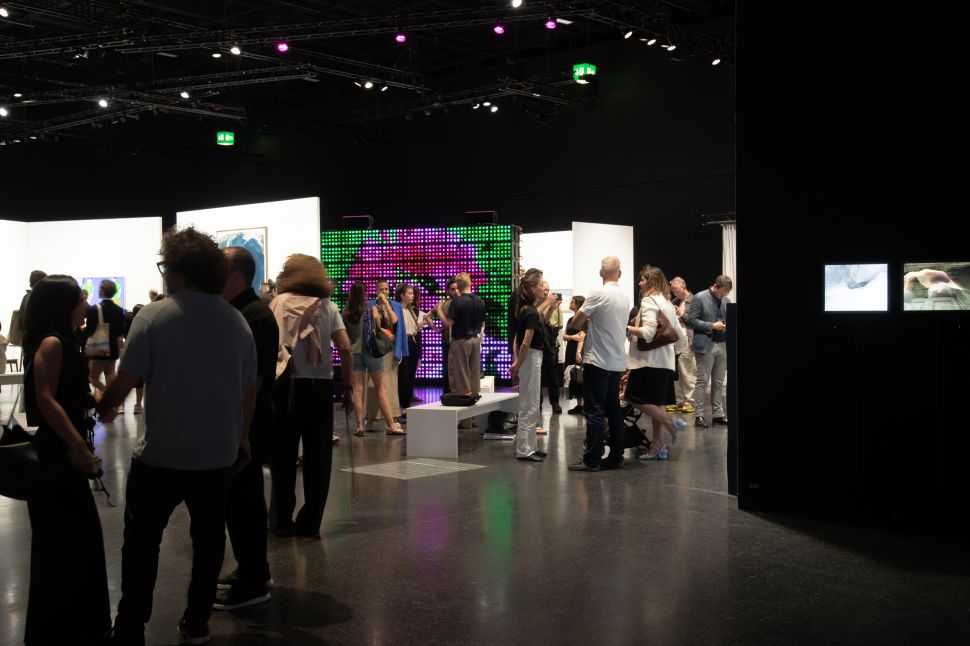
Art Basel’s Zero 10 debuted in Miami, where—true to form—it was mostly defined by the hype around Beeple’s Regular Animals, then found natural terrain in Hong Kong’s digitally fluent and crypto-native crowd before landing at the historic Swiss edition with a far more institutional format. Trevor Paglen, a pioneer at the intersection of art and new technologies who was honored at the Guggenheim earlier this spring, received the LG Guggenheim Award and holds a MacArthur Fellowship, curated the section alongside digital art strategist Eli Scheinman. Their goal was to contextualize these practices within broader art history and encourage connoisseurship beyond hype and speculation.
Together, the two cleverly conceived Zero 10 as an exhibition finally aimed at providing a more cohesive narrative of the past, present and future of digital art practices, advancing the discourse around them and fostering a deeper understanding of how they are already contributing to and shaping the future of artistic production. It was the survey that many in the community and beyond have long been waiting for: more concise in scope, but with contributions from various established key players in the digital art space.
To Paglen, the distinction between digital art and non-digital art has become increasingly artificial. Most contemporary painters use Photoshop, most sculptors use digital modeling software, and nearly all artists rely on technological mediation in some form. From this perspective, digital art is not a separate category but an integral part of contemporary artistic practice. “The argument we are making with this exhibition, and in general, is that all art is digital art at this point,” he told Observer before the fair opened. “Every painter I know makes their painting in Photoshop. Every sculptor I know makes a 3D rendering of their sculptures, then turns it into a physical thing. When you use that definition, it is all digital art.”
Artists and creative practitioners increasingly use computers and, perhaps surprisingly, A.I.-powered technologies to create work, inform distribution channels and build new touchpoints with emerging communities. After all, we now all interact with the world through technology; most of our experiences are filtered, amplified or expanded by devices. As Art Basel CEO Noah Horowitz acknowledged in an interview with The Art Angle ahead of the fair, Zero 10 was launched specifically to meet and attract these new audiences and communities where they are, while helping to build a bridge to the traditional art world on both the institutional and market sides.
Importantly, as Scheinman confirmed to Observer, Zero 10 is not based on the conventional open-call model, as in other sectors, but rather on a mix of direct invitations and inbound interest from galleries and artists. This allowed them to shape a narrative—particularly important in this Basel iteration, where the context is very different. According to Scheinman, or much of the Basel audience, the language of crypto and NFTs remains largely abstract.
The curatorial structure of Zero 10 in Basel was grounded in three interconnected pillars: historical pioneers of computer-based art; established contemporary artists whose practices are deeply informed by digital technologies; and younger artists working at the frontier of internet-native, blockchain-native and computational culture. By bringing these groups together, the exhibition demonstrated continuities that are often overlooked while confronting how to think about and engage with the technological conditions that shape contemporary life. Their primary objective was to articulate a historical lineage of digital art, tracing connections from computer artists of the 1950s and 1960s to contemporary practitioners working with code, A.I., blockchain, networked technologies and hybrid works generated in real time on site.
Harold Cohen.” width=”970″ height=”647″ data-caption=’Harold Cohen, presented by Gazzelli Art House. <span class=”lazyload media-credit”>Courtesy Gazzelli Art House</span>’>
Take, for instance, the work of digital art pioneer Vera Molnár, presented by Oniris.art and Interface Gallery, timed to coincide with her solo presentation at the Kunstmuseum Basel. She was one of the first academically trained artists to embrace algorithmic image-making, approaching the technology’s creative potential as a new language and a powerful vehicle for artistic expression, as was evident in the presentation “When Algorithms Draw: The Vision of Vera Molnár.” Another example is Harold Cohen, the British pioneer of computer and machine-generated art. At Zero 10, Gazelli Art House presented All Four (1964), a major early abstract painting exhibited at the Whitechapel Gallery in 1965, alongside his later machine-generated works, showing an already groundbreaking dialogue and continuity between his painterly practice and his later computational systems.
Cohen’s early interest in systems, structure and rule-based image construction found a contemporary echo nearby in the work of Paris-based artist William Mapan, whose Paysages Plausibles use machine-generated images as the starting point for painterly translation through oil. When we spoke, Mapan described a practice suspended between drawing, painting and code. “I generate the wireframe, the black-and-white lines, and then the composition makes me think of a photo or a location I’ve been to.” He said he considers himself simply an artist, working between the mediums available today. “I have two practices: I paint, and I draw, but I also code. I’m trying to combine the two. I make something in the middle.” Mapan added that the algorithm is collaborative rather than substitutive. He has a complicated relationship with A.I., he admits, and does not really use it; instead, code becomes a tool for iteration and surprise, almost like an assistant within a larger artistic process. The results evoke something of Cézanne’s structural decomposition of planes into tesserae of color, but here the landscapes expand without horizon into a potentially infinite, perspectiveless digital space. Inspired by real locations yet depicting places that do not exist, they reflect how our notion of landscape now inevitably combines physical and digital experiences.
The presentation sold out, with interest from institutions including the Centre Pompidou and the Guggenheim. Mapan’s work is already in the collections of LACMA, the Victoria and Albert Museum, the Toledo Museum of Art, the Museum of Art + Light, the Alan Howard Family Office and the Kanbas Collection, among others. In the booth, Mapan also presented Dances on Shadows (DOS), software linked to a robotic machine that invited collectors and visitors to take a direct role in the process of image generation: through an interactive interface, they could explore the code, navigate its iterations, select one and watch it rendered in real time by a machine plotter. Art Blocks, which presented his work at Zero 10, sold a large painting for $80,000, five medium works for $28,000 each and six plotted drawings with accompanying digital artworks for €3,000 each.
Nearby, ArtMeta’s booth offered the section’s strongest historical presentation of early digital art. Its exhibition, “From Code to Canon: Celebrating 70 Years of Digital Art,” traced computer and electronic image-making back to the 1950s, beginning with works such as Ben F. Laposky’s Oscillon No. 59 and the oscilloscope imagery of Mary Ellen Bute and Desmond Paul Henry. Emerging alongside early mainframe computers, cybernetics and information theory, these experiments positioned digital art as something born from light, signal and machine-mediated perception before the digital image existed as a file. Structured in seven chapters—SIGNAL, SYSTEM, GRAPHIC, NETWORK, GENERATIVE, INTELLIGENCE and PROTOCOL—the booth connected early electronic signals and algorithmic graphics to contemporary A.I. and blockchain-based practices, with prices ranging from $12,000 to $200,000. Among its gems was Charles Csuri’s Numeric Milling (1968), one of the earliest 3D physical sculptures created through a computer algorithm, carrying a $200,000 price tag. By Sunday, the gallery confirmed the sales of his Random War (1967), priced around $80,000, alongside David Em’s Transjovian Pipeline (1979), sold for around $50,000, and Herbert W. Franke’s Tanz der Elektronen (1961-1962), priced at $30,000. The gallery also sold its most historical works, including Ben F. Laposky’s Oscillon 4 (1950s) and Oscillon 1184 (1961), each for $30,000, and Mary Ellen Bute and Ted Nemeth’s Oscilloscope Test (1950/1951) and Oscilloscope Tests (1950/1951), each priced at $15,000.
The dialogue between these early experiments and new practitioners was particularly compelling, particularly in light of a nearby solo exhibition of generative digital and physical art by artist-engineer 0xDEAFBEEF, presented by Asprey Studio. Moving between coding, sound, electrical engineering, computer graphics and metalworking, 0xDEAFBEEF uses software and forged iron to explore the tension between generative systems and manual craft. “With both, you use tools to make your own thing through your creativity,” he told Observer, describing a practice rooted as much in the blacksmith’s workshop as in computational media.
At the center of the presentation were his Synth Poems, on-chain generative audiovisual works paired with forged-iron sculptures modeled on oscilloscopes. Generated at the moment of minting from a unique hash, each work produces distinct combinations of tempo, timbre, pitch and structure, with visuals derived directly from the audio signal. The result is an homage to early electronic image-making, especially Ben F. Laposky’s 1950s Oscillons. Another key work, Glitchbox, added a participatory, ludic dimension: functioning like a programmable audiovisual instrument, it lets viewers manipulate sound and image in real time through knobs and switches. Across the presentation, forged iron introduced an almost anachronistic industrial presence, carrying visible evidence of hand labor. For 0xDEAFBEEF, that physicality is a reminder that craft takes on new meaning in an age of automated production. “Touch as a sense is still there in the digital world,” he told Observer. Asprey Studio sold Synth Poem: Oscilloscope for $40,000, along with four forged-iron sculptures with digital artwork and prints for $7,500 each.
Art Basel-nominated Uzbek artist Aziza Kadyri, presented by eastcontemporary, similarly navigated the intersection of traditional craft and advanced technologies such as A.I. and machine learning. In a show-stopping, red-toned installation that paired textiles and screens in seamless integration with pixel coding and ancient weaving codes, Kadyri used suzani, a Central Asian embroidery tradition passed down through generations of women, as the starting point for training A.I. The system absorbs the ancestral symbologies and culture of this matriarchal knowledge, turning them into a disembodied “style,” but the works are ultimately brought back into the world through traditional artisans in Uzbekistan, restoring touch, labor and cultural specificity to images that might otherwise remain suspended in algorithmic space. In a fertile back-and-forth between human and machine intelligence, the installation prompts timely questions of authorship, agency and cultural transmission. A.I. can contribute to the preservation and repair of collective memory in the digital age, but is also subject to misinterpretation and misappropriation. Here, hand-based knowledge is negotiated with a machine that can read style but not inheritance. The questions of representation are especially charged, as Central Asian visual traditions have often been flattened, exoticized or made peripheral within broader art-historical narratives, and A.I. risks accelerating that abstraction by detaching motifs from the social and embodied knowledge that produced them.
The gallery’s founder, Agnieszka Fąferek, told Observer that traditional collectors were looking at works that use new technologies with curiosity but also with a certain degree of skepticism. Collectors from the digital world, on the other hand, were trying, with the same curiosity and skepticism, to identify the technological component in Aziza’s textile works. Still, the gallery closed several sales, and the first work sold was one of her interactive installations for $23,000—probably the most complex work in the presentation and one Fąferek never expected to sell. Even more impressive was the institutional response. “Numerous curators and professionals returned to the booth several times to study the project in greater depth, a sign that Aziza’s research is engaging with questions that feel very current and urgent,” the dealer said.
From these few examples, it’s obvious how Zero 10 in Basel sought to situate digital art within a broader history of artistic engagement with technology. By placing contemporary practitioners such as William Mapan alongside figures like Andreas Gursky, presented by Sprüth Magers, Avery Singer with Hauser & Wirth or Hito Steyerl with Esther Schipper, and by having these mega-galleries share context with Art Blocks, Fellowship and Asprey Studio—which specialize more on the digital side and have only recently entered the Art Basel orbit—the section created juxtapositions that aimed to reframe the medium within a broader art-historical discourse. It also established a shared ground for artistic experimentation alongside ongoing changes in society and in the way we relate to and perceive the world.
The point, Scheinman suggested, was not only to show digital art as a niche category but to demonstrate how deeply digital processes already run through contemporary art. “We wanted to have this historical arc. We wanted artists who are unambiguously celebrated as great contemporary artists, familiar to anyone, and then to show how many of those artists, whom you might not think of as digital artists, are, in fact, digital artists,” Paglen added, pointing to Ocean V (2010), part of Gursky’s ongoing series in which he constructs composite oceanscapes from satellite imagery taken 35,000 kilometers above Earth. Inspired by a nighttime flight from Dubai to Melbourne, the work turns the image into an almost alien, unfamiliar landscape suspended between the earthly and the celestial, while inevitably prompting an observation of our planetary condition, with shifting borders and landscapes shaped by global conflicts, extraction and climate change.
Several works on view used new technologies as tools to probe the complex systems shaping contemporary life. Avery Singer’s Shit Coin Maxi (2025), a composite layered image depicting two digital wallets found on Twitter, reflected on the entanglement of gambling, finance and technology, as well as the speculative crypto cultures that have shaped and often distorted the broader perception of digital art. Rafael Lozano-Hemmer’s Panoptic Chiasma, presented by Galería Max Estrella and bitforms gallery, similarly transformed interactivity into critique, exploring the intersection of human perception, computation and artificial intelligence while questioning how technological inputs are already embedded in our daily experience of reality. The gallery placed Lozano-Hemmer’s powerful LED lightbulb and light-dimmer installation Pulse Agglomerate (2024) on day one for $180,000 with a private foundation in Ukraine. Additional works sold by the end of the fair at prices between $90,000 and $240,000, including another Pulse Agglomerate (2024), which sold for $25,000-175,000 to CityX Foundation, with an agreement that it will be donated to a major institution.
Presented by Almine Rech, Japanese composer and visual artist Ryoji Ikeda’s epic series data.gram (2022) created a monumental dynamic installation of wall-mounted works that distill vast scientific datasets into 13 sequences. Developed after years of research with institutions including CERN and NASA, the series draws on reprocessed data to explore the aesthetic potential of scientific information, visualizing aspects of the universe that remain difficult to grasp, from quantum particles and hidden matter to human-scale environments and clusters of galaxies. Moving across radically different scales of existence—from the cosmic and seemingly infinite to the human, the microscopic and the barely perceptible—Ikeda explores the potential of new technologies to enhance our understanding of our position within a broader cosmic system. Priced from $25,000 to $325,000, the works somehow make the hidden architecture of the cosmos visually and sonically legible, while pointing to the politics and opacity of digital systems themselves, prompting questions about who owns this knowledge and who can actually access it.
Other works extended that ecological and systemic inquiry, using digital technologies to stage new relationships between natural processes, collective participation and extractive power. Hito Steyerl’s Green Screen (2023), jointly presented by Esther Schipper and Andrew Kreps, combined an experimental LED wall made from recycled glass bottles with living plants and A.I.-generated imagery. Bioelectrical signals from the plants shaped the work’s evolving sound and low-resolution animations of blooming flowers, creating a dialogue between organic life and digital systems while reimagining plants as active agents within contemporary media environments.
That idea of a living, evolving system took a more participatory form in Leander Herzog’s Infinite Garden (2025), presented by Nguyen Wahed. Built as an evolving blockchain-based ecosystem, the interactive installation turned collectors into active participants, inviting them to assemble and share ever-changing digital flora in a collective garden shaped by distributed contributions. The gallery placed it for $9,000, alongside 15 custom generative algorithm works by Andreas Gysin, each for $4,500.
At the entrance, John Gerrard’s triptych STANDARD (2023), Flare (Oceania) (2022) and Western Flag (Spindletop, Texas) (2017), brought by Fellowship, pushed those questions toward environmental crisis, fossil fuel extraction and systems of power. Generated live through custom software, Gerrard’s digital sculptures exist in perpetual, unrepeatable motion, transforming wind, smoke, fire and light into contemplative meditations on climate, energy and technological perception. The first work of the triptych sold for $500,000 to one of the most significant private U.S. collections of classic and contemporary art. Flare (Oceania) (2022) was also sold to a private collector by Sunday for $380,000.
If the number of sales closed by Sunday suggested that digital art is already fully integrated into the contemporary system, our conversation with Paglen and Scheinman ahead of the opening addressed some of the challenges still preventing even broader acceptance. Chief among them was the notion of creative authorship, especially in relation to A.I. When is a digital output truly “creative” enough to be considered art, particularly now that A.I. can potentially help anyone make art? “When I take people around the fair as soon as I mention A.I., I often get feedback like, ‘Why do you need the artist?’ or ‘Isn’t the A.I. just doing this?’” Scheinman said. “There are questions of authorship and ownership. These conversations are critical to have right now.” To Paglen, the key difference is that making art is not only about producing objects but about producing stories, contexts and languages around those objects. A prompt-generated image may be someone’s art, he explained, but that does not automatically make it good art. For him, strong art offers a way of seeing the world differently. “When something is an artwork, a lot of that has to do with the language you are using to make that object. Am I telling a story that connects to artists in the past who asked the same questions in different ways? Is it trying to talk to artists who have not yet been born? Is the language there? You are also creating a story around the object, which prompts somebody to see that object in a particular way.”
Another challenge, both Paglen and Scheinman agreed, is scholarly and institutional accreditation. “I think a lot of curators and professors were trained to look at art from the distant past. Even if you get an art history degree and write something about Warhol, that is still considered pretty new,” Paglen bluntly argued. “A lot of people, when they look at technology, do not understand it, and they know they do not understand it. Their instinct is to go back to a safe place in the 19th Century.”
Educating collectors and institutional buyers is vital, as digital art and its new outputs often require different ways of acquiring them, or different forms of support and participation in the work, rather than mere acquisition. “A lot of institutions were created to hang things on walls, which made sense for the last couple of hundred years. But that makes less and less sense now,” Paglen reflected, pointing to collectors who have pioneered the new media realm, such as the Julia Stoschek Collection, as figures already reimagining what kinds of museums or institutions should exist and how they should adapt to the latest evolutions of artistic practice. At Zero 10, works such as Leander Herzog’s Infinite Garden offer an example of a piece in which the network itself becomes part of the artwork: a model for a more participatory culture, networked ownership, co-creation, distributed authorship and collective stewardship that already prevails in the digital space, but might also offer the art world alternative models of sustainability for artistic production. In that case, blockchain is not merely a speculative market tool but a way to circulate work sustainably, structuring participation, ownership and community around it.
Moving from the early pioneers—the avant-gardes of digital art—to newer artists who are more internet-native or blockchain-native, and whom institutions are only beginning to examine seriously, Zero 10’s historical arc places these practices within a larger question: what happens to art in an age of rapidly advancing technology? This is a question Walter Benjamin first gave its modern theoretical urgency in The Work of Art in the Age of Mechanical Reproduction, and one that generations of thinkers have continued to pursue since. For Scheinman and Paglen, that broader framing is essential to addressing one of the lingering questions around digital art: whether it still needs to be treated as a separate category or whether it should simply be understood as part of art history’s longer negotiation with tools, systems and machines.
Scheinman sees the answer as still being tactical rather than ideological, following the rules the art world has long used to legitimize new forms of artistic expression as they emerge: first cohesively presenting them, then drawing critical attention—often through journalists, sometimes even through hype, given the dynamics of contemporary media culture—and finally building the historical framework that allows them to be contextualized within a more academic discourse. At this moment, he said, a dedicated section is still doing necessary work by helping audiences understand the history, context and breadth of digital practices. Many of the artists think of themselves simply as artists, not digital artists, but the section creates a space in which viewers can recontextualize those practices within a broader lineage of artists who, since the industrial revolution and the historical avant-gardes, have tried to engage with, absorb and creatively repurpose the new mediums made available by technological and scientific change. One could trace that impulse through Futurism, Ballet Mécanique and the many later moments in which artists sought not merely to use new tools but to possess them imaginatively and creatively.
The hope, according to Scheinman, is that over time those distinctions will become increasingly blurry, until the separate category no longer feels necessary, and we might begin to understand how these artists are already exploring new ideologies and epistemologies through their making. In doing so, they might offer ways to resist the technocratic hegemony advancing as A.I. companies enter public markets and as an expanding, interlocked system of political, financial and social control reveals both its threat and its potential. The art world, meanwhile, may discover in these practices new ways to maintain artistic integrity, creativity and sustainability from within.
More in Art Fairs, Biennials and Triennials
In Basel, a Cautious But Committed Market Rediscovers Its Nerve
At Liste Basel, Market Trends Give Way to Explorations of Contemporary Anxiety
Global Art Biennials: Renovation, Revelation—or Repetition?
In Philadelphia, a New Art Fair Removes Scale From the Equation
The Venice Biennale’s Most Powerful Pavilions Tune into Shared Consciousness
