
Earlier this month, the ninth iteration of Zurich Art Weekend unfolded across the city, featuring more than 150 events at over 70 venues. Its scale reads as punishing on the page, yet its layout kept things manageable. In this city, museums and galleries sit within a compact transport network. Artist-led spaces push that map into less expected corners, but central districts reward walking. Entry was, as always, free, a principle that put audiences in contact with a Swiss ecosystem rather than locking it behind professional privilege.
Scheduled immediately before Art Basel, Zurich Art Weekend has long functioned as a measured prelude to the fair’s intensity, permitting unhurried observation at a kinder pace. That balance of civic openness and coordination continues to shape the event’s identity. It also demonstrates a national field whose institutional confidence is matched by independent energy. It’s so successful because it remains true to its format. More than anything, the weekend offers a clear window into the city’s cultural life. By Sunday afternoon, some visitors had traded galleries for a dip in the Limmat River, joining in the summer ritual before heading to Basel. Although the program has ended, most of the exhibitions are still on view.
“Pour Noubia” at the Migros Museum für Gegenwartskunst
“Living with art stops one wilting!” at Luma Westbau
“The Histories” at Kunsthaus Zürich
“Side by Side” at Galerie Peter Kilchmann
“Handspiele” at Galerie Peter Kilchmann
“It’s All a Big Mystery” at Tobias Mueller Modern Art
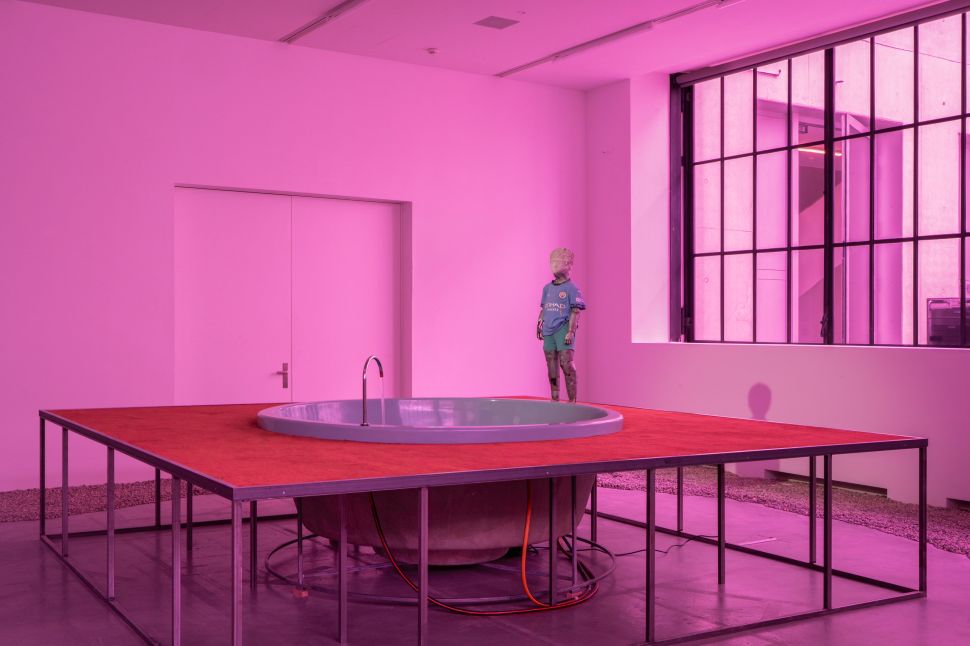
“Pour Noubia” at the Migros Museum für Gegenwartskunst
Limmatstrasse 268 & 270, 8005
Through September 6, 2026
Mohamed Bourouissa’s “Pour Noubia” delivers an affecting presentation at the Migros Museum für Gegenwartskunst. The French-Algerian artist approaches portraiture through people rarely granted recognition. His itinerary extends from Blida, where he was born, through the Paris suburbs to Osnabrück, where his aunt Noubia Meyer spent the latter part of her life. Film anchors this diasporic account. Still images and algorithmic motion broaden its emotional range without flattening individual recollection into documentation. In Généalogie de la violence (2024), 3D sequences enter the aftermath of an arbitrary police intervention, conveying humiliation without reducing pain to spectacle. Upstairs, gravel crunches underfoot, acoustically tethering the gallery to distant terrain. An accompanying publication gathers previously unpublished photographic series beside essays in four languages, enabling Noubia’s story to travel far outside the museum’s walls.
Mohamed Bourouissa, Le grand bain, 2025, in the exhibition “Pour Noubia” at Migros Museum für Gegenwartskunst.
© Mohamed Bourouissa, ADAGP, 2026. Collection Marta. Photo: Studio Stucky
“Regift” at Luma Westbau
Limmatstrasse 270, 8005
Through September 6, 2026
Luma Westbau marks the Swiss Institute’s 40th anniversary through “Regift,” revisiting the 2009 New York project by John Miller and Piper Marshall. Over 50 artists inhabit two floors, deepening the earlier inquiry into how gifts circulate and create mutual obligation. Eliza Douglas, Sylvie Fleury, Félix González-Torres and Camille Henrot feature within a cross-generational constellation that treats exchange as both a common custom and economic mechanism. Donated works are offered for sale to support the Swiss Institute’s future, converting the premises into an active funding model rather than a nostalgic reprise. Each gift produces attachment and debt.
Sylvie Fleury, I Love You: February 14, 2009.
Courtesy Luma Westbau
“Living with art stops one wilting!” at Luma Westbau
Limmatstrasse 270, 8005
Through December 20, 2026
Inside the same complex, the Hans Ulrich Obrist Archives centers on Maria Lassnig. Video conversations between artist and curator run alongside their correspondence. Watercolors introduce the presentation’s delicacy. The Ballad of Maria Lassnig (1992) renders biography palpable, while her animated Selfportrait (1971) recalls pioneering experiments within New York’s feminist milieu. A contribution by Philipp Timischl shows that her uncompromising focus on somatic awareness still resonates with emerging Austrian artists. Lassnig’s last incomplete letter to Obrist supplies the phrase: “Living with art stops one wilting!” The assembled record feels alive rather than embalmed, with friendship acting as an interpretive method.
Maria Lassnig, Untitled, ca. 2000-2002. Watercolor on paper.
© Maria Lassnig Foundation. © Prolitteris, Zurich, Switzerland
“The Histories” at Kunsthaus Zürich
Heimpl. 1/5, 8001
Through August 16, 2026
Kunsthaus Zürich stages an expansive encounter with Kerry James Marshall in “The Histories,” his first Swiss survey. Curated by Mark Godfrey, it spans 45 years and includes newly premiered paintings. Marshall’s command of the canon governs the hang. Black figures occupy compositions from which they were long excluded. Canvases and sculptures address the Middle Passage and slave rebellions, then move through Civil Rights and Black Power. Subsequent pieces challenge romanticized visions of Africa and reject idealized notions of an ancestral past. Across 70-plus works, inherited knowledge registers not as doctrine but as material that can be disputed and redirected. Marshall understands representation as a formal question with political consequences, never a slogan added after the image.
Kerry James Marshall, De Style, 1993. Los Angeles County Museum of Art, purchased with funds provided by Ruth and Jacob Bloom.
© Kerry James Marshall. Photo by Jack Hems
“Marisol” at Kunsthaus Zürich
Heimpl. 1/5, 8001
Through August 23, 2026
The museum’s “Marisol” exhibition restores María Sol Escobar (1930-2016) to a place between Pop Art and Nouveau Réalisme. This first European retrospective spans five decades, featuring painted wooden sculpture and works on paper. Her satire shifts between domestic convention and state authority. The works scrutinize prescribed femininity and family roles, then examine consumerist display and hierarchy. Blocky construction cannot limit their impact. Archival footage also chronicles Marisol’s involvement in dance, including set and costume designs for the Martha Graham and Louis Falco dance companies. These collaborations show how she understood bodies in space, beyond the static wit for which she is known. They complicate the myth of an enigmatic personality by revealing a communal dimension.
Installation view: “Marisol” at Kunsthaus Zürich.
© Estate of Marisol / 2026, ProLitteris, Zurich. Photo: Franca Candrian, Kunsthaus Zürich
“Side by Side” at Galerie Peter Kilchmann
Zahnradstrasse 21, 8005
Through July 24, 2026
Zurich’s gallery circuit favors considered visits. At Galerie Peter Kilchmann’s Zahnradstrasse venue, Marc Bauer’s “Side by Side” references “Der Kreis,” the Swiss magazine tied to homosexual emancipation. Works on paper and canvas fill the rooms. Wall drawings spread their narratives across the building, linking documentary traces with queer desire. Studies of hands express tenderness, while a soundtrack by Sin Maldita and Philipp Hülsenbeck charges the display with subdued tension. Bauer does not regard belonging as settled. He frames it as repeatedly negotiated through intimacy and memory, vulnerable to erasure but capable of return.
Installation view: “Side by Side,” Marc Bauer’s solo exhibition at Galerie Peter Kilchmann.
Courtesy of the artist and Galerie Peter Kilchmann. Photo: Sebastian Schaub
“Handspiele” at Galerie Peter Kilchmann
Rämistrasse 33, 8001
Through July 24, 2026
At the gallery’s second location in Rämistrasse 33, Francis Alÿs dedicates “Handspiele” entirely to cinematic animation. Related to his ongoing “Children’s Games” series, these pencil-drawn films isolate familiar gestures from their surrounding outdoor contexts. Hundreds of images transform elementary motions into precise choreography. Without landscape or spoken explanation, play functions as communication at its most elemental. Haunting, finely layered sound provokes unease, suggesting rivalry begins within even the simplest shared rule. What seems universal is culturally specific, learned physically before speech takes over.
Francis Alÿs, Incy Wincy, 2023. Single channel animated video, 1 min, b/w, no sound; Ed. 1/3 (+ 1 AP).
© the artist, courtesy Galerie Peter Kilchmann
“Not-Yets” at Galerie Tschudi
Rämistrasse 5, 8001
Through August 1, 2026
At Galerie Tschudi, Hana Miletić brings “Not-Yets,” pursuing her sustained research into care and unresolved change. Her handwoven textiles originate in images of makeshift repairs in New York’s Financial District and Bukhara. Adhesive tape holding shattered glass is translated into an abstract pattern. Cement patching a cracked facade undergoes a similar mutation. The pieces retain the reality of their sources without illustrating them. Hung across the interior, they generate a spectral atmosphere in which maintenance appears fragile yet consequential. Miletić asks viewers to notice provisional fixes that daily routines train us to ignore.
Installation view: “Not-Yets,” Hana Miletić’s solo exhibition at Galerie Tschudi.
Courtesy of the artist and Galerie Tschudi. Photo: Cedric Mussano
“It’s All a Big Mystery” at Tobias Mueller Modern Art
Waldmannstrasse 8, 8001
Through August 29, 2026
At Tobias Mueller Modern Art, Carmen D’Apollonio’s “It’s All a Big Mystery” casts ceramic lighting as a group of characters. Hand-built, the lamps preserve dents and visible seams. Irregular contours give each object a human attitude between awkwardness and swagger. A porcelain shade can radically alter its temperament. Illumination serves as structure and mood, not decoration. Humor prevents the installation from becoming precious, so sculpture and utility meet freely. Fixtures look almost ready to speak, though silence is part of the joke.
Installation view: “It’s All a Big Mystery,” Carmen D’Apollonio’s solo exhibition at Tobias Mueller Modern Art.
Photo: Stefan Altenburger Photography Zürich
“Being Here” at Mai 36 Galerie
Rämistrasse 37, 8001
Through August 8, 2026
Mai 36 Galerie completes the Hochschulen route with Irma Blank’s “Being Here.” After relocating from Germany to Sicily in 1955, Blank was suspended between idioms. That estrangement provided the basis for writing without readable words. Lines resemble script yet deny decoding, while breath determines duration. Pen pressure denotes concentration as its scratch sonically articulates time. Several series chart her path from private notation toward a visual lexicon. In the Showroom, an homage celebrates AA Bronson’s 80th birthday and General Idea’s enduring provocation, setting Blank’s quiet rigor against the collective’s media-savvy irreverence.
VALIE EXPORT at Karma International
Weststrasse 75, 8003
Through September 5, 2026
In Wiedikon, Karma International presents Valie Export’s (1940-2026) final project with the gallery, prepared before her unexpected death in May. Photographs from “Body Configurations” (1972-82) show her aligning her silhouette with architecture, testing how built environments discipline presence. Helmet-like sculptures from “Heads—Apheresis” (2002) replace faces with dark cavities. They evoke mortality while refusing its image. The pairing captures the artist’s force: she made corporeal experience a site where social order could be exposed and resisted. Seen now, the selection carries weight without softening the confrontational intelligence that defined her career.
Installation view: VALIE EXPORT’s solo exhibition at Karma International.
Photo: FLAVIO KARRER
