
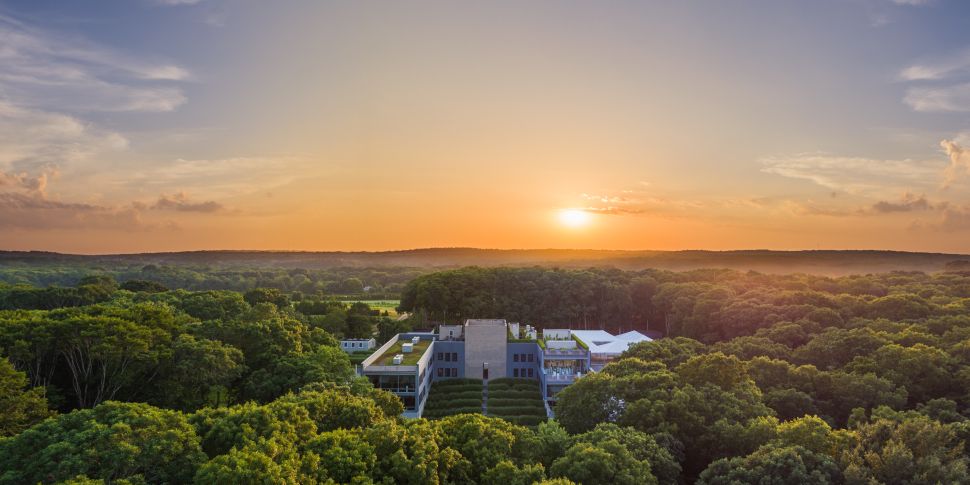
NOMAD, one of the first boutique art and design fairs to build an identity around itinerant, site-specific presentations, launched in 2017 in Monte Carlo before expanding to other wealth-capital hubs, including St. Moritz, Capri and Abu Dhabi. Now the fair is making its U.S. debut in the Hamptons at The Watermill Center, the experimental arts center founded by Robert Wilson. Since its founding, it has distinguished itself from more conventional fairs, anticipating the boothless, site-specific approaches we now see at fairs like Esther and Neighbors.
The fair’s inaugural Hamptons edition will feature site-responsive presentations spanning sculptural furniture, contemporary and modern art, fine jewelry and one-of-a-kind objects brought by a lineup of galleries including The Future Perfect (New York, Miami, Los Angeles and San Francisco), Todd Merrill Studio (New York), Tristan Hoare (London), Gallery FUMI (London), Maison Gerard (New York), Leila Heller Gallery (Dubai, New York), J. Lohmann Gallery (New York), Jeff Lincoln Art + Design (Southampton) and Robilant (London, Milan), among others.
Looking at NOMAD’s choice of locations, each has had a distinctive character and an affluent international audience. Yet the fair’s director, Nicolas Bellavance-Lecompte, tells Observer that affluence alone has never been a sufficient draw. “What attracts us are places that possess a strong cultural identity, a distinctive architectural character, and a history of attracting creative thinkers,” he clarifies. St. Moritz, for example, has long been a meeting point for collectors, artists and intellectuals. Capri represents a century of artistic and literary experimentation. Abu Dhabi is one of the most ambitious cultural projects being developed anywhere in the world today. And he sees the Hamptons as fitting naturally in that constellation. “It is not simply a luxury destination. It has been a place of retreat and inspiration for generations of artists, architects, writers and collectors.”
In Abu Dhabi, NOMAD fully embraced the local context, creating an experience deeply connected to its location in the former Etihad terminal of Zayed International Airport. As Observer reported from on the ground in November, the atmosphere was entirely on theme and brilliantly apt: visitors entered with boarding pass-style cards handed out at a check-in counter before navigating reactivated terminals populated by curated presentations complemented by lounge-style dining areas.
“Every NOMAD edition begins by listening to a place,” Bellavance-Lecompte offers when asked what to expect from the upcoming edition of the fair. In Abu Dhabi, he adds, that meant engaging deeply with the region’s cultural transformation and positioning design as a form of dialogue between local and international perspectives. In the Hamptons, the starting point will be The Watermill Center itself. “Robert Wilson created a place unlike any other, where theater, visual art, architecture, performance, and experimentation coexist; that spirit feels remarkably aligned with NOMAD.”
The Hamptons is a region with a rich artistic history, with era-defining artists including Jackson Pollock, Lee Krasner and Willem de Kooning having kept studios there. “We are entering into a conversation with the institution’s history and with the creative community that has flourished around it for decades,” Bellavance-Lecompte says. Many of this year’s special projects directly engage with the Hamptons’ artistic legacy, including presentations connected to Robert Wilson’s personal collection and archive.
He hopes NOMAD’s United States edition will become a long-term pillar of the fair’s annual calendar, explaining that “the response from galleries, collectors, and institutions has exceeded our expectations. The United States has always been one of the most important markets for collectible design, and yet there has been no platform quite like NOMAD operating here.” The Hamptons offer a unique combination of cultural sophistication, architectural quality and collector density that is difficult to replicate elsewhere. “Our intention is not simply to stage a one-off event but to establish a meaningful long-term presence.”
With its mix of contemporary art and collectible design, NOMAD has built a reputation for pairing radical dislocation with elegant curation. When asked to describe the galleries best suited to its platform, Bellavance-Lecompte answers that the strongest participants are those with a clear point of view. “The most successful exhibitors at NOMAD are not necessarily the largest galleries. They are the ones that understand storytelling, curation, and the importance of context. We look for galleries that can create a dialogue between historical and contemporary works, between disciplines and between cultures.”
He acknowledges that NOMAD’s audience has evolved across 15 editions mounted in multiple locations: “Today it includes major international collectors, museum directors, architects, designers, cultural patrons, entrepreneurs and, increasingly, a younger generation of collectors who move fluidly between art, design, fashion and hospitality.” The traditional distinctions between these worlds are disappearing, and “NOMAD reflects that reality.”
Fairs today are increasingly competing for attention from the same galleries, collectors and institutions, but Bellavance-Lecompte does not see NOMAD as being in the fray. “Collectors still need major marketplace events, and those platforms play an important role. What we offer is something different,” he argues. For him, NOMAD sits somewhere between a fair, an exhibition, a cultural gathering and a hospitality experience. “It is a place where conversations happen naturally, where collectors spend meaningful time with galleries, and where discoveries occur in an environment that feels intimate rather than transactional.” The goal, he adds, “is not to maximize footfall but to maximize the quality of engagement. In other words, NOMAD is less concerned with competing than with creating an entirely different art fair model. “We are building a temporary cultural ecosystem where design, art, architecture, food, travel, and human connection all become part of the same experience.”
