
Carmelo Anthony, the former NBA superstar and current host of the popular video podcast 7PM in Brooklyn, was born in Red Hook, a remote corner of Brooklyn long prized by those who move there for its isolation. Because it is cut off from the subway system by the Gowanus Expressway, a triangle hanging off Brooklyn’s western tip, it’s regarded by visitors who have taken a daytrip to the once-industrious port peninsula for a luxe burger, or a lobster roll, or a pint at Sunny’s after an afternoon antiquing- as a quaint bayside artists’ enclave lined with tiny esoteric independent shops and multimillion-dollar renovated brownstones and an Ikea. It is easy to miss that just a few blocks inland, the 3,000ish residents of the Red Hook Houses have a different relationship with this isolation. The near-century-old projects are among the largest, poorest, and most notorious NYCHA properties in New York. The buildings are low-slung brick cubes hugging overgrown, gone-to-seed courtyards. As Cee-Lo Green once suggested, if you strung a barbed-wire fence around the perimeter, the grouped buildings might more closely resemble a rural low-security prison campus than a place to raise kids.
The apartment Anthony was born into, 79 Lorraine Street, Apartment 1C, is a half-mile from a methadone clinic in one direction and a half-mile from the reimagined Red Hook waterfront in the other. It is easy to imagine a child born there, who perhaps moved to an equally rough part of Baltimore but comes back frequently to visit his family in the Houses, escaping the area out of boredom, and making his way to the waterfront. The child is gangly, growing at an alarming rate, shy and quiet but clearly intelligent. He and a cousin or two cross Dwight Street, where Lorraine becomes Wolcott, and keep walking, past the burgeoning commercial strip on Van Brunt, cutting over on Van Dyke, and following it a few blocks to the pier, where the world opens up, offering a panoramic view of the the ships off the coast, Governor’s Island, and the Statue of Liberty floating in the distance. The child, confined to cramped apartments and their underlit stairwells, to project benches, to shopping at open-air strip malls that read like commissaries, looks out on the majesty beyond the pier and dreams that one day he’ll have easy access to this view and all it inspires in him.
Carmelo Anthony, Jeremy Lin, Mero, Kazeem Famuyide. Photo by Abe Beame
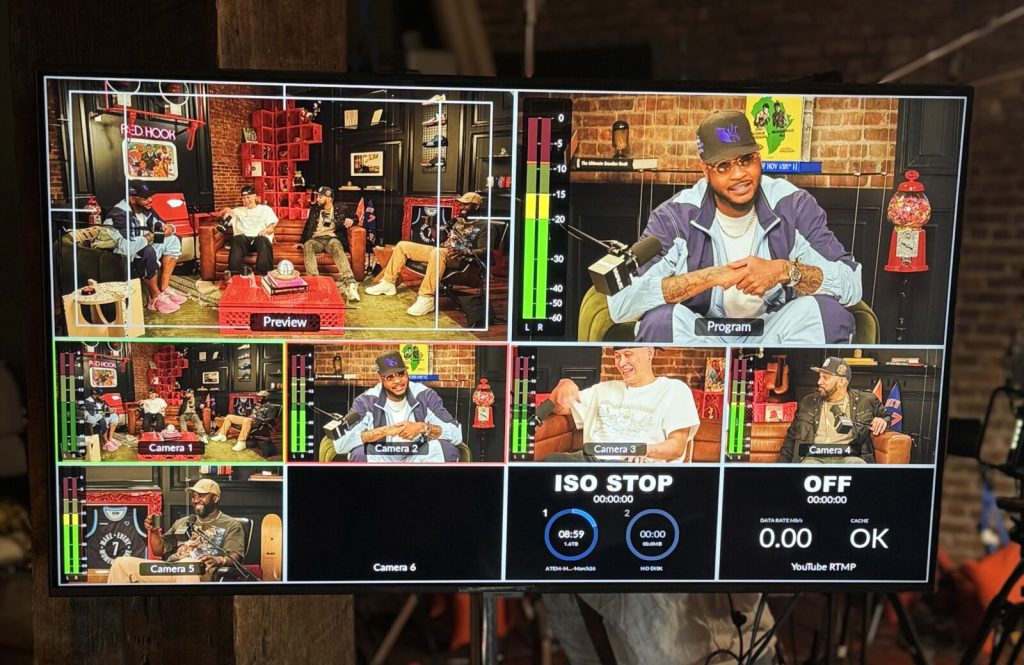
7PM in Brooklyn records in a 6,200-square-foot unit on the second floor of a waterfront warehouse at the end of Van Dyke, by Valentino Park, that is also home to an art gallery, a distillery with a tasting room, and a Key lime pie shop. It is hard to narrowly define the cavernous open-floor-plan space that proudly displays its industrial roots with raw brick walls, plank floors, and a slanted ceiling with exposed wood joists. It’s not an office, not a loft, not a lounge, not a studio, not a museum, not a library, not a living room, but there are elements of all these types of spaces in it. There are couplings of leather couches, a conference table, a poker table, a pool table, a mahogany desk, starburst chandeliers, lifesized KAWS sculptures, Virgil Abloh, Jay-Z, Kehinde Wiley, and Spike Lee art books, a flatscreen playing ESPN on mute, a state-of-the-art vinyl station to play records, massive portraits of Black Americana idols like Malcolm X and Muhammad Ali and Biggie Smalls, and a back wall made mostly of glass that shows off one of the greatest views of the Upper New York Bay I’ve ever seen.
A sign on the back wall proclaims “House of Melo,” and perhaps that is the most accurate accounting of the area Anthony’s production company, Creative 7, has leased to buy since deciding to move its operations here from the South Bronx in the aftermath of Hurricane Sandy. It is a monument to Anthony’s career, with several large paintings and photographs, different releases of his Jordan Brand sneakers, and framed jerseys from stops along his storied career. It’s a maximalist man cave.
I once read somewhere that man caves are expressions of sublimated childhood desires, outlets for the toys you couldn’t afford and the heroes you never got to meet, and that’s what immediately comes to mind in the 7PM studio. Anthony has the money, and access to curators that could line these walls with cool-kid modernist artwork for him, but has chosen pop-art several freshmen at Syracuse likely have print versions of on their walls right now. Alongside his own high school, college, and pro jerseys, there is a framed, signed Bernard King jersey, and a Michael Jordan Team USA jersey, and if you could go back to Melo’s childhood bedroom, I’d guess there were magazine covers or Champion replicas of these jerseys tacked to the wall with pushpins.
I ask Melo why he chose this warehouse space back in “The Hook,” as it is referred to lovingly on his show. “I was born right here,” he says. “My family was always here. Even after I moved, we never left. For, years this waterfront wasn’t available. They only had the port. I’m retired now. I’m in business, and I wanted to bring my business back to where I was growing up. Beyond the podcast studio, this is my gentleman’s club, my own Soho House. It’s the way that I always wanted my office to feel. I want to be inspired. Sit by the window, watch the Statue of Liberty. It just motivates me.”
7PM in Brooklyn is among an emergent class of former-NBA-player podcasts that have become an entire genre of the medium. They can be charming, frustratingly self-serving, and, at their best, revelatory, giving unfettered access to the architects of history, digging into primary-source accounts of that history, which for generations sports fans could only argue over and read about, mediated by journalists. Now, there are thousands of hours committed on a weekly basis to a living record of how the athlete thinks, feels, and presents themselves. These are spaces for reliving glory days and trading war stories, for reuniting teammates, friends, and rivals, for gossip, for hot takes. They can be viral-video factories, and can offer perspective on what it’s like actually being in the shoes of a player who participated in a pivotal game that happened last night, freed from what analytics suggested they should’ve done, or what the front-office reverberations will be, or what this means “for the league” in a big-picture sense. These former players can speak directly to the immediacy of this moment and how it feels because they have been in these high-leverage situations. They can offer perspective on this experience the young athletes themselves likely won’t achieve for many years.
As 7PM in Brooklyn approaches the end of its third season, the video podcast currently has over 600,000 subscribers on its YouTube channel and nearly 280,000 Instagram followers. It is currently ranked the number-five NBA podcast on Apple’s chart, trailing only Jeff Teague’s Club 520 as the most popular former-player podcast in the country. It attracts national sponsors and advertisers like FanDuel, Chase, and Square. Over its run, the show has picked up two regular cohosts in Joel “Mero” Martinez and Kazeem “Kaz” Famuyide. Along with its name, this is a window into the high-low aesthetic of a studio space that uses milk crates as table bases and shelving, functional “hood-stamped” decor, around Herman Miller chairs. Both Mero and Kaz are deeply New York-coded media members with a passion for New York sports. It’s a place where likeminded brothers can gather, argue, find common ground, and exchange heartfelt “YERR”s with each other.
Mero. Photo by Abe Beame
The show is mainly concerned with basketball history and Melo’s expert perspective on the modern game, with guests that range from current players like Jose Alvarado to former players like Rasheed Wallace and young players like Devin Harper or Melo’s bluechip son Kiyan, but also runs the cultural gamut. An episode might feature a “hood film” bracket, or a debate about the best DatPiff-era mixtapes, or Katt Williams’ standup routines, or history’s great boxing or wrestling matches with qualified artists, athletes, and cultural commentators like Wood Harris, Monica McNutt, Shawn Michaels, or Wale.
Some former-player podcasts are about analyzing the game on a granular level; some are about spouting goofy and inflammatory shit. 7PM is a cozy kickback show that braids basketball culture into pop culture in a way that rarely feels clunky, largely thanks to the openness and on-air comfort of its host. Ultimately, the show’s general focus and appeal is its celebration of the tenants, curiosities, and passions of Black masculinity. Melo’s “day job” is studio analyst for NBC, but this passion project is quickly turning into its own media empire.
It’s a trajectory I would not have been able to predict as someone who was on a rollercoaster ride with Anthony throughout his career, buying his Syracuse jersey with my winnings from a big-money bracket in college I crushed by picking his Orangemen, (still) believing he was a Trevor Ariza steal away from a championship in 2009, and being alternately electrified and enervated by his return to New York, both as a player and a personality that felt like he always kept his public at arms length. If the entire project of the former-player podcast is humanizing these figures their fans and haters have decades-long parasocial relationships with, it’s possible that the success of 7PM in Brooklyn and the embrace of the once-divisive Anthony is the greatest and most emblematic accomplishment of the genre.
“You have to put these two separate eras of media, when Melo was playing, and now, when Melo is a member of the media himself, into context,” Kaz Famuyide tells me over the phone a few days after my visit to the 7PM studio. Kaz plays the role of moderator and, when necessary, interrogatory journalist (“I approach the show like a YouTube commenter. I’m always asking myself, if I’m watching this conversation, lurking in the comments, what would I be typing?”) to Melo’s steady center of gravity and Mero’s stoned, anarchic, Carhartt-clad, bacon-egg-and-cheese-salt-pepper-ketchup brand of comic relief. “When Melo was a player, he dealt a certain way with the media because one, it’s New York, and two, you’re in the trenches as a basketball player. It’s not the most important thing,” Kaz says.
There was a general player mistrust of basketball media as it exploded onto the internet with an often toxic new style of all-caps discourse, held by non-professionals and even institutional sports journalists emboldened by an era that rewarded exponentially heightened hyperbole, rarely holding the offending keyboards or screaming heads accountable for their radioactive takes. “I think there was a generational divide in the media covering the sport, these older dudes who don’t connect as directly to the fans. Melo came in with a level of relatability. And it’s not just Melo. I think these shows have made a lot of these star athletes more relatable,” Kaz says.
Kaz explains that this era of autobiographical content has allowed players like Melo to open up and share the side of themselves that has always been there, and that perhaps a big part of the show’s appeal is this person we thought we knew revealing a previously unseen and pleasantly surprising side of himself. “As a basketball player, he was one of the greatest isolation scores of all time, and I think a lot of people would take the way somebody plays basketball and project that as their personality. So people tended to think he was selfish, somebody that only cared about himself. But we’re getting to see the “real” version of him now,” Kaz says. “You talk to former players, members of the media—the level of respect he has always gotten is crazy. That should tell you something.”
Carmelo Anthony, Jeremy Lin. Photo by Abe Beame
I learn upon arrival on the day I’m set to observe a taping of the show that the guest will be Jeremy Lin (and am completely crushed when I’m told, I’d argue somewhat cruelly, that Patrick Ewing had been scheduled to sit in as well, but canceled last minute). It’s a show the production team, which includes a producer, a social media director, and an assistant (all young, Black, and tapped in), has high hopes for, as Lin has been the show’s most-requested guest throughout its run.
Mero is the only on-air talent in the building, slumped in a chair in a Prada jacket, two fat-link chains, and low-top Adidas in a Notre Dame colorway, talking hoops with the tech crew as half a stuffed cinnamon milk blunt wrap smolders in the ash tray (for the entirety of the five-ish hours I spend at the studio, unless the show is taping, at least one blunt is in rotation among the crew). Drake’s Iceman is blasting through surround-sound bluetooth speakers embedded in the ceiling and the walls throughout the space.
I quickly learn Mero is always “on,” whether talking to off-camera coworkers or NBA superstars. I walk into the middle of a conversation about his recently made fast friend, New York City mayor Zohran Mamdani, and how he refuses to refer to OG Anunoby by his anglo-friendly nickname. “I was like, “Why you keep calling him Ogugua?” And he said, ‘I’m from Uganda,’ so I guess that’s valid.” He has an inexhaustible supply of anecdotes and impressions he pulls out on demand, riffing like the star of a Second City main stage located on Gun Hill Road that feels less performative than a natural function of a born entertainer’s personality. This is the third gig of the day for Mero, following his morning FM hosting duties and an appearance on ESPN’s First Take with Stephen A. Smith and Cam’ron (yes, he can do a flawless Cam). He has been up since 4:30 a.m., but I only know that because I ask, not because he’s displaying any fatigue. The only time he stops talking is to briefly walk over to a gigantic empty box a television was delivered in to tag it with silver and gold markers he was given personally by the legendary graf writer SKUF.
Kaz shows up soon after, coming directly from burning sage outside of Madison Square Garden following an NBA Finals loss, and is as crestfallen as I was when he learns Ewing won’t be making an appearance. The team starts running down the show notes on a laptop. Lin’s appearance on the show has been the subject of long-running curiosity and fanfare because of perceived animosity from the period when Melo and Lin were teammates, when the Harvard grad in New York on a 10-day contract in 2012 briefly took over the city while the rest of the stars on his team were injured. The narrative goes that Anthony had taken exception to being upstaged, and pushed Lin off the team soon after. Melo and Lin had spoken over the phone off the record recently, and the purpose of this show is to clear the air and satiate the curiosity of the diehard fanbases of both players who have been debating on their behalves for 14 years. “This is going to be our Isaiah/Magic moment” Kaz says, referring to the historic 2017 interview when former friends turned enemies Isaiah Thomas and Magic Johnson met on NBA TV to make amends.
Lin arrives first, and it’s somewhat disorienting to be standing next to an urban legend who delivered three of the best weeks of my life, and later played down the street from my apartment at Barclays as a Net, largely because of how unintimidating and regular his presence is in the room. He walks in with his sister-in-law, in black sweats, a hoodie, and a trucker hat. Lin is soft-spoken and unfailingly polite, and doesn’t smoke or curse. He presents more as a slightly taller-than-average youth pastor or middle school principal who runs the occasional marathon than a millionaire former NBA star. Mero immediately buttonholes him and has him in hysterics with a story that for whatever reason requires a note-perfect Aaron Judge impression.
Lin’s average bearing is a stark contrast to Melo’s, who arrives last, strolling into the studio with $220 worth of Hometown BBQ and a small crew of older dudes who are never introduced or explained to me, and stay to themselves. The room immediately bends towards Anthony, which is perhaps simply a matter of physical gravitational pull. Seeing him next to “regular people” like me, or even Jeremy Lin, gives you some perspective of how freakish and unusual Wembanyama is next to other giant human beings. But it’s more than that. Melo is fresh off a plane from Paris but no worse for wear. He smells rich, appears to have gotten both his facial hair and nails shaped up today, and must have a more coherent skincare routine than using the facewash my wife keeps our bathroom stocked with in the shower every morning. You can actually sense the magnetic cool that allowed him to take over rooms full of the world’s most dominant alphas for nearly two decades as a player.
Melo daps up Lin first (“J Lin in the building!”) and makes the rounds. Without any coordination, we line up as if at the beginning or end of a game (unless you’re Victor Wembanyama). Melo shakes each hand before slipping into the back, singing “Let’s Start Love Over” to himself softly, and returns changed out of sweats and into a Tar Heel-colored tracksuit with a purple and black Wu-Tang x Yankees fitted and his signature rose-tinted lenses in designer frames. The crew migrates over to the set organically, in Melo’s slipstream, and settles into the ease of natural conversation before the cameras start recording. Lin is clearly anxious, playing an away game on Melo’s court in Red Hook, in what we all—including Kaz and Mero—are surprised to learn, prior to the aforementioned phone call, is the first time the men have spoken to each other in 14 years. Lin wants to establish some talking points for them to hit that Anthony will be comfortable addressing—you can sense the immense respect the younger player still has for the vet whose approval he always wanted—but the host sets down his steaming mug of tea, leans over and lays a reassuring hand over Lin’s. “This is very living-room chill. If it comes back in a certain story, you want to tell, that’s cool, but we don’t have to force it.” Then the record starts.
What follows is a 90-minute seance you can watch or listen to across video and podcast platforms, more or less as it occurred. It is the vital work of the former-player podcast, one part nostalgia and one part correcting of the record. The two former teammates come together to soberly compare notes removed from the glare of the spotlight and the hubris of youth, addressing a blind spot in history and reminding fans who have their version of events cemented in their minds what was actually happening, from the perspective of the two main participants. “Perception is reality in certain situations” as Lin says early in the conversation, and for over a decade, that was certainly the case here.
Lin readily offers that at the time he was suffering from imposter syndrome, struggling with staying on any NBA roster making a 50th of the money the stars he grew up idolizing were as he was instantly, uncomfortably thrown into a conversation with them as a superstar-level talent. Both men share frustration over New York media pitting them against each other. Melo is candid about what an odd adjustment it was having this rookie emerge from out of nowhere, thrust into team leadership when ownership was split, front office was split, the coaching staff was split, and the team was split on how to process any of this as it lingered around 10th place. It’s two men who did the best they could at the time sifting through the chaos of that situation, along with the hurt feelings, confusion and disappointment it stirred. “We could have coexisted if we had time to figure it out,” Lin says at one point. Life rarely affords us that time, but conversations like this and forums like 7PM are providing athletes the incentive and opportunity to gain some kind of closure, to commiserate and laugh about these moments of tension, which Lin clearly appreciates, walking out of the studio lighter and more at ease than he walked in. “If there’s someone you haven’t talked to in a long time, pick up the phone and call them,” Kaz says to the show’s listeners, putting a fine point on the reunion and the reason any of this matters.
The production team exchange glances and nod approvingly as the episode wraps, knowing they’ve got one that’ll get traction online, and they begin the work of literal clip-farming. Lin and Melo come together to take flicks, and the team is immediately proven right. Just the image of Anthony and Lin dropped on Instagram racks up thousands of likes and replies within an hour, fueling speculation and debate over body language and facial expression from bad-faith commentators no dialogue, no matter the depth or breadth, can ever satisfy.
Carmelo Anthony, Jeremy Lin. Photo by Abe Beame
“This space is one big therapy session,” Anthony says. “From the look to the furniture to the images, it’s a therapist’s office. When guests come in here, they experience that. When you come in here, it’s inviting. It’s cozy. It’s comfortable.” After Lin leaves, the trio of Anthony, Mero, and Kaz have what is referred to as a decompress. Melo reacts to the interview and shares some reflections that he withheld during the record for the continuity of the episode and, I realize, out of deference to Lin. It’s a moment of transparent reflection with his cohosts, “off the clock,” the ultimate show of comfort, respect, and brotherhood with his ostensible coworkers. Because what just transpired was a natural, flowing conversation, it was easy to miss how generous Anthony was with the mic and the perspective, and I think about how often that word has ever been used to describe him by his detractors.
There is more work to be done over the course of the evening. The hosts need to record another hour-plus-long segment breaking down the current state of the Finals; they need to record ads and some social reactions for Threads. “I don’t know what time zone I’m in, hungrier than a motherfucker,” Anthony exclaims after Lin leaves, but the crew appears to be in no hurry. Mero is recording his Threads reactions direct to phone off to the side of the set, addressing “Real New Yorker” discourse. “I know that you’re mad you live in a third-tier city with a very small airport,” he says with a stoned grin, and Melo stays in his seat to watch the standup, laughing along with the rest of us.
“Whatever work we do over here is always in a safe space. I never want people to come into my space, my personal space, and feel a way,” Melo says. “I want you to come and feel like I feel. It’s a good vibe, good music, good smoke, good food, good conversation.” I’m taken aback by the ease with which the consummate nonchalant superstar deploys therapized speech. I ask him if he thought he would have been able to have the conversation with Lin 10 years ago. “No, no, no. I don’t think I was ready to have any of these conversations we have on the show, especially while I was playing. It’s only after we’ve gone down different passages, and had different experiences, that we can get ourselves to a point where we can actually come together and finally meet each other where we’re at.”
Kaz explains how the warehouse space has morphed in the few years since he joined the show.
“It’s become a house of all of [Melo’s] interests. We’re all comfortable here. After we’re done shooting, if a game is on, it’s a great place to kick it and relax. The best compliment we can get from viewers is “I feel like I’m in the room with you guys,” and that all stems from Melo’s openness,” he says. “People don’t get it. We literally just sat with Jeremy Lin, and there’s still going to be comments that are going to blame Melo and feel a specific type of way about how the situation went down. Melo knows this, and for that reason, most people wouldn’t even touch it. But there’s a certain level of comfort with yourself you have to have to extend that opportunity anyways, and I think there’s a level of respect you have to give to somebody who approaches life like that.”
After the reactions are finished, before recording the second segment, the crew breaks, with most heading to a communal table where smoked beef ribs are unpacked and laid out so everyone can help themselves to plates. I sink into a leather couch and watch for a while before realizing Melo isn’t among them. He has slipped out the back door, onto the wooden balcony attached to the back of the warehouse. I watch him light a blunt, lean on the balcony’s rail, and look out over the water.
The post To Build a Global Basketball Platform, Carmelo Anthony Went Back to Brooklyn appeared first on BKMAG.
