
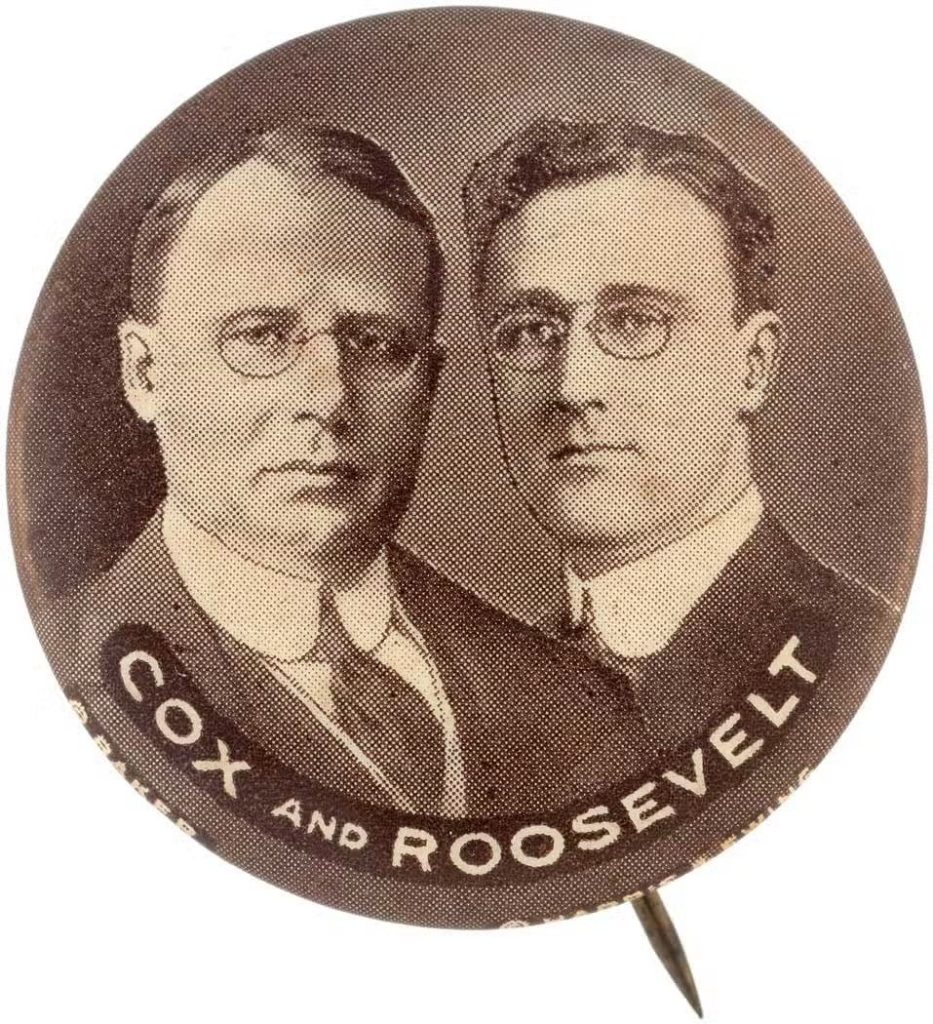
In 1920, it seemed clear to most political observers that Ohio Governor James M. Cox was not going to beat Warren G. Harding in the presidential election. People had had enough of Democrats and were going to vote Republican. Still, a campaign had to be waged, which meant among other things producing buttons with pictures of both presidential and vice-presidential candidates to hand out. That was another thing the Democrats didn’t do so well, since it was difficult to find usable photographs of vice-presidential candidate Franklin Delano Roosevelt, and the campaign didn’t begin producing these buttons until almost too late. As a result, only around 100 of these buttons—called “jugates” due to their side-by-side portraits—were ever produced.
More of these buttons probably would not have swayed the election’s outcome, but the scarcity of these particular one-and-a-quarter-inch round buttons has given them great value for collectors of political Americana. In 2022, one was auctioned at Hake’s Auctions in York, Pennsylvania for $185,850. “There are a lot of collectors of sets of these buttons, going back as far as these campaign buttons were produced, and the Cox-Roosevelt jugate is the rarest of them, which is why the price was so high,” Scott Mussell, Hake’s American director, told Observer.
Americana is an extremely wide category, encompassing almost anything produced in the country over the past 400-plus years. It may include folk art: hand-crafted items like weather vanes, quilts, whirligigs and carved decoys; political and historical memorabilia; flags; Civil War daguerreotypes; Revolutionary War powder horns and muskets; historical manuscripts; furniture; and vintage posters advertising and pop culture. “Someone recently sent me a ticket from the last Beatles concert in America, dated August 12, 1966,” Mussell said. The estimate for that consignment will be $1,000-2,000.
Americana is in a class by itself. There is no Germania or Britannia, for instance, or any other sort of foreign equivalent. When asked by Observer to define Americana, the heads of Americana departments at auction houses were generally stumped and resorted to describing certain types of objects that they have included in sales. Erik Gronning, a senior advisor at Sotheby’s in charge of American furniture, folk art and Americana, said that there were “two types—’books and manuscripts, and everything else.’” As a sales category, it is a broad miscellany of objects that are (typically) hand-made or hand-written but (usually) not fine art. That definition doesn’t completely hold, since those Cox-Roosevelt buttons were produced by machines and painted portraits are often sold in Americana auctions.
There are buyers devoted exclusively to this thing called Americana, but Julia Jones, head of sales in Americana at Christie’s, noted that some of the collectors she has worked with are interested in modern art and see connections with the work of folk artists. Other buyers create a period room in their otherwise contemporary homes, outfitting it with antique furniture and other decorative arts that fall within the category of Americana. Earlier this year, Christie’s sold a portrait of George Washington by Gilbert Stuart whose first owner was James Madison. Stuart is otherwise a painter whose works are sold in sales of American art, but “this is such an iconic Americana image. It is the portrait that we see on the one-dollar bill.” It isn’t just an artwork but “an exceptional object that expresses American heritage,” which placed it in an Americana sale.
Americana knows no political orthodoxy. A recent Hake’s online auction included a ceramic plate with an anti-slavery image, but the auction house has also sold sneering Jim Crow-era images of African Americans on plates and other objects. It isn’t a matter of being fair to both sides; it’s all Americana.
Because most Americana consists of objects from the distant past—colonial America—to the not-that-long-ago, buyers tend to be history buffs. “A lot of them are amateur historians, but some are actual educators who want to buy things that they can show in their classes,” David Lindeman, manager of Anderson Americana in Ohio, told Observer. Anderson Americana has also had the opportunity to sell Cox-Roosevelt jugates, one going for $42,900 in 2006 and another for $35,000 in 2022. For some buyers, the history they are searching for is their own, Lindeman noted. “We have Vietnam veterans and people who were part of SDS. They’re still angry at each other, but they both buy from us.”
One would have to be a dedicated Civil War buff to pay $281,000 in 2022 for the more than 1,000 documents in six boxes comprising the archives of Gideon Welles, secretary of the Navy under Abraham Lincoln, or $27,500 in 2020 for the diary of a cavalry officer protecting immigrants on the Overland Pass in 1865. Both sales took place at Swann Galleries, the New York City auction house that deals primarily with printed material and has held dedicated Americana sales since 1942. Rick Stattler, head of Swann’s Americana department, told Observer that most bidders and buyers are in the U.S., as one might expect, “but we also have some overseas buyers, in Europe and Asia. There is a subculture of people in Germany and France who are interested in American Indians.”
Dedicated watchers of the History Channel’s show American Pickers might assume that interest in Americana is largely a rural fascination, since the show’s hosts spend their time rummaging through barns and outbuildings for objects of interest. But “that’s more often where material is sourced than where it will go,” said Caroline Tamposi, consignment director of Americana and political memorabilia at Heritage Auctions, the Dallas, Texas-based house that holds more than half a dozen Americana sales every year. A high percentage of buyers live in cities in California, New York and Texas—”places where they have a lot of money.”
Tamposi concurred that many, if not most, buyers are history buffs, and “quite a few are lawyers and doctors, sometimes people with old Texas oil money,” since some lots can be very expensive. Museums and academic institutions also bid for items to add to their collections. Occupying a space between curiosity and history, a recent Heritage sale included side-by-side miniature portraits of George and Martha Washington, created in 1857, above sealed envelopes containing actual locks of their hair. An 1869 letter from General George Custer to his wife, Elizabeth “Libbie” Custer, written little more than a month after the Battle of the Washita, sold last February at Heritage for $550,000. In this 21-page letter, Custer describes the conclusion of the winter campaign on the southern plains, his role in a council with Plains tribal leaders, his handling of the captured Kiowa chiefs Satanta and Lone Wolf and his growing reputation as an “Indian fighter.” Objects that seem to tell a story from a pivotal point in American history—particularly items dating back to the Revolutionary or Civil wars—are most sought-after, but objects from shipwrecks (coins, tableware, jewelry) or the Wild West (Annie Oakley’s gauntlet gloves or a diary from a henchman of Billy the Kid) are also popular, Tamposi said.
The realm of Americana ranges from pop culture collectibles to fine objects, and prices follow suit. One of the most expensive items ever sold in a Sotheby’s Americana sale was a tea table, presumably made in 1765 by Newport, Rhode Island, cabinetmaker John Goddard, which sold to a private collector in 2005 for $8.4 million. “It is utilitarian,” Gronning said, “but is also true sculpture.”
