
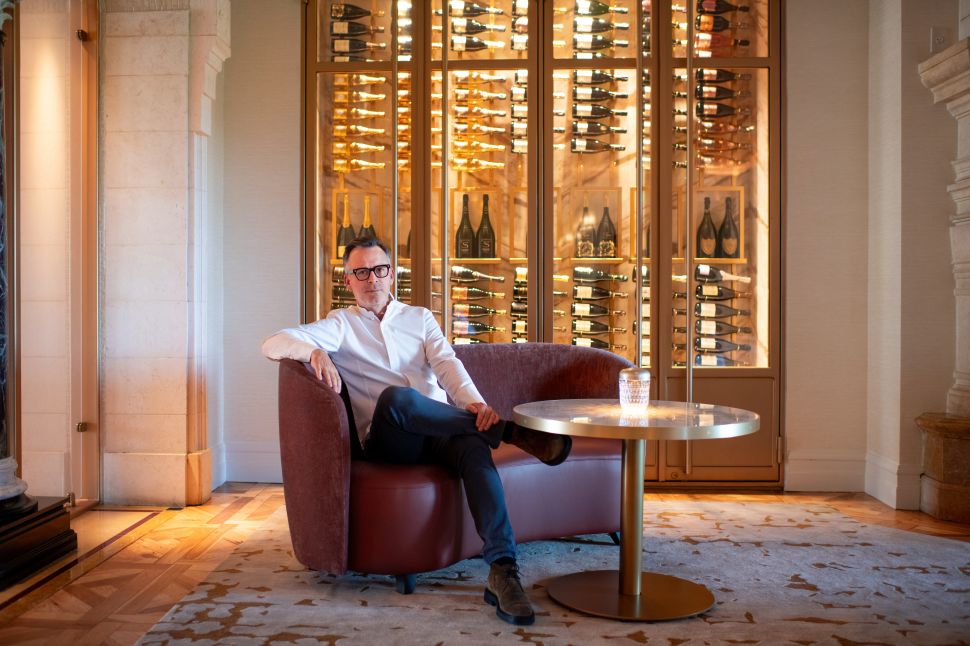
Addison, which maintained its status as San Diego’s only three-Michelin-star restaurant when this year’s stars were announced on June 24, has a new kind of glow.
On May 26, William Bradley, the founding chef who’s been at the helm of the restaurant since its 2006 debut, unveiled Addison’s first major makeover. Bradley, who constantly thinks about his restaurant’s identity and sense of place, tapped California design firm Bishop Pass to modernize Addison with lightness and brightness. The space feels warmer now, with champagne-colored accents and gold metalwork juxtaposed with original elements like rosso marble columns and exposed wood beams.
There’s also a reimagined lounge, with a metallic ceiling fixture, where Addison is accommodating walk-in guests for Champagne and a five-course tartlet tasting menu. Depending on your perspective, you can see this as an impromptu way to enjoy bar snacks (including one topped with turnip, A5, oyster and caviar) or you can see this as a rarefied bang-bang situation.
“We had one of our guests who’s been dining with us for many years,” Bradley tells Observer. “He actually was the first one and still is the only one who’s had the entire tasting menu and then went in the lounge and had the tartlet menu.”
Unlike many tasting-menu restaurants, Addison makes food that you crave again and again. The restaurant, even with its new design, is about familiarity and comfort. The layout remains the same, and so does the choreography of the staff presenting dishes and pouring wine at your table. The room is distinctly different, but it’s striking how the spacing between tables and the rhythm of dinner remind guests of previous visits to Addison.
And while Bradley and his team are constantly tinkering with new dishes, there are Addison crowd-pleasers that are always on the menu, like the chicken liver churro, shellfish chawanmushi and the signature “eggs and rice” with N25 reserve caviar, Koshihikari rice, smoked sabayon and sesame.
“Those are craveable dishes that people really, really enjoy,” Bradley says. “There’s a gentleman who’s eaten at Addison probably 25 times in the last two years, and he still says every time, ‘Can I get a double eggs and rice? And can you send me out with a bag of the churros so I can have them tomorrow night?’ I do give him a double rice upon request, but he’s never left with a bag of churros because the labor on those is a little too much.”
In 2022, Addison became the first Southern California restaurant to earn three Michelin stars. This came after Bradley admittedly spent years emulating fine-dining restaurants around the world, before realizing that he needed to find his own voice.
“I think the most important thing at the highest level is you have to have a style and food that has an identity,” Bradley says.
For Bradley, who was born and raised in San Diego, this identity is about being a top-tier expression of how people eat in Southern California. Bradley is a chef who thinks of Addison as a place where he creates cohesive albums and not just hit singles. Addison’s latest tasting menu brings together Mexican and Asian elements to tell a story about spending your life in San Diego.
The meal starts with tepache and ends with champurrado, which reminds Bradley of childhood Sundays spent eating at the homes of his Latino friends. Southern California is also rich in Asian food, so Addison serves barbecue shima aji, a riff on yakitori that weaves together gochujang and shiitake syrup. There’s quail in two parts: Addison’s version of quail egg drop soup with silken tofu before the main event of Cantonese quail with five-spice quail jus that’s spooned on your plate tableside. (Bradley says he spent eight years convincing elusive purveyor Brent Wolfe to sell him Wolfe Ranch quail.)
The flavors at Addison are simultaneously familiar and wondrous, and the temperature and textures of Bradley’s food complete the picture. His cooking is precise but not precious. The soup gives you that feeling of being in a Chinese restaurant and getting something that toes the line between pleasantly hot and a little too hot. The chawanmushi and the caviar with rice are also dishes that feel like warm hugs. As you scoop deeper into these dishes, the heat builds, the textures change, and the pleasure increases.
“Something that gives you different temperatures and different textures feels luxurious,” Bradley says. “It’s very intentional. Precision is everything in those compositions. We really work through the execution process because I feel that cuisine of this new generation can sometimes be tepid. I wanted there to be dishes where, you know, hot food needs to be hot, warm food needs to be warm.”
Bradley never takes anything for granted. He says he’s “always surprised and always relieved” when his restaurant retains its three Michelin stars. And he knows that he can’t get those stars year after year without pushing harder and embracing change.
“At this point in my career, I actually really enjoy the evolution of the restaurant,” Bradley says. “I’ve always chased the mindset of, it’s very important to stay relevant.”
For the restaurant’s renovation, “We were really looking at the overall beauty and grandeur of the room and really trying to soften that and make it feel a lot more comfortable in a place that’s modernized,” Bradley says. “We softened the interior and just made it very cohesive with the cuisine.”
When your identity is based on being in San Diego, adding lightness and brightness makes perfect sense. And Bradley has had guests tell him that Addison looks, feels, smells and tastes different now.
“When the senses are heightened, the cuisine can be enjoyed to the full,” Bradley says. “It all goes back to that identity. We never want you to feel like you’re anywhere else but Addison.”
