
Art historian and curator Paco Barragán makes a compelling argument that biennials negotiate a set of contradictions: “It is at once local and global, political and aesthetic, critical and institutional, temporary and perennial. Its success, however, comes at the cost of a growing sense of saturation.” In many countries, this negotiation results in spectacle that glazes over politics, celebrates the state or caters to international arts professionals rather than the broader public. The 35th Reykjavík Arts Festival, which engages over 1,300 artists from broader Iceland and the world, shows how sensory saturation can be a superpower: political and artistic, centered on local communities and international artists rather than the state, with programming for all ages. According to Statistics Iceland, in 2025, 12,900 people aged 16-74 were employed in the cultural and creative industries, which corresponds to 5.7 percent of the Icelandic labor market. Because creativity is ingrained in Icelandic culture, artists often maintain multiple practices regardless of economic status. Iceland’s creative ecosystem stands in contrast to the specialization and economic precarity that often shape artistic production in the United States. The prevalence of artists working across disciplines helps explain why experimentation feels so natural within the festival. Iceland’s environment for experimentation stems from its large creative sector, close-knit creative community and robust support for artists. The festival’s greatest innovation is refusing to treat artistic disciplines as separate.
The festival is directed by Lára Sóley Jóhannsdóttir, who previously led the Iceland Symphony Orchestra, and her background in classical music has shaped a distinctly interdisciplinary vision. “I am a musician and the arts festival is all the arts, so I feel a huge responsibility in serving all the art forms and making sure that they are equally treated,” she tells Observer. The festival was devised as an interdisciplinary and multisensory experience, with several types of connections made across geographies, ecologies and memories. Jóhannsdóttir also views Reykjavík as belonging to the entire country: “It’s owned by everyone living on this island… we also have events around the country. For the events taking place, also to be broadcast, built and shown on TV later.”
When imagining the festival, she worked with leaders of cultural institutions who helped shape programming at their respective venues, and Jóhannsdóttir looked to Luminato (Canada) and Bergen International Festival (Norway) as models and co-commissioned Hildur Guðnadóttir as the Artist in Residence at both the Reykjavík Arts Festival and the Holland Festival (the Netherlands). This residency model, found in a handful of biennials, embeds risk-taking into the festival structure by giving artists time to develop and premiere their work. Together, the three performances reveal the breadth of Guðnadóttir’s practice. “Close-Up” pairs her with the Iceland Symphony Orchestra, “Where to From” layers her latest compositions with Theresa Baumgartner’s lighting design and “Generations in Harmony” reimagines her work through a choir in Hallgrímskirkja.
The festival program signals a broader shift in the biennial format. At a moment when global biennials are under pressure to differentiate and sustain audience engagement, Reykjavík offers a compelling model for how festivals are evolving through sound, scent and embodied connection. “Reykjavík Arts Festival is a festival of perception. It is a moment to come together, open our minds and let art speak to us in ways which only art is capable of,” Logi Einarsson, the Minister of Culture, Innovation and Higher Education, tells Observer.
Artistic entry points for all
A project that emphasizes the geographic connection is “How Can We Break This Circle?” by Project HOFIE performed at Elliðaárstöð Visitor Center. In the space, there were several cushions to sit on and bleachers around a small circular area rug. Viewers were instructed to draw on individual sheets of paper with crayons and markers on the back of cardboard slabs or doodle on larger sheets in the front during the dance. Adults and children alike were captivated by the duo, who confined themselves to the small rug, despite having a dynamic range of motion that included headstands, lunges and other movements that pressed against the limits of space. Instead of seeing the rug as a restriction, their movement revealed the tufted island as a space of opportunity. By the performance’s end, the dancers fell out of the circle and drew on the larger sheets of paper. Afterwards, visitors encountered an installation of drawings made by previous audiences. They ranged from anatomical sketches to abstract colors and lines, where others traced the movement and shapes within circles.
At the Living Art Museum, an exhibition called “Ode to Joy” is by Ukrainian art Open Group (Yuriy Biley, Pavlo Kovachog, Anton Varga). The show’s title, the same motto of the European Union, takes on a different meaning as the debate for the Icelandic population to decide whether or not to join the E.U. arrives. While the entire show had artwork to offer, the most captivating piece was a work imported from the Polish Pavilion in the 2024 Venice Biennale. In Repeat After Me II (2022), two large screens face each other with seating and many microphones underneath. In its own space, the piece emulates an “apocalyptic karaoke bar.” Participants recount their memories of Russian attacks on Ukraine. Their testimonies rely on onomatopoeic sounds that communicate the attacks’ physical impact. They say tatatatata, the sound of gunshots, and shhhhhhshhhhhh from launching missiles. After their stories, they only make the sound, or the motion is done with their mouth in complete silence, with the sounds displayed as captions on the screen where visitors could repeat into the mics. The act implicates the viewer in the violence being described. Similarly, with the performance Ingoma! A Revolution in Rhythm, the festival embraced politicized content. A group of women drummers from Rwanda, called Ingoma Nshya, break the taboo of women drumming and explore it as a healing modality from the memory of the Rwandan genocide. Therefore, the festival’s theme of connection, in both contexts, reads as an open-ended question.
How ecology and the senses guide exchange
While “Membrane: Myths & Fictions of Soil” at Nordic House showcased many works, one that resonates most with the participatory nature of the festival is For as Long as Mountains Dance by Latvian artist Linda Boļšakova. Certain elements felt intrusive: performers breathed into audience members’ ears and lay across their bodies, while the unexpected use of the pop-house hit “How Deep Is Your Love” briefly disrupted the work’s atmosphere. Yet despite these distractions, there was conceptual clarity in emulating durational geologic time and including fluid falling movements that interpret the tectonic, granular and sedimentary forces at play beneath the surface. A serene environment was created through a poster of images and poems, gurgling fountains that misted, and rocks. The artist explained that the choreography emerged from hiking the landscape and studying movements such as the drift of mist through the air.
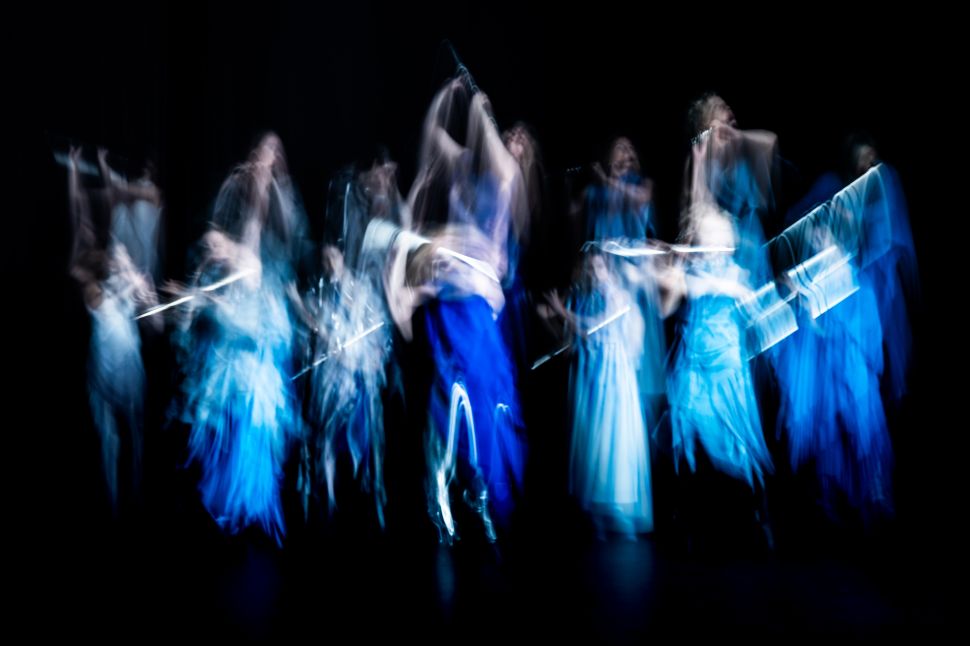
Another example of ecological relationality is the flute septet, viibra, that formed in 2016 for Björk’s Utopia. viibra transformed the environment of the concert venue Harpa by arranging chairs in a circle with two openings for the group’s procession. The redesign, according to the concert ephemera, is imagined as a “Venutian Wetland” where the “self-organizing collective of co-existing lifeforms…exist in a fragile symbiosis where the line between individual and whole dissolves, and adaptation is not a choice but necessity.” In this setting, the group blew into flutes in a percussive way, where the breath barely resolves into notes. Their polyphonic respiration functioned like wind, creating a call-and-response rhythm that rippled through space. At one point in the performance, the performers went behind the audience with one flutist in the middle, creating a sphere of sound.
The debut of LOVE LOVE imagined a surreal Martian tennis landscape built through music, sculpture, choreography, scent and collaboration. Cymbals became terrain, tennis rackets became sculptural forms, and performers transformed sporting equipment into instruments. At first, the group used recognizable instruments like the harp, an electric guitar, an array of percussive instruments and a cello, but then it progressed to using a violin bow on the harp and a saw to cymbals spun on the ground, where red volcanic clay is heaped onto them while a tennis ball machine launches balls across the stage. One of the performance’s most striking moments occurs when the cast holds taut several large rope strings that one performer puts golden glitter on them. Then, to the music’s syncopation, they lift the strings, creating an instrument-like form animated through collective action. Tennis rackets first became percussion instruments and later sculptural forms; performers volleyed balls across the stage, amplifying the percussive rhythm of tennis grunts. More than any single project in the festival, LOVE LOVE demonstrated how Reykjavík dissolves distinctions between artistic disciplines, treating collaboration itself as a creative medium.
In parallel to these exhibitions and performances is Fischersund, the scent partner of the festival. One activation took place in a greenhouse in Lækjartorg where visitors could step in and encounter the festival scent alongside the poetry of Lilja Birgisdóttir, a founding member of Fischersund art collective, who leads the audience into an interpretation of the land distilled into a fragrance of the festival. The scent also appears in a handcrafted festival beer. Culminating the Fischersund experience was a sonorous scented concert by musicians Jónsi from Sigur Rós, Sindri Már Sigfússon and Kjartan Holm at Austurbæjarbíó. This is perhaps the most bewildering part of the festival because of how it deconstructs the institutional notions of art. A thin veil appeared before the band as they created an abrasive yet melodic rock soundscape that made the audience tune into every note and word, whether understood or not. The scent emerged via perfume samples distributed to audience members, fog machines in the ceiling and one person wearing a gigantic floral bouquet who walked through the audience of 800 people to deliver a new scent. At first, the performance risked feeling like a gimmick tailored to the attention economy, but in a place like Iceland where natural elements and interpretation are never separate, it came off as a conceptually rigorous evocation of the memories of the local terrain.
Many expanded art forms in the festival unlocked memory and dreaming. In Metamorphlings, the first retrospective of James Merry, best known as Björk’s longtime mask maker and former research assistant, the National Gallery of Iceland presented a circular chronology of his work. He draws from archaeological Celtic references, his deep interest in ecology and a highly detailed imagination. Intricate masks range from embroidered to silicone-cast prosthetics to wire-wrapped to 3D-printed. He describes the masks as “made to look like they are growing out of the head” and “permeable” instead of covering the entire face. Positioned as a solo retrospective, it shows that Merry is a worldbuilder himself, adding another layer to Björk’s musical, visual and sartorial worldbuilding. Visitors enter this world through iPads placed among the masks, allowing them to try on A.R. versions of Merry’s creations. The exhibition’s centerpiece is Atenovx (2026), which maps the winter and summer solstices onto the head with one pearl that can move around to show the entire course of the day.
Accompanying Merry’s work is Björk’s exhibition, “Echolalia.” She reintroduces Sorrowful Soil, Ancestress, and debuts Nerve Bloom. In the Sorrowful Soil installation, the music video of Björk in a volcanic environment singing is played in a central arch on the wall. At the center of the installation, a circle, another recurring motif throughout the festival, is 30 individual speakers wrapped in the Icelandic wool score of the song. As the listener walks up to each speaker, they can hear each voice in the choir, but if standing in the middle, the voices blend and coalesce around Björk’s voice. Ancestress extends this immersion through a funerary narrative that transforms grief into a communal experience. The environment embodied Björk’s lyric of being an “emotional textile.” In Nerve Bloom, CGI creatures within an ecological dreamscape sing. Nerves unfurl from the creatures’ skulls while strands of hair braid together in time with Björk’s voice. Together, the works make it difficult to locate where one artistic discipline ends, and another begins.
Reviving time and memory
In “FLOW: Sólon Íslandus & Mógil” at the National Museum of Iceland, contemporary musicians revive the artwork of Sölvi Helgason. He is considered a folk artist and outcast from the 19th Century. As he worked in various homes, he created comedic depictions of himself and others around him by showcasing their bodies in caricature or even making those he did not like into alienesque versions of themselves. Transcending time, the musical group Mógil decided to collaborate with this folk hero, or what music critic Rob Moura describes as a figure akin to a “patron saint of artists,” whose prolific work went largely unrecognized during his lifetime. Through projects like Mógil’s, Helgason’s legacy continues to evolve. In the small gallery of his figurative work and floral abstraction, there is a screen and headset to listen to the music of Mógil, which draws from Helgason’s visuals and philosophical writings.
Karin Sander demonstrates the malleability of memory through “Karin Sander: 1957-2057,” at the Reykjavík Art Museum. On the first floor, Sander presents participatory works that transform visitors into contributors, from displaying their personal belongings to generating 3D-printed portraits. Upstairs, a series of blank canvases placed throughout Reykjavík accumulate traces of their surroundings. One canvas accumulates graffiti, while others collect wool, mud and bird droppings. Nearby, rotting fruits and vegetables become increasingly unfamiliar as they decay. Their drippings paint a line on the white gallery wall. When asked about the aspect of Sander’s patina work, museum director Markús Andrésson shares how the museum approaches this push against the norm of temperature, pest and environment control. If decomposition progresses too far, the museum can replace the work, an option Sander embraces because she is ultimately more interested in change than preservation. The work ultimately tests the boundaries of museum stewardship: at what point has an artwork changed so much that it must be replaced?
Many biennials reinforce these institutional norms through a set curatorial thesis by a single curator or duo prioritizing visual art, which past versions of this biennial have done. At Reykjavík Arts Festival, cultural partners co-author the overarching theme of connection. The result privileges audience experience, dissolves disciplinary boundaries, activates multiple senses and invites participation. They even forge an unexpected collaboration by partnering with Brim, an industrial fishing company. Their CEO, Guðmundur Kristjánsson, emphasizes that their participation is a natural part of their work, as supporting the arts is important to the “sociality” of Icelandic culture. His statement reinforces the festival’s broader proposition: that the arts are not separate from society but integral to its social ecosystem. As a model, the festival offers a refreshing response to widespread biennial fatigue through immersion. Multisensory programming carries the risk of becoming gimmicky, at a moment when cultural institutions compete for attention. Sound, scent, movement and participation become accessible curatorial tools that deepen visitors’ relationships to place, memory and one another. In Reykjavík, interdisciplinarity is both a programming strategy and a vision for how art might function in society: participatory, interconnected and embedded in everyday life.
