
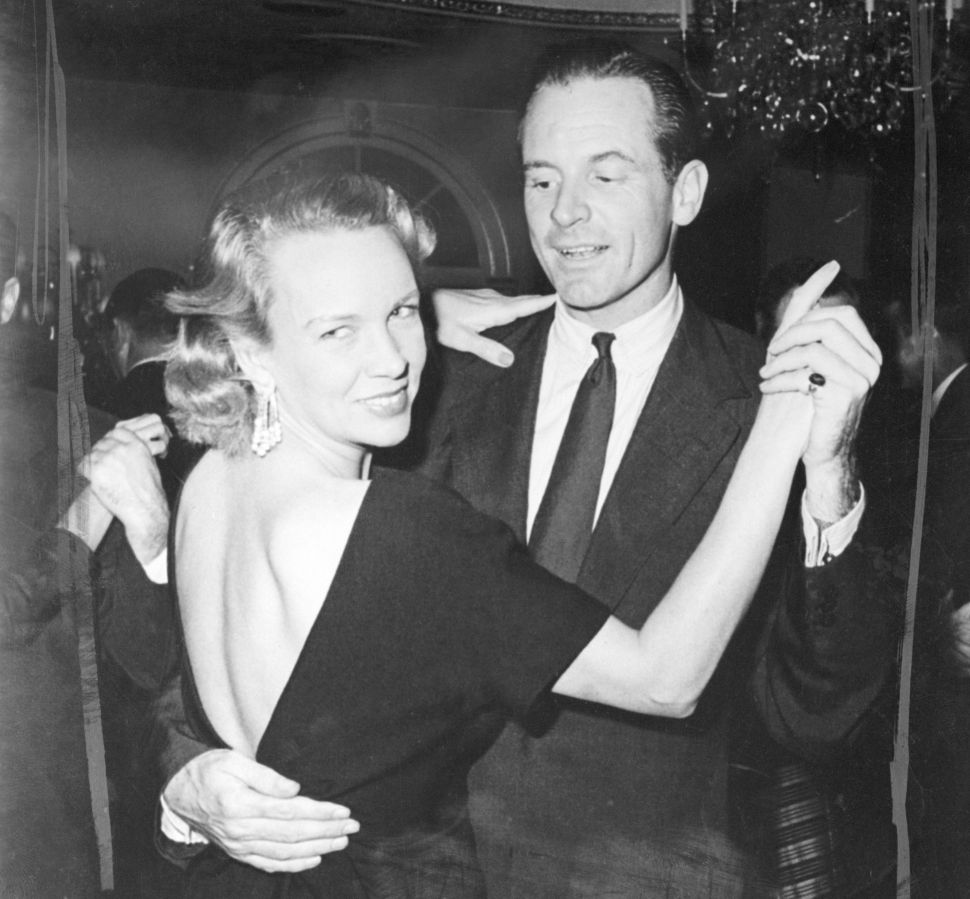
Ann Woodward killed her husband, William Woodward Jr., in cold blood. Didn’t she? If you recognize her name at all, you know her as the woman who shot her banking heir husband in the middle of the night and got away with the (purported) crime by claiming she thought he was a burglar. Truman Capote called her “Bang Bang” and referred to her as a “jazzy little carrot top killer” who had been “brought up in some country slum way.” Truman Capote remains positively unmatched for bitchiness but, like many others, may have somewhat overstated the horrors of her origin.
Born Angeline Lucille Crowell in 1915, she came from a farm in Kansas. Her mother, Ethel, was a schoolteacher, and her father, Jesse, would later leave farming to become a streetcar conductor. The couple divorced during Ann’s childhood, after which Ann had little to do with her father. She was remembered as being a “sweet, quiet little girl” who spent an inordinate amount of time eating ice cream sodas in her cousin’s drug store.
Fortified by this diet, she grew into a willowy fashion model. She moved to New York City in 1937 to work for the John Robert Powers agency and was soon gracing magazine covers. She then turned to radio acting, playing roles in CBS soap operas like “Joyce Jordan, Girl Intern” and “Lincoln Highway.” She was called “the most beautiful girl in radio.” Ann also took on some small roles in the theater, appearing in a Noel Coward play, Set to Music, where she was reviewed as “one of the ten most beautiful girls in New York.” And she danced at the Copacabana nightclub, where uncharitable people would often describe her not as “beautiful” but as a “showgirl” or, just as often, “a hooker.”
During these years, she was remembered as being extremely ambitious. She studied French, copied the mannerisms of the English actors in Coward’s plays, and, according to her biographer Susan Brandy, “believed no one was truly unhappy on the French Riviera.”
In 1943, when she met William Woodward Jr., her life was going fairly well. Though the press billed their marriage as a Cinderella story, Ann wasn’t quite the country mouse rescued from her servile chores by one of America’s richest men. Though it is true, they came from different worlds. William Woodward Jr. (“Bill”) was as true a blue blood as Groton and Harvard could produce. His father was the chairman of the Central Hanover Bank and Trust. They were a family that loved horses and had produced three Kentucky Derby winners.
22-year-old Bill had also never been with a woman when he met Ann. His friends thought he was gay. He was not. He was shocked and delighted when she welcomed him to her apartment in a blue negligee, seducing him with lines she had memorized from movies. He was immediately sexually obsessed. Bill’s father liked her, though he thought Bill should give her an allowance and an apartment, not marry her. His mother did not approve—a feud which would eventually birth the Dominick Dunne novel The Two Mrs. Grenvilles.
Their speedy marriage was likely spurred on by the war. Everyone wanted someone waiting at home. When Bill shipped out as an ensign with the Navy in 1943, the two were married. Happily, Bill returned home unscathed, and the couple went on to have two children, breed racehorses, and travel the world, including going on safari. “Ann developed into a dead shot and in India bagged two Bengal tigers and two leopards.”
It is true that Ann and Bill seemed to have marital difficulties and apparently multiple affairs. They were extremely jealous, and each hired private detectives to spy on the other. Bill resented Ann’s flirtatious nature and was enraged whenever Ann teased other men. Conversely, in one nightclub, Ann slapped Bill until he bled after she saw lipstick on his handkerchief. This scene metamorphosed into a rumor that he was “having an affair with Marilyn Monroe.” Some sources claimed that Bill had asked Ann for a divorce, but she “always refused or asked for a $3,000,000 settlement.”
Truman Capote—who had very little nice to say about anyone—wrote in La Cote Basque, where he described her under the pseudonym Ann Hopkins, that, “Surely it was then she decided to kill him: a decision made by her genes, the inescapable white-trash slut inside her, even though she knew the Hopkinses [aka Woodwards] would arrange a respectful ‘divorce’ and provide a very good allowance.” I’m going to point out that Truman Capote came from a very small Southern town himself, a fact he seems happy to forget whenever it’s not profitable.
On October 29, 1955, the couple drove to a party in Locust Valley being held for the Duke and Duchess of Windsor. By this time, Ann was well established in all of Bill’s social circles and described by the Daily Mirror as one of “society’s box-office beauties.” As biographer Susan Brandy notes, “Ann led the list of the rich ladies who were invited to charity balls to promote tickets.” None of this admiration stopped Ann and her husband from constantly fighting, which they reportedly did, once again, at the Locust Valley party.
Back home, the couple went to their own bedrooms, across the hall from each other. Ann took sleeping pills. At some time in the night, Ann claimed she heard a burglar. She grabbed her gun, wandered into the dark hallway, and shot twice. The “burglar” turned out to be her husband, who died fifteen minutes later, as Ann embraced his bleeding body and screamed at the night watchman to get help.
Newspapers marveled that “she didn’t think it could be one of the children, or the cook, or, least of all, her husband, even though the shadowy figure was standing by her bedroom.” Socialite Liz Fondaras declared, “There was no prowler. Ann made him up.” The general sense was that Ann, unhappy with the terms of her potential divorce, decided to take the matter into her own hands. It is possible Ann was a cold, calculated spousal murderer; women in male fields exist.
What is less discussed, however, is that there actually was a burglar on the Woodward roof that night. A young German refugee named Paul Wirths admitted that he was directly above Ann’s bedroom the night she shot Bill. He was scared away when he heard the shots. When Ann heard this, she sobbed that even with his confession, “nothing can do any good now.” She knew that, in public opinion, if not in a court of law, she was damned. The stories about her and her husband would only grow more outrageous with time.
Throughout the investigation, Ann appeared distraught. She appeared to be genuinely mourning her husband. The Danville Register noted that “the once beautiful blonde was a haggard, tearful figure.” In the turmoil, she sent her two children, 11-year-old William Woodward III and 9-year-old Jimmy, away to Le Rosey, the Swiss boarding school. While William went on to have a stable life, working as a reporter. Jimmy never recovered from the trauma and wrote “letters to his mother, accusing her of being a cold-blooded killer.”
Dr. Jane Olden, a psychiatrist who treated Ann, noted that Ann’s entire sense of identity revolved around her marriage and her position as Mrs. William Woodward. “I don’t buy her shooting him as a conscious decision,” she stated. “Once he was gone, she was destroyed. Still, subconsciously, she had to hate his hold over her. Studies of battered wives show that fatal accidents do occur after fights.”
The incident being ruled an accident, Ann was never charged—but her exoneration didn’t put an end to her difficulties. If Bill was dead, Ann’s life as she knew it also ended. Banished from New York society, she traveled the world hoping to find someone, anyone, who had not heard of her. Her biographer recounts Ann meeting a handsome man in Tahiti. They bonded over being from the United States and spent a pleasant afternoon chatting. The next morning, Ann watched as person after person pulled the man aside and whispered to him. Finally, Ann asked, “You know, don’t you?” He replied, “So many people went out of their way to tell me.” In such a manner, Ann, who had been one of the ten most beautiful women in New York, “reeled from one romantic disappointment to another.
It only got worse. Truman Capote began telling a story wherein Ann had to shoot Bill because she had never divorced her first husband. Bill, therefore, could have divorced her without paying any alimony as she was a bigamist. This was fiction, though one that enthralled many dinner party guests as Truman opined that he was the only one who knew the real reason that Ann shot Bill.
By 1976, Capote had decided to publish his story in Esquire magazine. Ann’s friends informed her. The day before it was printed, Ann committed suicide. She left a note behind begging people to “remember Ann Woodward.” In her will, she expressed her wish “to be buried next to my late husband.” Her son Jimmy, who had been a drug addict, jumped to his death a year later. William Woodward, III, waited until he was 54 to leap to his death. One of his friends told The New York Post, “All the scandal, all the tragedy, had an effect on Woody. Toward the end, he was living the life of a recluse.”
It’s not clear whether Ann had her husband’s blood on her hands. Only she knows for certain. But it sure seems Truman Capote was dripping in her blood.
