
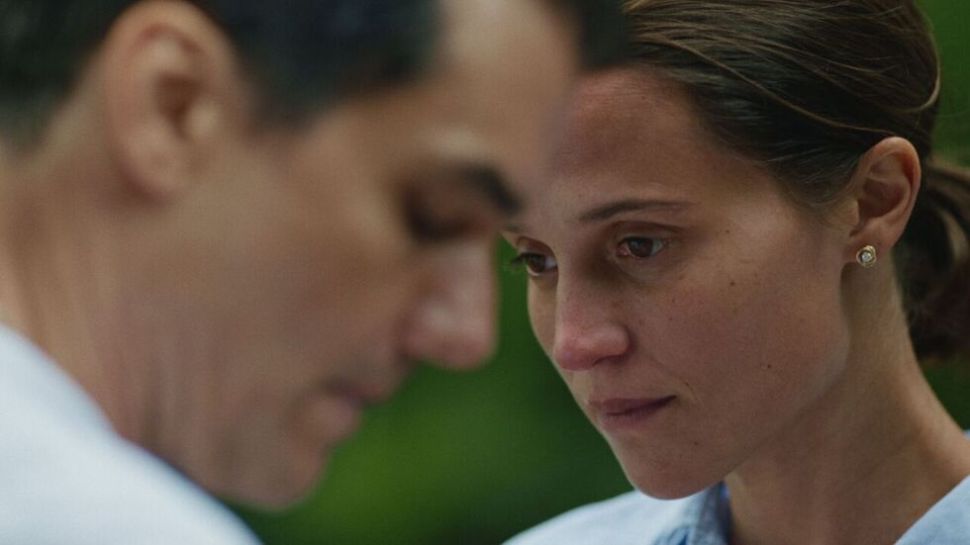
There’s an immense confidence to Rachel Rose’s understated drama The Last Day, the kind of deftness often born of cross-disciplinary artistry. The movie marks her feature debut, but it shares its title with one of Rose’s many video installations—specifically, one that captures Earth’s epochs through photographs of objects around her daughter’s bedroom. On the surface, this exhibit shares little with its feature-length namesake, which premiered at the Tribeca Film Festival, and loosely adapts the structure of Virginia Woolf’s Mrs. Dalloway. However, Rose’s assuredness, in unraveling a tale of two suburban mothers who feel dislodged from themselves, ends up—like much of her museum work—a powerful rumination on modernity.
An impressionistic prelude lures us from a forest to civilization, as gentle sunrays kiss the fur of a beautiful fawn who, once it stumbles upon a stark, cold roadside, finds its mother’s corpse. The rotting deer carcass foregrounds a pristine home in Westchester, New York, where author Julia (Alicia Vikander) plans a Fourth of July party while wrangling her pre-teen daughter Eve (Eva Jade Hatford) for a scheduled playdate.
Before we learn much about Julia—who we also see attending a support group, given her father’s recent passing—Rose’s images establish an unforgiving connection between death and stifling modernity. Through warped reflections of her characters in glass and metal surfaces, the filmmaker extracts the jarring internal moods they seek to bury around other people.
THE LAST DAY ★★★1/2 (3.5/4 stars)
Directed by: Rachel Rose
Written by: Rachel Rose
Starring: Alicia Vikander, Victoria Pedretti, Wagner Moura
Running time: 99 min.
A chance encounter at a coffee shop sees Julia picking up the lost wallet of a young nurse, Taylor (Victoria Pedretti), but the former’s busy day delays her trip to return it. In the meantime, Rose also focuses on Taylor’s life as a mother of three, whose youngest—a newborn—has left her in a state of repressed chaos and prescribed medication. Although the two women seldom interact on screen, Taylor’s postpartum depression (PPD) feels like a reflection of Julia’s own frustrations with motherhood (which have in turn left her unable to write), as though the two women were fated to meet. However, there’s no grand plan in place for them to help each other—the film, as its title suggests, has a nihilistic streak—and yet, the possibility of their encounter results in potent thematic cross-pollination.
They are, in essence, sides to a coin, in the manner in which their affluent lifestyles and vapid surroundings contribute to their respective malaise. Julia’s husband is frequently away, leaving her to clear out her late father’s belongings in Manhattan mostly by herself, while her adolescent daughter is none the wiser about her mother’s mood, allowing Vikander to build unspoken resentment. Taylor, meanwhile, lives in a perfect portrait of domestic contentment as seen from afar—the house, the car, a kind husband, three kids—but she’s always seconds away from unraveling, affording Pedretti the kind of ferocious unpredictability for which she’s known.
In The Last Day, volatility bubbles just beneath the surface of polite conversations, which each supporting actor carries out with affable naturalism. The only exception to this stuffy etiquette is an ex that Julia runs into in the city, Peter (Wagner Moura in a brief but memorable role), with whom she catches up before old wounds start to open, sending her running once more.
There’s little catharsis to be found throughout the film, whose story Rose positions as one of silent, festering feelings which, at best, give way to fleeting moments of clarity (even if that). It’s a mood piece first and foremost, one whose plotless meandering feels tonally focused, thanks in part to the measured cinematography of Eric Yue, who departs from his overt formal flourishes (in films like I Saw the TV Glow and Teenage Sex and Death at Camp Miasma) and ensures that each plain, reflective surface around Rose’s characters both illuminates them while verging on blinding them. The world around Julia and Taylor is just too much for them, and they seldom have an escape route.
The story takes expectedly morose turns, in keeping with both Mrs. Dalloway and its filmmaker’s own battle with PPD. However, that the movie mines such macabre territory, with such dramatic precision, also makes it artistically purifying, as though Rose were purging herself of the very anguish she portrays. In mining her most intimate anxieties, as a mother and a creator, she arrives with one of the year’s most striking debuts, which builds quietly but assertively to an archly edited climax of poignant reflection. There will be few films as emotionally affecting this year.
