
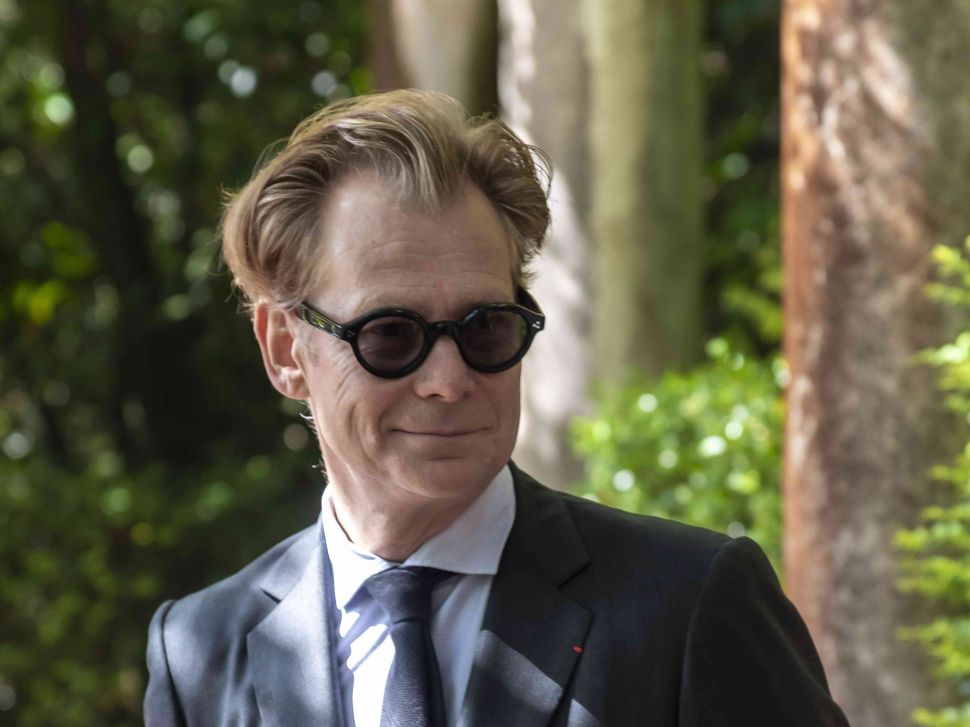
The Bass Museum announced recently that Philippe Vergné—who has run museums from Marseille to Minneapolis to Los Angeles and, since 2019, Porto’s Serralves—would soon arrive in Miami Beach as the institution’s first artistic director and chief curator. He starts in October, sharing the museum’s leadership with executive director Silvia Karman Cubiñá in a role the two invented over months of conversation. He inherits an institution mid-transformation, with a Johnston Marklee expansion on the way and Art Basel Miami Beach two blocks from his door. We caught up with him to hear more about his new gig.
You’ve described this move as a return to curating after years of running institutions, saying you want to find out if you “still have it.” I assume that’s kind of a joke, but after three decades and several directorships, why do you want to return to hands-on curatorial work?
Well, it is only kind of a joke. At the end of the day this is what I love the most. The dialogue with artists, accompanying their vision, learning from them. I never stopped curating, I just had to do it less in the director role. Years ago I learned from my friend and colleague Adam Weinberg when he was the director of the Whitney Museum of American Art, that even as a director you don’t stop curating.
Being a director allowed me to have a different impact on an institution, allowing me to give opportunities to a younger generation of curators, which for me was very important because when I was a younger curator I benefited from people who trusted me. I was intrigued by the challenge of being a director, but mind you, I’ve been director of institutions that are very special. They have all been very artist-centered institutions, where the role of a director is different because they never lose direct contact with the artists. In Europe especially, the role of the director is also artistic director, unlike in U.S. institutions where there is often a distinction, so I have been able to curate a lot over the last few years.
Eighteen months ago, I curated an exhibition at the Serralves with eight artists entitled “Material Evidence,” and I understood that I was missing that curatorial role. I’m 60 years old now, and I want to do what, I hope, I know how to do well.
The position is a new one, developed with Silvia Karman Cubiñá, whom you’ve known for years. How do you picture the artistic director and chief curator responsibilities dividing between the two of you in practice?
I see it as a partnership. One is about building an institution. The other one is about programming an institution. It is about the synchronicity of operations, aspirations and inspirations. It is a credit to Silvia Cubiñá and her board for shaping this new position at The Bass through our conversations. She and I were talking about where we are in our professional lives right now, and she was telling me she wants to be more of an institution builder, and I told her that I want to be more of a curator, so I think it really started there. She really loves building an institution and said she might be ready to let go of curating, and I really love thinking about a program and curating, and I might be ready to let go of the institutional part. It was really as spontaneous as that conversation.
Then we went into the nitty-gritty of it, trying to find what it means to work in this partnership. It means on my end, being involved in exhibitions, acquisitions, parallel programs and education, all in partnership with Silvia, which relieves some of that pressure on her. Meanwhile, the Bass is planning an ambitious expansion, and I know how all-consuming that is as a director: the institution has to grow, through fundraising, planning, and possibly growing the board, and in parallel, the program must grow alongside the institution. That’s how I see this dialogue and partnership happening.
When we started the conversation, I was not aware that the architects for the expansion would be Johnston Marklee, whom I know well from my years in Los Angeles, and also because Mark Lee came to visit Porto to see the work of Álvaro Siza, the architect of the Serralves Museum, so it all comes together. It’s a new path for the museum and for Silvia and me, so we’ll be experimenting with it.
You and Silvia have pointed to shared enthusiasms like Haegue Yang, whose Bass catalogue you co-edited, and Allora and Calzadilla. What do those particular artists tell us about the kind of program you want to build here, and how far should a chief curator’s personal taste reshape an institution’s direction?
It would be premature to name names yet. But if I look at the history of Silvia’s program and vision and at my own work, I would say that it might be about the joy of comfort and confrontation, of thinking of the museum as a permanent biennial. An ongoing and ever-evolving group exhibition. Personal taste is a bit like having an accent. You have it, you compose with it, you fight it, you own it.
I look at the program and the conversations I’ve had with Silvia, even before she was at the Bass, and we have a common ground. I remember seeing a fantastic exhibition of Allora & Calzadilla that she organized, and it was wonderful. There is one artist, penciled in the upcoming program, with whom I worked at Serralves, who is internationally based and works in a sound-style installation with a lot of musical experimentation and performance, which you also see in Haegue Yang’s experimentation coming from Korea. You have artists from Puerto Rico, Korea, Paris, the Middle East—that gives you a sense of the values we share. I think in terms of the program, we might be in the comfort zone, and what we need to do is to challenge it, and that’s where the conversation will get rich and important.
I happened to see you not long ago in Porto for the opening of the Duerckheim Collection at the Serralves Foundation, a refined European institution set on 45 acres of bountiful nature. It’s quite a dramatic change to go from that to Miami. What are the challenges of programming for a Miami audience?
Well, both locations have unique settings and natural environments, Art Deco architecture, Pritzker Prize expansions and growing ambitions. The challenges… they are a privilege. For me, the institution is the artists, and the commitment to the institution is to the artists. Both places are very different, of course—different geographies, architectures and cultural contexts—but I tend to see those differences less as obstacles and more as opportunities. My primary commitment is always to artists, and the role of the institution is to serve them meaningfully within its specific context. To do that well, I have to be present.
Moving between cities has always been part of how I’ve learned. Each transition—Marseille to Minneapolis, Minneapolis to New York, New York to Los Angeles and then to Porto—has involved sharp cultural contrast. Again, being out of my comfort zone is important to me. In Miami, that means recognizing its particular energy—its diversity, its internationalism, its seasonality, and responding to it without reducing it to a stereotype. You build a program by listening to artists, to audiences and to the city itself.
I’ve always admired colleagues who spend decades in one institution, building deep institutional memory. My own path has been more nomadic, and that’s shaped how I approach programming. Each move has been a chance to learn again, to recalibrate. But the constant, wherever I am, is the same: the institution exists for the artists. If you stay grounded in that, the differences between places become less about difficulty and more about possibility.
You’ve served in senior roles at an impressive number of institutions: the Walker Art Center, Dia Art Foundation, the Museum of Contemporary Art, Los Angeles and now Serralves. Which of these jobs would you say contributed most to your development? Where did you learn the most?
All of them. From my first museum in Marseille to Serralves, this is cumulative. I have learned a lot from all of them. Different lessons at each institution. They all share one dimension: the artists and the visitors. They are what links and connects and are the chemistry between and throughout all the institutions.
You’ve overseen expansions before, at Serralves with the Álvaro Siza wing and going back to Marseille, and you’ve said a new architectural form gives an institution a new mission. The Johnston Marklee expansion is already underway at the Bass. Have you given any thought to the new missions it might unlock for that institution?
I would actually frame that a bit differently. I don’t think an expansion gives an institution a new mission, whether it’s a museum, a library, or a concert hall. It’s more that an expansion allows the existing mission to grow. If you look at why cultural institutions expand, it’s rarely because they’re changing direction. It’s because the mission itself is evolving and deepening, and the building is no longer equipped to support that growth. The need isn’t conceptual; it’s practical. Programs expand, collections grow, audiences change and the institution needs the space to respond.
That was certainly my experience with past projects: as exhibitions became more ambitious, as collections required greater care and visibility, and as public programming broadened, the limitations of the existing structure became clear. The mission remained consistent, but its expression demanded more room. I see the same trajectory at the Bass. The expansion will support a growing exhibition program, a developing collection, and an increased emphasis on community and visitor engagement. It creates the conditions for the museum to do more, but it doesn’t alter its core purpose. The mission stays the same; the capacity to realize it is what expands.
The Bass sits in Collins Park, two blocks from Art Basel Miami Beach every December. Will it invigorate or terrify you to be in the shadow of the loudest art fair in the country?
In a very sunny place, the shadow is a very good place. We’re part of an ecology, and it’s a changing one. There’s a great deal museums can learn from the private sector. When I was a student, and even now, galleries are often where I encounter artists for the first time. If you look at how major galleries have embraced estates, archives, publications, education and parallel programming, there’s a lot to take from that model. I think, too, about Art Basel—how conversations and talks became such a visible, integral part of the fair. When Sam Keller introduced that, it marked a real evolution.
Of course, the scale of it all is significant, but that comes with the territory. Art fairs have, in many ways, become institutions in their own right. I wouldn’t say they resemble museums, but they do function as a kind of private-sector counterpart. And there’s value in that. Each time I visit a fair, if I leave having discovered a few artists I didn’t know or encountered ideas I hadn’t considered, then something meaningful has happened.
I used to think more in terms of a divide between museums and the marketplace, as if they weren’t working in tandem. Now I see it more as a relationship with necessary boundaries, like any healthy partnership. Ultimately, if the goal is to serve artists and audiences, then we need to find ways to work together more closely.
