
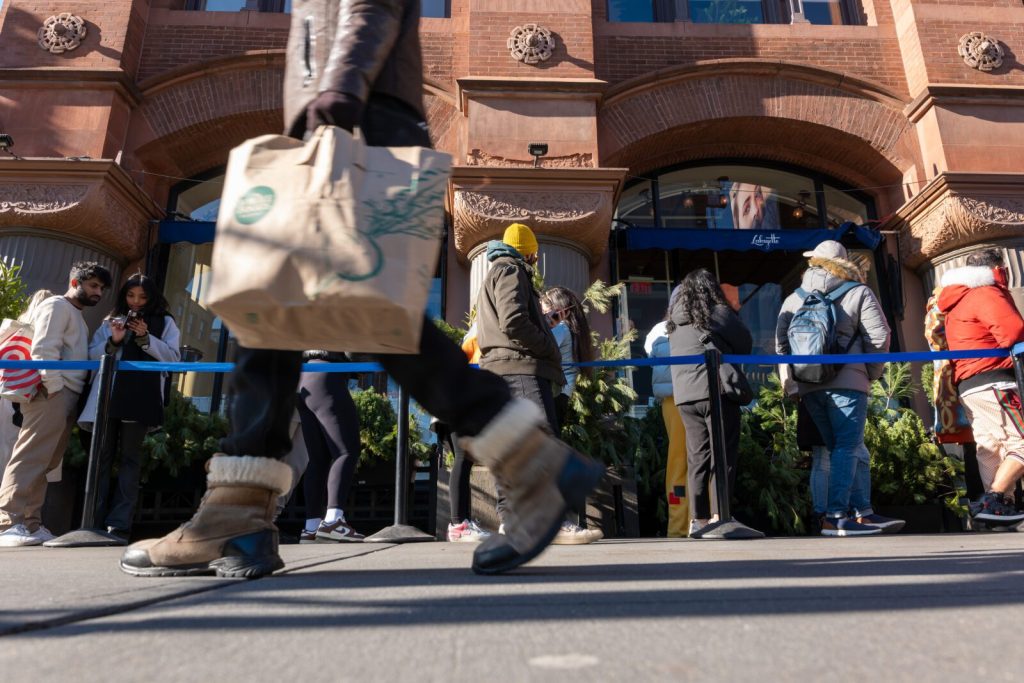
The New York City reservation economy has tipped into self-parody. Bots scoop up tables the instant they drop, then resell them on a gray market so lucrative that one Brown University student reportedly made $100,000 in 19 months flipping them back in 2024. The state finally stepped in: In December 2024, Governor Kathy Hochul signed the Restaurant Reservation Anti-Piracy Act, making New York the first state in the nation to outlaw the practice when it took effect last February. Diners unwilling to pay a premium or run a bot have even resorted to hiring TaskRabbit “line sitters” when trying to snag a table at a popular restaurant.
But there’s a quiet rebellion going on behind the scenes as a growing cohort of restaurants have looked at this entire apparatus and simply opted out. These eateries don’t sign up for Resy, don’t take reservations over the phone, and certainly don’t engage with the black market, because there’s nothing to scalp. All diners get is a door, a list, and a wait.
It’s tempting to read the trend of walk-in-only restaurants as a marketing play concocted by the businesses to manufacture lines outside of their establishments that would, in turn, pique the interest of potential diners who are walking by (or seeing the line on social media). After all, the line outside Lucali in Carroll Gardens, where Beyoncé, Jay-Z, Taylor Swift, and Travis Kelce have all turned up, does look awfully good on TikTok. But after speaking to a handful of owners who’ve gone reservation-free, a more interesting answer emerged. There isn’t one reason these restaurants ditched the booking system but, rather, three distinct ones—and none of them involve virality or social media.
The most unglamorous explanation is also the most common: When you have only a few tables inside a space, a reservation isn’t a convenience but a logistical landmine.
If I had a bigger restaurant, I would take reservations.
“We have four to six tables for sit-down dining, and we don’t take reservations, because if we did and somebody came in and then the reservation arrived, we would have to make them get up,” says Roberto Lopez, owner of Mezquila Bar & Tapas in Park Slope. His verdict is blunt: “It’s easier not to have reservations.” Tellingly, the policy is a function of size, not philosophy.
“If I had a bigger restaurant, I would take reservations, which I do at my other restaurant,” Alma, he adds.
@fiaschetteriapistoia
There’s also the problem of how unpredictable some diners are. “Sometimes a customer won’t leave, and that can create a problem, especially if the place is small,” Lopez says. That lingering table can torch an entire evening’s worth of bookings.
The city is full of these jewel boxes. Fiaschetteria “Pistoia,” for example, the tiny Tuscan trattoria with outposts in the East and West Villages, was born in Tuscany in 1890. Here, it’s run by Pistoia native Emanuele Bugiani, who makes it a point not to take reservations, perhaps a mark of the sort of vibe that he’s going for. As Lopez’s fellow operators will tell you, smallness isn’t a constraint to apologize for; sometimes it’s the whole point.
For Lula Phelps, co-owner of the LA-and-New-York mini-chain Salt’s Cure, going reservation-free was a clear-eyed operational decision.
Our team is playing Tetris every day to get the line moving as quickly as possible.
“The walk-in policy was born out of having a full-service restaurant with table service and noticing that it wasn’t the most efficient way to do things because it takes longer and there needs to be more staff,”” she says. The fix was counter service, rolled out in 2017.
“It has worked really well for us,” she reveals. “Our team is playing Tetris every day to get the line moving as quickly as possible.”
Because guests pay up front and there are no held tables sitting empty, “you’re never waiting to fill in gaps.”
@kazunorisushi
The same engine powers KazuNori, the counter-only hand-roll bar with multiple Manhattan locations, where there are no reservations and no waitlist but the line moves fast because nobody lingers over the sushi.
Lalo Rodriguez, owner of Manhattan’s Cocina Consuelo, frames the economics from the other end. Reservations, he points out, are a cost: “It’s an extra task and an extra payment that you have to give to someone. Running a restaurant, even when you’re busy, you don’t make a lot of money,” he says. For a small operator, the booking system is one more expense in a business with famously thin margins.
The booking slot can also kill the vibe.
Rodriguez set up Cocina Consuelo as a pandemic-era supper club in his apartment built around sobremesa, the Mexican tradition of lingering at the table long after the meal.
“We wanted to preserve the vibe by not giving the table away for another reservation,” he says. “A lot of people come back because they are not rushed.”
Refusing reservations, for him, is a way of protecting intimacy. “I don’t think in the future we will accept reservations, because a lot of people know us now, and we’re friends with them,” Rodriguez says. A booking system, he worries, would put a transaction where a relationship used to be.
That ethos has kept neighborhood institutions humming for decades. Casa Adela, the cash-only Puerto Rican landmark on Loisaida Avenue founded in 1976 by the late Adela Fargas, never modernized with apps or online booking and remains a community clubhouse as much as a restaurant.
Some people need to know that they will have a table for six at 11:15 a.m.
Rodriguez is convinced the wait itself has become part of the appeal. “I think lines here are part of the excitement of trying something: a new experience, a new place,” he says. “Staying in line is part of the culture especially in New York.”
But it would be remiss not to acknowledge that the walk-in gospel collides with a basic human need for certainty, especially in a city that moves at the pace of New York.
“Some people need to know that they will have a table for six at 11:15 a.m.,” Phelps acknowledges.
Lopez hears the same hesitation: Would-be guests have told him they’d rather travel to the restaurant if guaranteed a table once there. As a result, even he has wavered, admitting that “sometimes I think that we should take reservations.”
For most of these walk-in-only restaurants, though, the line is a feature of the experience. Phelps, whose menu items have gone viral, is unbothered by the hype.
“I don’t believe in virality as a staying power,” she says. The goal is the opposite of a trend. “We have been viral, and it makes me laugh—we’ve been making the same thing for years.”
The post Why Are New York Restaurants Opting Out of Reservation Systems? appeared first on BKMAG.
