
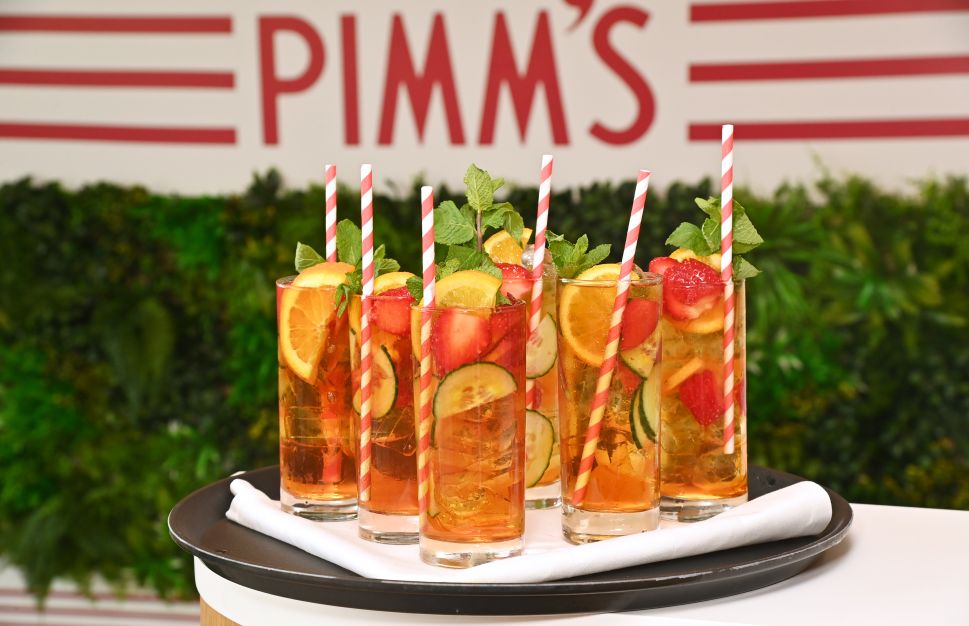
The 2026 Championships at Wimbledon kicked off June 29, and with it, the Pimm’s Cup runneth over. Last year, over 300,000 Pimm’s Cup cocktails were served at Wimbledon. Think of it as the English answer to the U.S. Open’s Honey Deuce or the Kentucky Derby’s Mint Julep. So if you plan to celebrate Wimbledon in authentic style—or if you just want a supremely refreshing cocktail on a hot summer day—you’ll want to dive right into a Pimm’s.
While also a flavorful sipper tied to tennis, the Pimm’s Cup predates the Honey Deuce by over 150 years. It started with James Pimm, a fishmonger who opened a few oyster bars in London in the 19th century. Oyster bars were plentiful at the time, and Pimm needed a hook. He created an herbal liqueur he called Pimm’s No. 1, mixed it with tonic, served it in a little tankard and called it a health drink.
In 1859, an entrepreneur named Samuel Moray bought the Pimm’s No. 1 recipe, and bottles of the herbal liqueur soon hit the market. In 1870, Moray sold the company to future London Lord Mayor Horatio Davies, who jumped on the marketing train and got Pimm’s on the menus of bars and restaurants around the world.
The drink proved an easy sell. Gin had already been popular in England for over a century, and Pimm’s No. 1 liqueur was like a lower-alcohol version: gin-based and complex with botanicals, spices, and citrus peels. Over time, it shed its wellness-centric branding and came to be enjoyed for the simply delicious drink it was, and the Pimm’s No. 1 Cup cocktail evolved to include tonic with lemon juice—a call that would later further loosen to allow for lemonade or lemon-lime soda—and garnishes of cucumber, mint and strawberry.
“The combination of fruit, herbs, cucumber and effervescence makes the Pimm’s Cup feel elegant but approachable,” Jacopo Rosito, beverage director and mixologist at Four Seasons Hotel Miami, tells Observer. “I think that’s exactly why it’s endured for so long—it feels celebratory without being too serious.”
Easy to make and easier to enjoy, the Pimm’s Cup became a staple at English pubs, bars, restaurants and eventually at events like Wimbledon and the Royal Ascot over the first half of the 20th century. The Wimbledon tennis tournament—the oldest in the world—began in 1877 and grew into an annual display of British pride that, accordingly, celebrated English traditions. There’s the special box for members of the royal family to watch the matches (and be watched by attendees), and the custom of eating strawberries and cream—not your typical arena hot dog—while taking in the match.
As Pimm’s Cups became popular orders in English pubs, the drink was adopted as a quintessentially British beverage for the tournament, too. Wimbledon’s signature strawberry snack proved the ideal garnish.
The Pimm’s brand leveraged these illustrious connections by emphasizing tennis in the liqueur’s advertisements. This continued to boost the cocktail’s profile, and the Pimm’s Cup became one of the most consumed drinks at the Wimbledon tennis tournament throughout much of the 20th century. In 1971, the first official Pimm’s bar set up shop at the tournament, and the beverage became the de facto Wimbledon cocktail, growing in demand each year.
“It’s popular because it’s low-ABV, so people can sip it for hours,” says Mario Colasanti, bar supervisor at The American Bar at The Stafford London. That said, even a low-ABV drink can do some damage if consumed without caution for hours on end. “Back in the ‘90s, the bartenders actually had to limit portions because the crowd was getting a bit too rowdy at Centre Court,” Colasanti adds.
The Pimm’s No. 1 Cup soon traveled beyond England’s tennis tournaments. Across the pond, it became such a hit in New Orleans that the cocktail became a frequently ordered fixture there, often mistaken for a Big Easy-born recipe.
The Pimm’s Cup landed in New Orleans—and in doing so, made its United States debut—in the 1940s thanks to Joe Impastato, the original owner of the historic Napoleon House bar. “He’d become acquainted with the drink following his travels to England,” explains Braithe Gill, beverage director for the Ralph Brennan Restaurant Group that operates the Napoleon House in NOLA today. The Southern city did put its own twist on the cocktail, using ginger ale or ginger beer as the mixer, a recipe option that’s stuck.
Today, Napoleon House claims to serve more Pimm’s Cups than any other U.S. venue. The National Day Archives granted the Napoleon House an official “Pimm’s Cup Day” on July 1, so if you want to celebrate this cocktail and can’t get to Wimbledon, head to New Orleans. There, the Pimm’s really struts its refreshing stuff and proves why it’s remained such a staple for summer tennis matches and warm-weather drinking overall.
“It’s light, citrus-forward, effortlessly refreshing…it was practically engineered for a city where summer arrives early and lingers long,” Gill says.
As can happen with cocktails that feature such a simple recipe, Pimm’s has served as a canvas for different variations. While lemon and fizz are the traditional Wimbledon way, Cups can be made with ginger ale or beer, or club soda with lemon juice and simple syrup or even Prosecco. But spirits have gotten involved, too, at different points in the drink’s history: The Pimm’s No. 2 Cup incorporated Scotch, the No. 3 brandy, the No. 4 rum, the No. 5 rye whiskey and the No. 6 vodka.
“I do think the other Pimm’s varieties are worth exploring because they show different expressions of the same idea, but realistically, No. 1 remains the iconic version and by far the most recognized globally,” Rosito says. “The others are rarely requested today and are more of a curiosity for cocktail enthusiasts.”
Nowadays, it’s more likely you’ll find fresher riffs on the Pimm’s No. 1 Cup in the hands of creative bartenders at cocktail bars. Other liqueurs join the party, like Aperol and Campari; sometimes it’s vermouth, other times it’s actual gin or a lesser-used spirit like cachaça. Bartenders may add signature flavors like cucumber into the mix in the form of syrup, and may play with the carbonated mixer element by using beer or different sodas.
“How a bartender makes their Pimm’s can say a lot, but honestly, there is no bad way to make one,” says Jacob Coombs, co-owner and head bartender of the Marquis Lounge in Portland, Maine, where Pimm’s Cups are served by the pitcher in the summer. “We build ours with strawberry rhubarb cordial, cucumber, mint and refreshing tonic, then add our own secret ingredient: a borage sous vide Swedish punsch.”
At the Napoleon House, you can get a non-alcoholic Pimm’s Cup with Louie Louie Good Time Seltzer, a locally made THC and CBD tonic. They also make frozen Pimm’s Cups, and serve Pimm’s Cup flights with seasonal spins. Other bars, however, prefer to stick closer to the original script.
“For me, the perfect Pimm’s starts with restraint: fresh cucumber, seasonal fruit, mint and enough dilution to keep it bright and refreshing,” says Rosito. At the Four Seasons Miami, his summertime riff keeps the basics but swaps ginger ale or lemonade out for Champagne. “It gives the drink a more elegant texture and makes it feel slightly more celebratory while still preserving the easygoing spirit that makes the Pimm’s Cup so timeless.”
The simplicity of this beloved cocktail makes it easy for even the most novice home bartender to enjoy at home while watching Wimbledon. To make it true to tennis-tournament form, mix yours with lemonade and fresh strawberries, cucumber and mint aplenty. Discover the drink while cheering for your favorites, then keep this in your repertoire all summer—or all year—long.
Pimm’s No. 1 Cup Recipe
Ingredients:
2 ounces Pimm’s No. 1 liqueur
1/2 ounce freshly squeezed lemon juice
Ginger ale or ginger beer to top, or 4 ounces lemonade or lemon-lime soda
Cucumber slice, strawberry and mint sprig to garnish
Directions:
Fill a chilled highball glass with ice. Pour in the Pimm’s No. 1, and then you can choose your own adventure. Add the lemon juice and then the ginger ale to fill, add the lemon-lime soda, add the lemonade and possibly a splash of tonic for effervescence. Opt for a citrusy wheat beer or a refined Champagne—keep trying mixers until you find your favorite. Garnish with a skewer of cucumber and strawberry alongside your mint, and feel free to riff here, too. Add orange and lemon wheels, basil or rosemary.
