
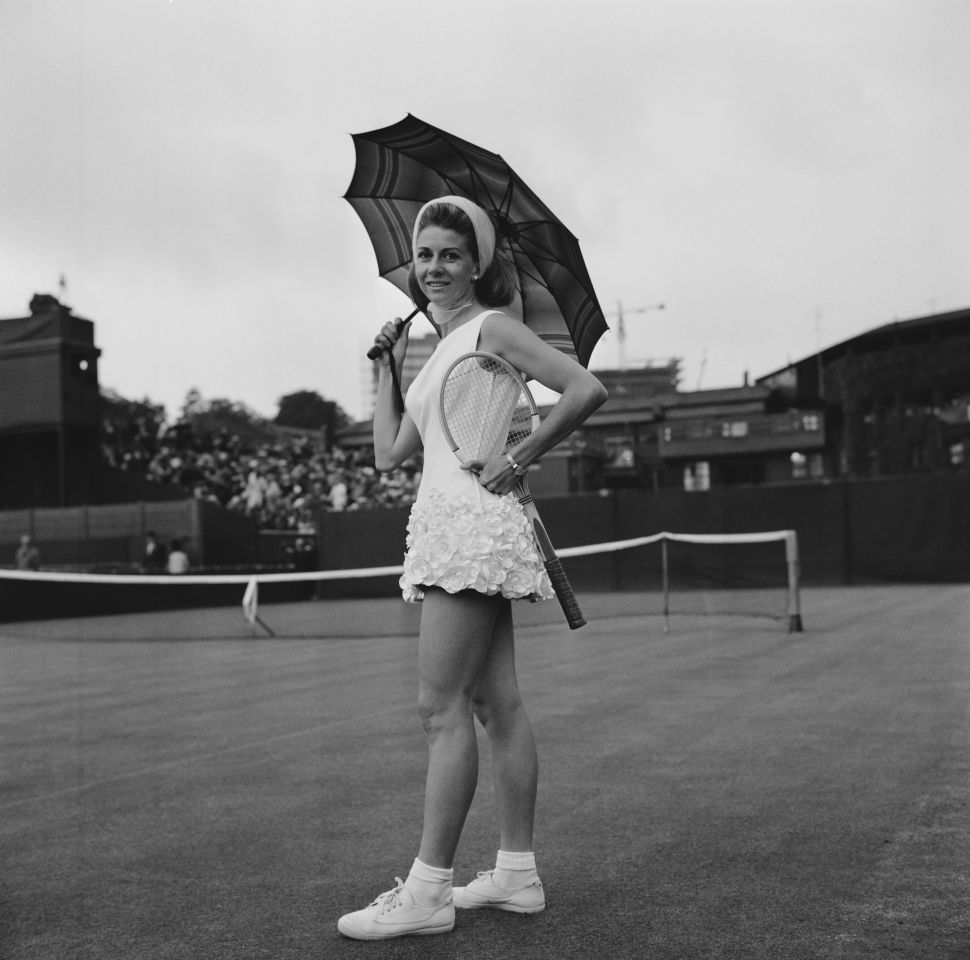
There are plenty of sporting events with traditions. Few wear theirs as visibly as Wimbledon. For two weeks every summer, the world’s best tennis players compete on the greenest grass courts dressed almost entirely in white. It is one of the last remaining sporting events where the uniform matters almost as much as the competition itself.
“Elegance always triumphs,” British etiquette expert Laura Windsor tells Observer. Windsor, who trained under a former member of Queen Elizabeth II’s royal household and has served as an etiquette consultant on Bridgerton, says the tennis championship’s all-white dress code “is a tradition, and that’s why the Championships are the most coveted competition in sport.”
In an era when athletes increasingly use fashion to shape their public image—arriving at stadiums in runway looks, signing luxury campaigns and turning tunnel walks into marketing moments—Wimbledon asks them to do the opposite: blend in.
But it’s all in the name of tradition. While the rest of tennis has embraced color, experimentation and individual style, Wimbledon continues to hold on to one of the sport’s oldest customs. The all-white rule has become as recognizable as Centre Court, strawberries and cream and the line that takes over southwest London every summer.
Wimbledon is also the strictest dress code in professional tennis. Unlike the Australian Open, Roland Garros and the U.S. Open, where fashion has become part of the competition itself, Wimbledon leaves less room for creative interpretation. “The dress code is deliberately white to remove any visual distractions so that the attention is on the quality of play rather than of the player,” says Leanne Miltun, director of business development and international relations at The British School of Excellence.
According to the All England Lawn Tennis Club’s (AELTC) official clothing regulations, players must be dressed in “almost entirely white” from the moment they step onto the court, whether they are competing or practicing. And to be clear, white “does not include off-white or cream.” What about a trim of color? There is a limit: a single strip of color no wider than one centimeter. The wording sounds straightforward, though the reality is anything but.
The regulations extend to almost every visible item a player wears. Shirts, skirts, dresses, shorts, leggings, hats, headbands, wristbands and socks all fall under the same rules. Logos must be discreet. Underwear must also be white if it is visible during play. Even shoes are expected to be almost entirely white, including the soles and laces.
It’s the kind of attention to detail that makes Wimbledon unique. At most sporting events, nobody would notice the color of a bra strap, a shoe sole or the piping around a sleeve. At Wimbledon, those details can become the story.
Dating back to the Victorian era, the dress code was a matter of etiquette. “White clothing was associated with wealth because it was expensive to keep clean. It was also thought to look more elegant and made perspiration less noticeable than darker or more colorful clothing,” says Windsor.
Today, Wimbledon says the rule is about preserving the visual identity of the Championships. In a sporting landscape increasingly shaped by sponsorships, social media and personal branding, the tournament continues to prioritize uniformity over individual expression. Love it or hate it, there is something instantly recognizable about a Wimbledon match before a ball has even been struck.
What happens if you break the dress code? The chair umpire can instruct players to change before continuing a match if they believe the clothing rules have been violated. In practice, disputes are usually resolved with a quick outfit change, but the rules ultimately allow the referee to default a player who refuses to comply.
Over the years, some of the biggest names in tennis have found themselves on the wrong side of the regulations. Roger Federer was asked to swap his sneakers after wearing a pair with bright orange soles in 2013. A year later, Eugenie Bouchard had to change a black sports bra that became visible beneath her top. Venus Williams was required to alter her outfit after flashes of colored undergarments were deemed a violation of the rules, including a pink sports bra worn in 2017.
Perhaps one of the most famous acts of resistance in Wimbledon dress code history came from Andre Agassi, who boycotted Wimbledon from 1988 to 1990, refusing to play in protest of the strict all-white dress code. He eventually returned and won the title in 1992, but his standoff cemented the tournament’s clothing rules as one of the sport’s most debated traditions.
Sometimes the infractions have been even smaller. In 2022, Tatjana Maria was asked to change her green undershorts after they became visible beneath her dress. At other moments, players have been pulled up over colored piping, striped headbands and decorative trim—details that would barely register at any other Grand Slam but become headline news at Wimbledon.
Yet the restrictions have also inspired creativity. On the opening day of the 2026 Championships, Naomi Osaka embraced the all-white uniform mandate, arriving in an elaborate white, kimono-inspired walk-on dress by Japanese designer Hana Yagi before revealing her Nike kit underneath. Osaka’s latest fashion statement is one in a growing catalog. She’s made a habit of collaborating with designers on tournament-specific looks—remember the jellyfish-inspired ensemble at the Australian Open?
Alongside players thinking outside the box court, the Championships have also shown they are willing to move with the times when necessary. In 2023, following conversations about player welfare, Wimbledon amended its clothing policy to allow women and girls to wear dark-colored undershorts beneath their white outfits while competing. The decision came after several players spoke openly about the anxiety of wearing white during their periods and was widely welcomed across the sport.
While there is no official dress code for the vast majority of attendees, Wimbledon arguably still attracts one of the best-dressed crowds in tennis. Unlike many major sporting events, attending the Championships still feels like an occasion people dress for. Think: linen tailoring, summer dresses, blazers, loafers and Panama hats are everywhere. Frequent Wimbledon-goers in the Royal Box include David Beckham in immaculate tailoring and Sienna Miller in effortless summer staples—additional proof that the aesthetic feels polished but is rarely overdone.
Despite the AELTC not providing an official dress code for spectators, there is guidance. Clothing displaying political slogans, offensive messaging or promotional branding is prohibited, while oversized hats that obstruct the view of those behind are discouraged. Beyond that, the expectations are largely unwritten. People simply seem to understand the assignment.
Conceivably, that’s why the all-white rule continues to survive despite regular criticism. The rules have changed when necessary, but the philosophy behind them has remained remarkably consistent. Is that the real paradox of the all-white dress code? Strip away the color, the branding and the spectacle, and the players remain instantly recognizable anyway. Greatness, it turns out, never needed a louder outfit.
