
For the Netflix children’s animation “Team Hot Wheels,” Brandon V. Fletcher, 45, drafted storyboards, synced scripts and painstakingly drew the show’s four mischievous heroes’ antics frame by frame.
But when his company, Noggin, a children’s streaming service, was acquired by Paramount in 2024, Fletcher lost his senior animator job, alongside all 200 of his coworkers. A year and a half and 143 job applications later, Fletcher said he has turned from the job search labyrinth to liquidating all $58,000 of his retirement savings to pay down credit card debt and rent.
In the past, he found new opportunities through word of mouth, but recently things have changed.
“The problem is, nobody else is working. That only works if you have friends at other jobs,” he said.
Animator Brandon V. Fletcher has been unemployed for two and a half years and is afraid of losing his Bed-Stuy, Brooklyn apartment, June 26, 2026. Credit: Alex Krales/The City Reporter
Fletcher is one of more than 100,000 unemployed Black New Yorkers struggling to stay afloat in an atmosphere experts say combines a rollback of diversity-boosting hiring practices, more competition for blue-collar jobs, corporate layoffs and a soft job market.
While the national Black unemployment rate in May sat at 6.6%, New York City faces an 8.8% Black unemployment rate, up half a percentage point year over year, according to data from the state comptroller. The figures point to widening labor market inequities between Black and white New Yorkers, who were the only demographic group to make employment gains in the last year, the state data showed.
“White, well-educated people have been benefiting from the growth that’s been there in high-wage employment and some of the high-wage sectors, like in the health care sector,” said James Parrott, economist and senior adviser at the New School’s Center for New York City Affairs.
Economists and experts say an elevated Black unemployment rate, typically double that of the white unemployment rate, is a common trend in American labor — and is emblematic of systemic racism and structural inequity.
“Disproportionately higher rates of unemployment for Black New Yorkers is, in many ways, a constant; it’s not a new phenomenon,” said Jennifer Jones Austin, CEO of the Federation of Protestant Welfare Agencies, an antipoverty advocacy organization.
But the current rise in Black unemployment rates, Austin said, is symptomatic of a cultural rollback of diversity, equity and inclusion, or DEI, policies under the second Trump administration.
“It is tied to where we are, the political climate and the acceptance that it is OK to no longer try to build greater equity and opportunity for Black people and other people of color,” she said.
Labor market inequality has deepened, with the New York City metro Black-white unemployment rate gap the widest among major U.S. metro areas, at 5.6 percentage points as of the third quarter of 2025, according to the Center for New York City Affairs.
Los Angeles, which had the highest Black unemployment rate at 9.6% in that quarter, had a smaller gap, with white unemployment at 5.4%. Other cities, including Chicago, Dallas and Houston, had much smaller Black-white unemployment rate gaps.
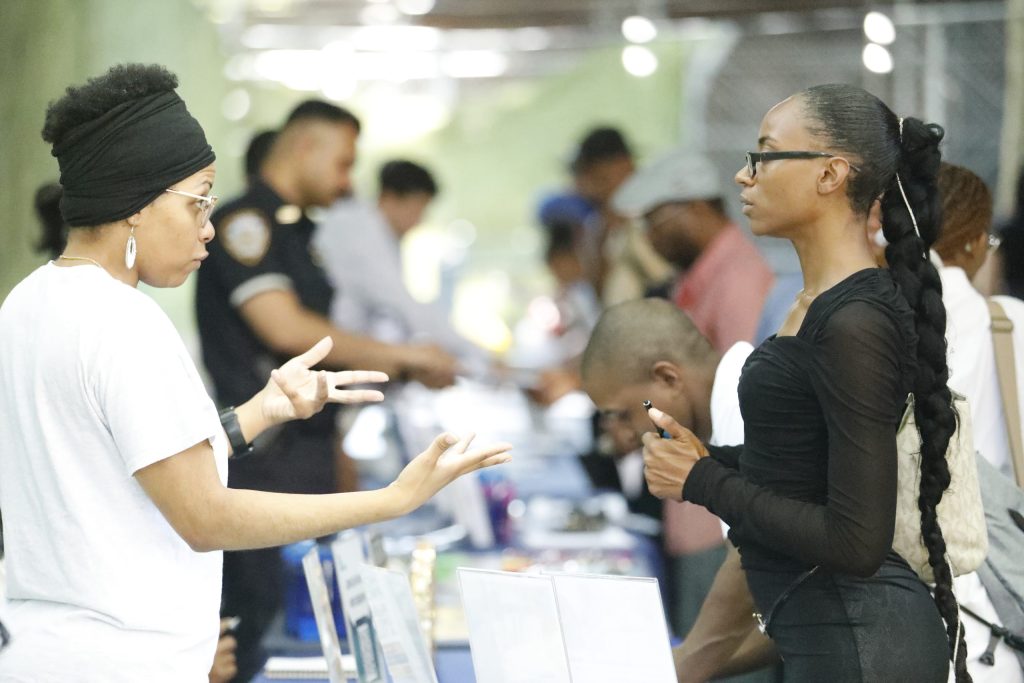
Workers attend a job far in Mott Haven, June 29, 2026. Credit: Alex Krales/The City Reporter
Meanwhile, in cities like Atlanta, Georgia, Provo-Orem, Utah, and Houston and Dallas in Texas, unemployment for Black people remains low. In recent years, those same cities have seen substantial increases in Black immigration. In Atlanta, which gained more than a half-million residents in the last five years, a third of its new residents are Black, and roughly 46% of the overall population is Black, according to the latest Census data. Dallas and Houston have seen steady increases in their Black population, growing by 52% in Dallas and 43% in Houston between 2010 and 2024, according to the Pew Research Center.
It’s unclear whether these Black residents moved to these cities specifically because of employment opportunities, but nevertheless, those places seem to have absorbed the new residents into their labor markets well. In the first quarter of 2026, Texas’ Black unemployment rate sat at 6.6%, while the national average was 7.1%, according to data from the Bureau of Labor Statistics and EPI.
“We have a very dynamic labor market that helps people get into jobs no matter what race they are,” said Pia Orrenius, a labor economist at the Federal Reserve Bank of Dallas, pointing to the state’s loose labor regulations that allow employers to hire — and fire — with ease, where new migrants to Texas from New York City might be trading in a stronger safety net for better employment opportunities.
“This year to date, professional and business services, which are a lot of white-collar jobs, also temp jobs, are up a lot. We’re also seeing a lot of job growth in health, construction, oil, and gas.”
In New York City, even an expensive college diploma, typically a catalyst toward a high-paying job, is no longer a surefire way to secure a job. For those with a bachelor’s degree, the employment rate worsened by 3.6 percentage points over the last year, according to the Center for New York City Affairs’ 2026 budget outlook.
“In the face of economic and federal funding uncertainty, firms may be operating under a ‘last-hired, first-fired’ approach,” the report stated. “This approach has historically disproportionately impacted Black workers.”
Following Trump’s federal layoffs last year, in which 277,000 federal employees were permanently laid off, a report from Economic Policy Institute economist Valerie Wilson drew the connection between the layoffs and the decline in Black female unemployment.
Last year, Black women had the highest decline in national employment and labor force participation, especially among those with bachelor’s degrees, down 1.4 percentage points from 57.1% in 2024. Now, Black male employment rates are falling at a faster rate, down 1.7 percentage points — from 60.5% to 58.8% — through the first three months of 2026, driven by non-college graduates.
“The Trump administration’s aggressive anti-equity DEI agenda could have a chilling effect on how openly companies pursue equity in hiring and promotions due to fear of litigation or other sanctions by the government,” Wilson told The City Reporter.
Youth employment overall, but especially Black youth employment, has flailed, as industries still struggle to bounce back from the COVID-19 pandemic, with fissures forming in critical entry-level roles.
“The most glaring example would be retail. Retail jobs are well below 15%, 20% of where they were pre-pandemic,” said state Deputy Comptroller Rahul Jain. “Why is retail important? Retail is a stepping stone in terms of industries — you don’t need, for the most part, a college degree to do it.”
Other blue-collar sectors contributing to Black employment in the city have also steadily faltered over the last three years. Those include labor-intensive fields, such as manufacturing, which saw a loss of 13,500 jobs since January, construction (-11,900), transportation and warehousing (-3,400), and accommodation and food service (-18,000), according to data from the state Department of Labor.
Youth Rate Highly Depressed
Black youth unemployment is particularly severe in the city.
For people ages 16-24, 23.8% were unemployed in 2024, nine points higher than pre-pandemic, and the highest of all demographic groups, according to comptroller reports.
While the city’s overall youth unemployment rate has fallen 1.3 percentage points in 2025, Black youth still face substantial hurdles in a low-fire, low-hire economy, where overall layoffs are low, but employers are slow to bring in new talent. That creates very competitive applicant pools for jobs that do open up.
At a job fair in Mott Haven last week, 24-year-old Rochelle Williams and her mother, Lillian, floated between tables staffed by employees pitching jobs in city government. Rochelle, who graduated in December from Hunter College, said she would like to be a graphic designer, but came to the fair after unsuccessfully applying for jobs for six months.
Rochelle Williams, 24, and her mother Lillian Williams, 66, attend a job fair in The Bronx’s Mott Haven, June 29, 2026. Credit: Alex Krales/THE CITY
She said she’s been shocked by the contraction — and lack of attention paid to the issue — when it comes to opportunities for the youth.
“It has been a little bit demoralizing, especially with no responses [from employers] because at least with rejections, you know it’s time to move on from that job,” Rochelle said.
Jain, the state deputy controller, said that as more New Yorkers experience layoffs from white-collar roles and switch to trade professions, Black workers may feel the squeeze.
“Black folks have a higher share of their occupations in those areas than they do in other office-type jobs, but if we’re seeing a greater interest from other racial groups in these types of jobs, there’s more competition,” he said.
Searching for Change
Thirty-three-year-old Alesha Buckins, who identifies as nonbinary femme, used to work as a vault processor, counting money for security company Brink’s. Since getting laid off in December, she said she’s submitted more than 200 job applications but received little to no feedback from employers.
Buckins decided to enroll in a solar installation program for installing clean energy panels and using artificial intelligence to neutralize her resume for Applicant Tracking Systems, or ATS, so that her resume won’t be filtered out by possibly biased algorithms.
“Most Fortune 500 companies use outdated ATS systems that are discriminatory towards people of color and minority communities; they literally filter you out,” she said, adding that she’s since started hearing back from employers after upgrading her solar skills.
Workers attend a job far in Mott Haven, June 29, 2026. Credit: Alex Krales/The City Reporter
Some workers, like 47-year-old Harlem resident Desmond Postell, said they have given up on their job search for now.
Postell, who was laid off from his role as a senior human resources advisor at a grocery company, said he’s planning to move to Costa Rica, where he has family and the cost of living is lower than in New York. Despite having both a bachelor’s degree, and a master’s degree in human resources, he said he was left with a severance package and $28,000 of student debt.
“There’s no place in America historically for a Black man. There’s no place for us,” Postell said.
Fletcher, the animator, said he’s continuing his job search and upskilling efforts so that he doesn’t have to move back to Florida, where he grew up. He said he’s moving forward with a sense of caution.
“Sometimes, now I fill out applications, and I’m like, ‘Do I click the African American box?’ Or do I not do it, just in case, because of people’s biases?” he said.
Our nonprofit newsroom relies on donations from readers to sustain our local reporting and keep it free for all New Yorkers. Donate to THE CITY today.
The post Black Unemployment in NYC Still Trails Nation Amid Competition, DEI Retreat appeared first on The City Reporter.
