
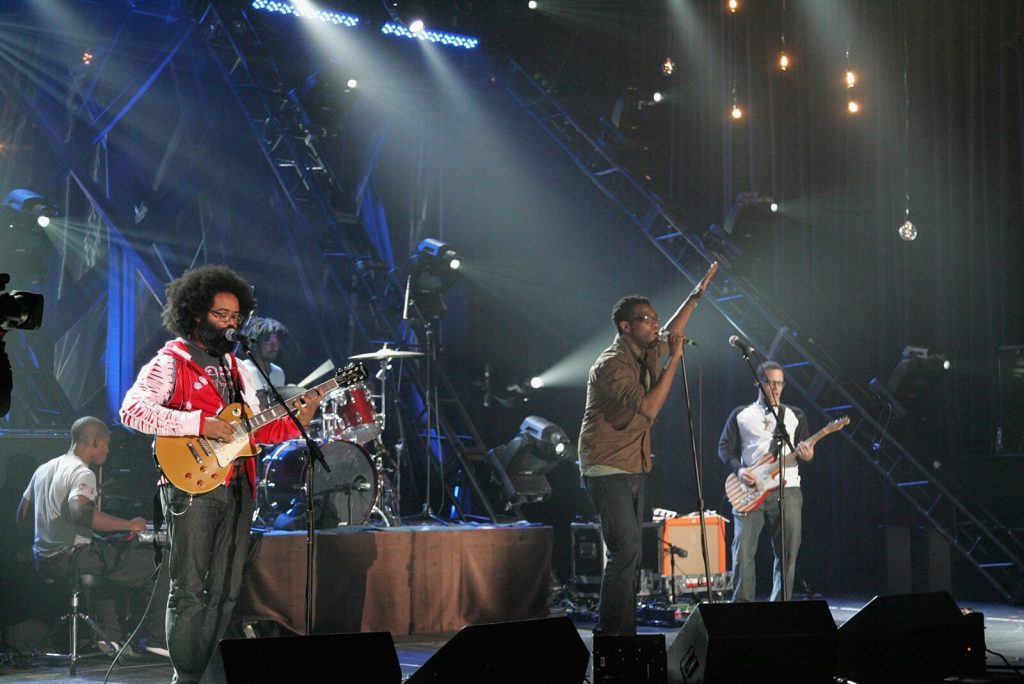
The commercial break ends, and there’s David Letterman sitting at his desk on the Late Show soundstage, holding up a CD. Please welcome, uh, TV on the Radio. The camera swoops in a low arc from on high as frontman Tunde Adebimpe twists the microphone off its stand while the band gets into gear. They’re about to play “Wolf Like Me,” the driving first single from their 2006 sophomore album, Return to Cookie Mountain, released 20 years ago this week, which is either about werewolf sex, or about regular human sex using werewolves as metaphors. It’s a good first single. Some people would probably say it’s the best song TV on the Radio ever made. Decades later, it’s certainly their most popular. The song was written for the live moment. It’s a propulsive, full-throated howl of lust and anguish. You know what it’s about, even if you don’t really know what it’s about. You get what I mean. Certain phrases rise to the forefront—“There’s a curse that comes with a kiss,” or “We’re howling forever,” for example—so that, combined with Adebimpe’s delivery and the pure, crushing force of the band, you’ve got enough to work with. It’s not about a complete understanding so much as it’s about submitting to the song and letting it work.
On that normally anodyne stage, Adebimpe appears possessed. His free arm windmills and wiggles like it’s not even attached to the rest of him. When he’s really belting it out, he arches the upper half of his body so far back it looks like he’s going to break in half. The rest of the band barely keeps things on the rails, and that’s by design. The best TV on the Radio songs are often the ones that sound like everything is on the cusp of spinning out of control.
This rendition of “Wolf Like Me” is now considered one of the best Late Show performances ever, and I think that’s because it doesn’t feel premeditated at all. Instead, it’s like a spirit gripped the band, and it would’ve happened whether they were onstage in front of a national audience or playing to a couple hundred people in a raw warehouse space on the outer edges of Williamsburg, as long as it happened right then. They’d figured out how to translate to the stage the raw energy they’d been developing since their first EP, Young Liars, which coaxed beauty from a militant, skeletal drum machine marching through droning landscapes of guitar and a multi-tracked chorus of voices that sounded like a beautiful battering ram.
Before TV on the Radio was TV on the Radio, Adebimpe, who was working as an indie film actor, as well as an animator for MTV’s Celebrity Death Match, met a producer and musician named Dave Sitek because they lived in the same building near the not-yet-gentrified Williamsburg waterfront. The way Adebimpe describes it, their clear devotion to art at the expense of most creature comforts was the thing that bonded them. From a 2008 New York Times profile: “It just became apparent very quickly that we were going to be friends because his room was full of all this musical equipment with nothing but a mattress, and my room was full of paints and video equipment and nothing but a mattress.” The pair’s earliest work eventually took the form of a DIY album called OK Calculator, its title a riff on Radiohead’s accurately technophobic OK Computer, which seemed to embrace the encroaching doom of technology even as it warned of it.
Listening to it now, it’s undeniably rough, but the core of what would make TV on the Radio great was already there: a heady mix of lo-fi keys and kinetic vocals melding together to create a buzzing collection of tracks that gestured at the big ideas and romanticism that the band would eventually become known for. Soon, their circle expanded: Drummer Jaleel Bunton had been bartending and thought he’d maybe collaborate with his friends for a bit and then just go back to working the bar. Bassist Gerard Smith—who lends a sort of grounded depth to Cookie Mountain—spent his time busking on subway platforms between Brooklyn and Manhattan. Adebimpe liked his music, so he’d sometimes stop for a couple minutes, usually when he saw him at the Bedford L platform, then a promising passageway to a thriving artistic community, now the closest stop to Williamsburg’s very own Whole Foods and Apple Store. Smith eventually realized he recognized Adebimpe from his acting work in the 2001 rom-com Jump Tomorrow, which he’d seen and loved, and the pair struck up a friendship and began collaborating.
Guitarist, multi-instrumentalist, and co-writer Kyp Malone—who was at the time reliably unavoidable around Williamsburg and Greenpoint, waiting to cross the intersection at, like, Grand and Lorimer, his massive puff of beard and cloud of hair obscuring a good 70 percent of his face—feels, in retrospect, like the crucial missing element that locked the band into place. His lyrics are often hyperspecific and poetic, and his voice is a gnarled falsetto that soaks into the music, permeating it with a cracked, occasionally esoteric mysticism.
Kyp Malone’s lyrics are often hyperspecific and poetic, and his voice is a gnarled falsetto that soaks into the music, permeating it with a cracked, occasionally esoteric mysticism.
In that same Times interview, Malone says: “I like pop music. I also like the sound of a dying refrigerator. I can listen to that for an hour and a half if I’m in the mood.” This is basically the key to TV on the Radio. What if we made pop music but there was also a dying refrigerator droning hypnotically at the same time? Even that phrase: “dying refrigerator.” Not “malfunctioning.” Not “broken.” DYING! Fridges don’t die because they didn’t ever live…but that concept: lifecycles, finding beauty and inspiration in the natural ending of things…that is what this band is.
A month after the Letterman performance, TV on the Radio and their psychedelic chamber-folk openers Grizzly Bear were playing a show at Manhattan’s Irving Plaza to celebrate the release of Return to Cookie Mountain. It was, for a couple reasons, an arrival. For one, TV on the Radio had figured out how to take the sound of Young Liars and blow it up into arena-ready music that was anthemic and idiosyncratic and felt connected to the past without being beholden to it. They even got David Bowie—David Bowie!—to guest on “Province,” and it didn’t feel forced. The other reason was that the album underwent a complicated delay: dropping worldwide through 4AD on July 6, before hitting the U.S. and Canada two months later as a co-release between Interscope and Touch & Go. That kind of gap is functionally meaningless now, thanks to the internet. But back then, you had to put in a little bit of effort if you lived in North America and wanted to hear it along with the rest of the world. Maybe you snagged an import copy, or maybe you got a slightly different version that was missing some songs on Limewire. But mostly your option was to sort of just…talk about it.
These were hopeful years for indie rock, and very hopeful years for a band like TV on the Radio, which was innovating within an established mode, creating music that sounded like nothing else from very recognizable pieces of rock and soul and gospel and art-punk detritus. When you’re in the moment, it’s rare to feel sure about anything. Is this band I love as big as I imagine them to be? Do people care as much outside of this room as they do inside? Is their sound influential or am I just in a bubble? It’s hard to tell. But that night, it was clear that TV on the Radio had become impossible to contain.
Roseland Ballroom, October 25, 2006. Photo by Scott Gries/Getty Images
Return to Cookie Mountain could only sound like it sounded because it happened when it happened. It was a laugh in the face of the heightened security and stuffiness of a post-9/11 New York. A scoff at the final years of the George W. Bush presidency. An embrace of hope that didn’t pretend like there wasn’t still plenty to worry about. On Cookie Mountain, the band was able to properly synthesize their relationship to politics in their music. It was not overtly political, but the stories in the songs played out in the shadow of America’s full transition into a proud surveillance state, bursting at the seams with fluorescent patriotism and venomous, militant jingoism. You hear it almost immediately on album opener “I Was a Lover,” which begins with a line that sets the stage for everything that comes after it: “I was a lover/before this war.” Crucially, Adebimpe, Malone, and the rest of the band never wallow in despair, never succumb to empty cynicism, but they don’t pretend everything’s great, either. You can still love and party and grow while everything’s collapsing around you. And they did. The Irving Plaza show closed with a bacchanal that featured Grizzly Bear and Antibalas (members of both bands contributed to Cookie Mountain) joining TV on the Radio onstage for a massive jam lead by Adebimpe. I don’t remember this part, but in a Spin profile of the band from 2007, Will Hermes wrote that Sitek beatboxed. It makes sense. Genre lines were blurred. Everything was fucked. Everything was possible.
The city had been riding an exciting musical wave for years: The Strokes had already wrested popular music from the hands of Limp Bizkit—not so much in a sales-y way, but culturally, more as the ur-influence for how we talked about and listened to rock music. A sort of indie rock sheen had become the dominant aesthetic among the arbiters of popular culture, and that started to trickle down into every facet of young, cosmopolitan life. Everyone went from skinny-jeans-curious to skinny-jeans-faithful. The music scene moved from downtown NYC—too expensive!—to Brooklyn. Or at least that is now the generally simplified narrative. In truth, the lines were a bit more blurred than that: Brooklyn bands like TV on the Radio didn’t just supersede what was happening in Manhattan one day. It was mostly all one thing happening simultaneously. Waves and waves of bands kept arriving from different corners of the five boroughs, each with geographically specific sonic distinctions if you knew what to listen for.
What’s weird, though, is that no new bands that came after TV on the Radio ever really sounded like TV on the Radio. This is not because they weren’t influential. What they were doing felt so singular to that particular group of collaborators. In the wrong hands, a record like Cookie Mountain could sound false and unearned. It had to come from these guys: a band of predominantly Black men in a mostly white musical space, eschewing popular indie signifiers of the time in favor of a collective conviction in making emotional art undiluted by outside pressures or encroaching cynicism.
What’s weird, though, is that no new bands that came after TV on the Radio ever really sounded like TV on the Radio.
You know that phrase that always gets thrown around?: “The Velvet Underground didn’t sell many records, but everyone who bought one went out and started a band.” That same idea can be applied to TV on the Radio. The band’s influence came less in the form of carbon copies of their sound and more from a demonstration of pure artistic inspiration: Each member seemed to have a fully formed musical life, working on other projects between TV on the Radio records that expanded their web of influence while standing on their own sonically. There was Dragons of Zynth, the twin brothers who released the Dave Sitek-produced Coronation Thieves in the wake of Cookie Mountain, and took that album’s youthful spirit and applied it to acid-damaged garage rock, with an occasionally psychedelic bent that makes it seem like you should be hearing it on a scratched-to-shit private-press lathe you dug up in the back of a musty record store. There was Kyp Malone’s solo work, his band Iran, his additional solo project Rain Machine, and far too many more to list. Sitek kept extremely busy, bringing numerous artists into his orbit at a rapid rate: producing contemporaneous work for Liars and the Yeah Yeah Yeahs (two other bands that helped define the sound of a post-Is This It New York), bringing longtime Baltimore friends and collaborators Celebration to a national audience, and also, unexpectedly, producing an album of Tom Waits covers sung by Scarlett Johansson, which I’m convinced will be rediscovered down the line as an extremely odd piece of Millennial Art, capturing the creatively fertile mood of its time to mixed but fascinating results. All this music had a cumulative effect, positioning the band’s Brooklyn scene as a forever-expanding world-eater. No one assumed that any of this stuff would somehow take over pop radio, but it didn’t need to. TV on the Radio was a nucleus.
But when Cookie Mountain was released, TV on the Radio had yet to deliver on the raw creative promise of Young Liars, following it up with the muted LP Desperate Youths, Bloodthirsty Babes. Desperate Youths is a good record, and had it been their third or even second album, it would actually feel like a nuanced, if mostly mellow, next step for the band. In that way, Return to Cookie Mountain is kind of an anomaly in their catalog: a youthful ode to the fucked-upness of life, the beauty of pain, the confusion of creation, and the pressures of having no clue what you were going to do with yourself—those high highs of promise stretching out forever if you just keep going. It pulled together the clatter of Brooklyn warehouse junk, choruses of horns snaking and weaving through walls of guitars that sounded like an imaginary scenario where Glenn Branca was able to get in Phil Spector’s ear via a shared love of Bomb Squad maximalism and My Bloody Valentine’s Loveless to make an album that asked the question: What if we made shoegaze, but instead of staring down at our pedals, we cast our eyes to the heavens in search of redemption and purpose? The greatness of the album lies in that tension between hope and pain, and how they often blur together. Adebimpe is frequently joined on vocals by Malone, whose ragged falsetto floats above his baritone like a ghost.
On the airtight “Playhouses,” the pair sound like they’re singing the same song from separate rooms. Jaleel Bunton’s drums don’t so much anchor the track as they do spasm through it, threatening to spin it out into orbit, but never loosening their hold long enough to get there. Dave Sitek, meanwhile, is a great if somewhat undersung lover of shoegaze, both as a producer and a guitarist. His signature style—washes of guitar humming against a cliff of craggy feedback—is undeniably one of the things that drew me, and probably everyone else, to the band in the first place. When they’re locked in—and they are extremely locked in on “Playhouses”— listening to TV on the Radio feels like pushing your hand against, then through, a cascading waterfall.
The lyrics for “Playhouses” were written by Malone, who evokes the desperation of young love through lines that flip-flop between the conscious and unconscious, hope and frustration: “Beneath the cigarettes and sugar shit of alcohol breath / I can taste the ocean on your tongue / Remember when we sat on the sidewalk / of your old block, against the wall / under the stars / talking about love’s meaning, ”pitching his voice forward and then upward, turning evocative images into impressionistic memories. Later in the song, he drops a lyric that feels like a lament: “Playhouses haunted by broken spirits just trying to get high.” It’s possible to interpret that line in a number of ways, but I can’t help but hear it as an indictment of his generation—of any generation, really—for the way we’re doomed to repeat the mistakes of the previous one, forever disappointed when we can’t capture some kind of magic that we assume was once there, but maybe never really was.
There’s a story I think of often from a 2006 issue of The Fader. The piece, written by Nick Barat, focuses on Kyp Malone’s esoteric solo work. The photos, by Jason Nocito, capture industrial Greenpoint in flux—quiet, grey, desolate. One photo stands out: Malone is frozen mid-moment, looking like he is about to step off a blasted piece of cement and right into the East River, a desiccated dock sagging sickly behind him. This part of Greenpoint is now a waterfront park where families picnic and newly minted Brooklynites catch those first patches of spring sun on their lunch breaks. It’s just another part of the city, no better or worse than anywhere else. But it no longer has any of that desolate mysticism that made a band like TV on the Radio possible, and that’s the beauty of all this. If Return to Cookie Mountain has any wisdom to impart, it’s to have conviction in what you put out into the world. I don’t mean that in a cheesy way—or, actually, maybe I do. The best art can make old ideas feel new again. The album sounds hopeful, but it’s also apocalyptic. Chaotic. It didn’t spawn a legion of imitators, because it wouldn’t make sense to imitate it. How could you even begin?
The post There Could Never Be Another ‘Return to Cookie Mountain’ appeared first on BKMAG.
