
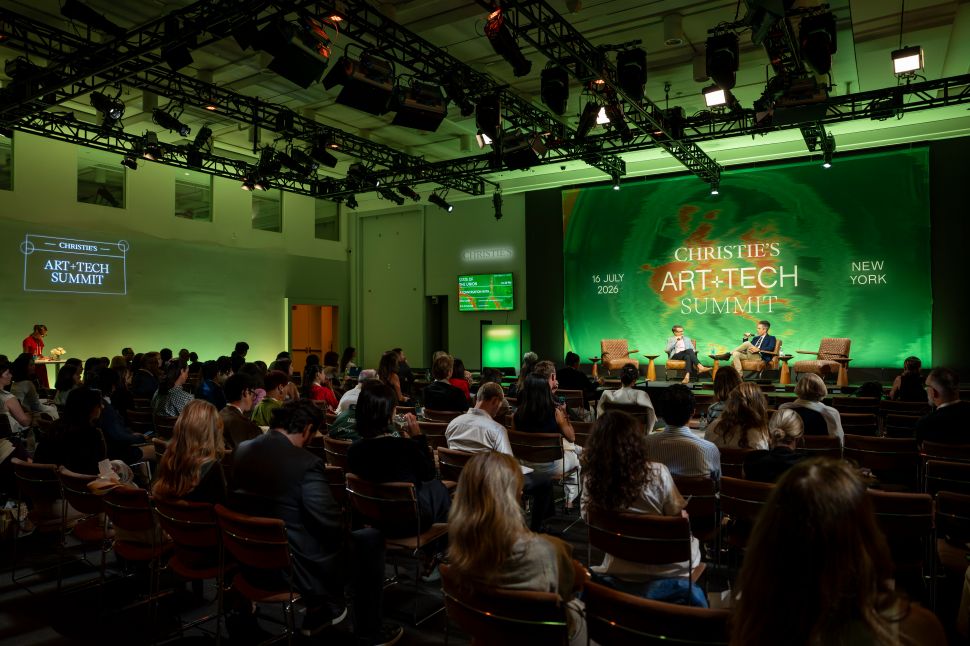
The annual Christie’s Art+Tech Summit has always taken on the year’s hottest topic. In 2026, the event could hardly avoid the elephant in the room that is artificial intelligence. A.I. was not only the opening theme but the focus of the entire morning, with tech founders, analysts and researchers offering both theoretical and critical perspectives on the increasingly machine-driven reality we are beginning to inhabit.
This year’s speaker list did not necessarily feature the most innovative voices working at the intersection of art and technology—figures Christie’s could presumably have accessed fairly easily, including artists such as Trevor Paglen, Zero10 curator Eli Schein, Toledo Museum of Art director Adam Levine or the sundry innovators we have covered this week. Instead, the program leaned heavily toward the U.S. technology and investment worlds, with speakers including the “Einstein of Wall Street,” Peter Tuchman; Rich Barton, co-founder of Zillow and Glassdoor; and Robinhood co-founder Baiju Bhatt. Art+Tech is now organized through Christie’s Ventures and Innovation Labs, which invests in companies working across digital assets, A.I., fintech and hardware. The summit is, first and foremost, a business-development opportunity—a way for Christie’s to build bridges across art, technology and investment.
From 10 a.m. to noon, the discussion moved rapidly from Benedict Evans’s excursus into the evolution of A.I. technology and, more importantly, the relationship between capital and innovation—and therefore its market—to the more philosophical question of whether A.I. is thinking and what still makes human thought and creativity unique. From there came the inevitable questions about its disruptive power in the job market, but also about the opportunities for knowledge sharing. Described in the panel simply as an “analyst,” Evans is one of the most influential independent technology thinkers writing today, particularly on the long-term impact of A.I., mobile computing and digital platforms, known for his ability to synthesize technological trends into clear strategic frameworks for investors, executives and policymakers.
He bluntly framed generative A.I. as just the latest tech in a succession of computing-platform shifts that began with mainframes and moved through PCs, the web and smartphones—a line of reasoning other speakers would return to throughout the morning session. Each technology initially appears limited, then becomes the center of excitement, hence investment and company creation, before settling into the background as mature infrastructure. Generative A.I., he argued, is still at the start of that cycle: “Each technological wave arrives faster because it builds on the infrastructure of the previous one… ChatGPT launched into a world with billions of smartphones. But it still takes much longer to change organizational structures, processes, deployment models and consumer habits.”
For technology companies, it is better to invest too early than arrive too late. That explains why Google, Meta, Microsoft and Amazon view overinvestment as less dangerous than missing the transition entirely. Evans divided the resulting platform war into four areas: chips, data-center capacity and power, model development and deployment—who uses A.I., for what, at what price and with what economic return.
The most visible result is an extraordinary increase in capital expenditure on building this new technological infrastructure. The largest cloud companies, which until recently spent roughly $100 billion a year, are now guiding toward several times that amount. Evans estimated that annual A.I.-related infrastructure spending could approach $800-900 billion.
The scale is not unprecedented compared with global oil, gas or telecom investment, but it is unprecedented for the technology industry, he noted. A large share of that spending is flowing into Nvidia and the broader semiconductor industry, as chips, data centers and power are seen as the necessary elements needed to build all the capacity the industry is aiming for. OpenAI has announced enormous infrastructure ambitions without yet having the cash flow required to finance them directly, Evans argued. Much of the proposed spending, therefore, depends on partners’ balance sheets and on forms of vendor financing, more politely described as circular revenue.
Hence, the real question is who will capture the value and where the profits will accumulate. Sam Altman, Evans said, has compared intelligence to water or electricity, but utilities are not known for high margins. His more cautionary analogy was mobile telecommunications: smartphone adoption and mobile data usage transformed the global economy, yet telecom stocks largely stagnated because much of the value was captured by services operating above the network—Amazon, social platforms, e-commerce companies and other digital businesses.
OpenAI and Anthropic may survive as global-scale infrastructure providers, much like utilities, Evans argued, but the uncertain challenge is whether they can also own the emotional and experiential relationship with consumers. This was a point that Abhay Parasnis of Typeface also raised in the subsequent panel on Funding Innovation with Kevin Hartz of A*. Both also emphasized that standard model capabilities may become commodities, leaving differentiated experiences, trusted services and specialized knowledge as the real sources of value.
Evans also pointed out that chat itself is still much too poor an interface: users often do not know what to ask, and complex workflows are difficult to describe. The technology, therefore, needs to be embedded in specialized software, applications and tools. All the speakers agreed that the user experience is not yet there to make the potential of those tools truly accessible at scale. In the closing panel, Replit’s Business Development VP Jeff Burke also predicted that by 2030, A.I. would move beyond the prompt box and keyboard into more intuitive, personalized interfaces. Emerging formats could include voice systems, spatial A.I. and smart glasses, with one company likely to develop a breakthrough experience within the next several years. As computing, code generation and customization improve, those capabilities should become available across multiple devices and forms of interaction.
Improving user experience will help broaden adoption, which Evans pointed out remains limited rather than something used daily by most people. Enterprise adoption follows a similar pattern. The easiest applications—analytics, customer service and internal search—are being deployed first, but their effects are difficult to identify in earnings.
Evans concluded his panel with another interesting note for anyone in the humanities: A.I. is still not particularly original or creative, but to truly serve the dynamics of luxury, it would need to be. A.I. is particularly effective when the desired output is the average, standard or typical answer. Taste, luxury and culture often depend on precisely the opposite: the unexpected object that breaks the pattern. The artistic, creative aspect still needs to come in and requires human input.
He further developed those topics in the following panel discussion with Rui Costa. A neuroscientist and President and CEO of the Allen Institute, Costa opened his speech with a reminder that human reasoning begins before language. People experience multidimensional internal states and later compress them into words. A model’s ability to reproduce those words does not establish that it shares the underlying experience. Evans similarly warned of the risk of anthropomorphizing systems. “It is like seeing faces in clouds,” he said. “A system might get close enough to human behavior that the distinction appears not to matter, even if it has no structural understanding. We do not have a good theory of why these models work so well, but we also do not have a good theory of human intelligence.”
As machines assume more cognitive functions, Evans argued, human differences may become more valuable. Just as industrial production gave new meaning to the handmade object, generative systems may similarly heighten the value of taste, authenticity, judgment and work that departs from the statistical average. Both Evans and Costa agreed that what makes people uniquely human may become more valuable, not less, in an A.I.-saturated world.
Costa also argued that people may consciously fear A.I., but their brains increasingly incorporate it as a tool as they start using it. Scientists still pose creative questions and formulate hypotheses, but increasingly embrace the idea that A.I. can perform analyses that were previously impossible or prohibitively slow, thereby expanding the possibilities for continuous knowledge production. “Today any smart kid from anywhere in the world can make a big discovery,” Costa provocatively argued. “Open models that are good enough could create a garage-band mentality for science, provided access to hardware and infrastructure is widened.”
Once again, both Evans and Costa emphasized that input, intention and final judgment should remain human. And it is this human agency that should be protected. “I want as much automation as possible, but I still need surprise and the agency of being human. Discovery often begins with an unexpected reaction—something unfamiliar, difficult or initially unappealing,” Costa stated. “We need to be very deliberate in the way we use it and what we ask,” Jeff Burke would echo in one of the afternoon panels, discussing the necessity of guardrails, taste and understanding users’ human experience.
Parasnis and Hartz’s panel delivered a similar message: the future workforce may need deeper domain knowledge, not merely greater familiarity with A.I. tools. “Young people feel enormous pressure to move immediately: drop out, join a startup and avoid missing the A.I. wave. I would advise them to slow down and build deep foundational expertise in science, art, music, the humanities or another domain,” Parasnis stated. “As the intelligence layer becomes pervasive and abundant, the human role may be to guide these systems within a specific field.”
This expansion of access to knowledge is also the vision behind Baiju Bhatt’s latest venture, Cowboy Space Corporation, which aims to send A.I. data-center infrastructure into space—something that might have been pure science fiction only a few years ago. This is something he sees as inevitable if we want a world in which computers help us day-to-day, but people do not want all these data centers in their backyards. “Assuming energy consumption and processing requirements continue on their current trajectory, the amount of knowledge work humanity will be able to undertake with access to the next generations of models could be extraordinary,” he said, connecting from his private jet. He emphasized that we are already encountering severe limits on the amount of compute we can bring online. “Even if we look only at the United States, I see a future in which access to computing, knowledge and intelligence is treated much like access to other essential resources.”
In his speech, the preoccupation with technological capacity as a form of economic power was clearly placed above any ecological or human concerns implied in the proposition of “colonizing space” as “new cowboys.” But the mission of expanding knowledge apparently legitimizes exporting the ecological problem into other cosmic spaces we do not technically even own. Over the course of the entire day, none of the other speakers meaningfully addressed the ecological and ethical concerns raised by A.I.
With the second part, the summit finally got to how technology is driving innovation in art. The afternoon opened with Christie’s Global Chairman of 20th and 21st Century Art, Max Carter, in conversation with Bloomberg journalist Erik Schatzker about the career apex of selling the billion-dollar S.I. Newhouse collection, likened to winning the World Cup. While the metaphor felt slightly exaggerated, the sale definitely helped propel Christie’s to its best first half in five years. But “the market never left,” Carter said. It is just changing.
What distinguished the latest cycle, he argued, was not only quality supply but a meaningful influx of new buyers. “What made the last six months special was demand,” he said. And perhaps that was all the art world needed to hear to have some hope. “It was not only people who had been buying five, six, seven or 20 years ago. There were many new buyers. When you combine great supply with new buyers, the result is powerful.”
Although a single bidder can secure a sale and two can create competition, four bidders can create real action. “More bidders increase confidence and the likelihood that the work reaches another level,” Carter argued. “When you have four bidders per lot, good things happen. Even a bid at a lower level gives others confidence. People are social creatures. They like to see that others are also prepared to pursue the work.”
This is why, Carter said, the number of bidders per lot is sometimes a better market indicator than price. “It shows how many people you attracted to an object and how successfully you presented and priced it.” And even if there is a guarantee, it still shows that there was a market for the work at that price. “Guarantees may make the market seem more opaque, but they also create transactions. If you can bring together a buyer and a seller and provide the seller with a secure result, you have made the market function.”
Still, perhaps one of the biggest revelations of the entire panel was that Christie’s is already selling to tech billionaires in Silicon Valley. When Schatzker questioned whether all this money flowing into A.I. and SpaceX could affect the market, Carter confirmed that it already had. And he expects more to come. “Based on conversations with clients who are deeply involved in SpaceX and some of these other companies, I think the impact could be enormous,” Carter said, arguing that the strength of the equity markets over the last several years had already been instrumental. “A small number of people who are already active in the art market will benefit from this wealth accumulation, but many other people will create levels of wealth that were previously unimaginable to them,” Carter continued.
It might be his humanist optimism as a classicist—as he revealed in the introduction—or simply that he has spoken with enough wealthy people during his decades at Christie’s to sustain this hope. But Carter is persuaded that art is one of the things people inevitably turn to when they reach a different stratosphere of wealth or affluence. “They begin thinking about what they want to spend money on—particularly things that might give their lives meaning and purpose in a different way,” he said. He then confirmed: “Some clients connected with SpaceX have already been buying in anticipation of liquidity. Others are waiting. Future I.P.O.s could produce another meaningful wave of demand.”
Ultimately, Carter was very confident that the recent $80 billion investment in SpaceX would soon translate into a significant boost in market demand. But Christie’s has not been sitting around waiting for these buyers, we heard: the auction house has proactively identified and cultivated potential collectors, believing that the best art needs the best clients for certain pieces. “We identify people over the long term whom we believe should become buyers of great works. But major collections also bring audiences to us. The Paul Allen sale attracted people who had not previously been traditional fine-art clients because Allen’s achievements inspired them.”
This probably also explains why Christie’s still holds this summit: to give these people a stage, to demonstrate that art is relevant and to show that the auction house is part of the conversation, even though, on the art side, we are still very much figuring out what innovation might look like. The art world will be, as usual, slow to adopt it, except among artists and creators, many of whom are already experimenting.
When asked how much stock prices, interest rates, geopolitics and generational wealth transfer matter, Carter drew on his experience working in the auction world through several economic cycles. All of this affects art, he said, but more so with repeatable or commodity-like material: artworks that may become available elsewhere, soon, perhaps at the same price or less.
When something truly singular is there, it is time to buy, with the right excitement, timing and opportunity. The decision remains fundamentally human and instinctive. “Buying art is also more emotional than buying a stock,” he said. “That can make the market less directly responsive to macroeconomic signals.” It is exactly for this reason—something A.I. could never override—that singular works can overcome economic weakness. Carter pointed to the Yves Saint Laurent sale during the 2009 crisis as evidence that generational quality still compels spending.
When asked about innovation, Carter pointed to the smaller—or perhaps already quite significant—improvements in live-streaming auctions. It was already a major step toward democratizing them, or turning them into a form of entertainment, more or less like soccer or basketball games that people can get excited about. They even began applying the same dynamic camera effects to achieve that. This, according to Carter, not only encourages emotional engagement but also greater transparency and, eventually, trust.
Remote buying at the highest levels surged during the pandemic and remains significant. Carter sees it as further proof of this democratization, since it reduces the physical and psychological distance surrounding auction houses. Digital tools, in general, have helped give more potential buyers access to works. “We have made progress in reducing that distance. Before Covid, one of the largest barriers to a high-value transaction was the need to place the client physically in front of the work, whether in New York, London, Paris or Hong Kong,” he recalled. “Covid made that impossible, but technology had finally reached the point where people could make informed decisions remotely. Instead of sending a transparency and asking someone to hold it to the light, we could provide images that allowed a client to zoom in closely enough to see the hairs of the brush, inspect the back and watch a detailed video.”
However, based on what Carter shared, Christie’s is still at a level of technological integration that is nowhere near what Andrew Wolff, after acquiring and merging Artnet and Artsy, is now envisioning for the art world, as he later discussed.
Echoing the speakers before him, Carter, however, also emphasized that the more digital our lives become—the more digital becomes an inherent part of life—the more people may appreciate and value expressions of human genius. “When I hire someone, I look for curiosity, resourcefulness and independent thinking. If you approach A.I. with those qualities, chances are you are going to elevate, evolve and enrich the way you do business. You will find interesting uses for it. But if you approach it because you are intellectually lazy and want to shortcut or crudely approximate human effort and initiative, it is going to detract from the work and lead to bad outcomes.”
He eventually also addressed the NFT bubble, which had dominated the summit only a few years earlier, particularly after Christie’s sold Beeple’s Everydays: The First 5,000 Days for $69 million in 2021. For a time, there was also a dedicated department at Christie’s for digital artworks, which has since closed. “I’m actually very proud of what we did in that space, and that is probably surprising coming from someone with my background. We took a fairly advanced position on something that was still quite niche at the time,” Carter said. “It then became much more mainstream, and we served a different group of clients. It was a very interesting learning experience.” He remains firm that the initiative helped introduce Christie’s to new clients and generated knowledge about an emerging field. And if the NFT boom is over, there is no reason to leave the field.
What is even more surprising, speaking as someone who came from the classics, is that, despite all this, Carter completely rejected the idea that digital art is dead, comparing it to specialist categories that grow quieter under external conditions. It was the Russian art department he mentioned, which gave the comparison an entire atmosphere of its own. Christie’s can preserve its expertise and remain ready for a market revival.
In another, more art-oriented panel, the only one in which there was a true discussion of digital art, art advisor Benjamin Godsill, in a dialogue with digital artist Kiya Tadele, moderated by Marcus Fox, Christie’s Global Managing Director, brought to the stage the key point: collectors are changing, and younger collectors are digital natives. “I believe digital art represents that kind of shift multiplied a hundredfold,” one collector said. “The next generation of collectors and patrons will be digital natives rather than digital citizens, and that will fundamentally shape the work they engage with and support.” Godsill went even further, framing it as another craft: “This is not a new movement. It’s just inevitability.” Godsill emphasized that, at this point—and increasingly as we move forward—almost every kind of art-making can use A.I., even if only for notes or brainstorming.
Before that, Andrew Goldstein had joined collector and philanthropist Komal Shah, Anne Kraybill, CEO of the Art Bridges Foundation, and artist Jitish Kallat for a conversation that moved in several directions, not always with an obvious connection to either the art-and-technology intersection or the panel’s title, Art, Archive and Heritage. Still, in his opening remarks, he offered a reference to the classics that felt particularly apt. “Long ago, Archimedes said, ‘Give me a lever and a place to stand, and I will move the world.’” He was not simply talking about how impressive levers were as a cutting-edge technology, Goldstein noted. He was talking about the importance of knowing where to stand and where to position the lever—of understanding where force should be applied to a given problem to produce the desired result.
Finally, Andrew Wolff, a former venture capitalist turned art entrepreneur, took the stage to retrace his career in finance and his path into the art world before addressing what many had been waiting to hear: the recent acquisitions of Artnet and Artsy and his strategy for combining them into a single platform designed to solve some of the art world’s most persistent problems.
His pitch made the plan clear: to build a vertical, one-stop software system for the art world by bringing Artnet and Artsy together. He described it as “the gesso behind the painting”: the underlying infrastructure. This would include the marketplace element and data insights, while adding middle- and back-office capabilities for art-market participants to the front-office tools the platforms already provide. Media and publishing would remain another central pillar.
As both a collector and an investor looking to direct capital toward the arts after years spent building and managing other ventures, Wolff sees the art market as fragmented across inventory systems, databases, marketplaces and administrative tools. Media and publishing also remain an important pillar, because they provide top-of-funnel distribution and a direct relationship with collectors and the public. “In a world where large language models may weaken direct relationships between businesses and audiences,” he said. The final pillar is financial services; they do not offer these services yet, but he reveals that they are also part of the longer-term roadmap.
Still, Wolff clarifies that he sees Artsy and Artnet occupying different positions, and they will keep both brands. He described Artsy as the heart and Artnet as the head. In his vision, Artsy is the emotional, discovery-oriented platform that attracts younger collectors and emerging artists through a stronger consumer experience. Artnet, by contrast, provides the analytical side through its price database, verified historical information and institutional authority. Together, the two brands could cultivate new buyers while helping them make more informed decisions.
The next step—which could already represent a genuine revolution for the art world—is that Wolff imagines Artsy becoming something closer to what Letterboxd is for film, where users do not simply watch a movie; they follow reviews, identify people with similar tastes and form communities. Most importantly, the platform could gather data on buying patterns, preferences and user behavior. “All that kind of secondary user behavioral data can actually go into some of these heuristics in terms of valuation,” he said, citing Nielsen as an example. Apparently, his goal is to similarly aggregate and anonymize thousands of data points to identify insights into broad patterns in art buying.
Structured price data, like the kind Artnet provides, is only part of the picture. “There is also a large amount of unstructured ‘data exhaust’ from the ecosystem: What are people viewing? Where do they pause? What do they like or ignore? What are they financing or storing? Behavioral data can enrich valuation models,” Wolff argued. “Cognitive and neural-network approaches may also help identify patterns that go beyond simple comparables such as artist, size or color. The goal is to identify deeper visual, historical and behavioral relationships that may help explain value.”
When it comes to the platform’s economics, he also made it clear that he is already thinking about how the data and the insights derived from it could be monetized to make the business sustainable, as already happens in other areas of luxury and entertainment. Asked, toward the end, how he sees the art market in 2035, Wolff said that the future is already here; it is simply not evenly distributed. “Many of its seeds are visible in the tools people are already using, but they have not yet been fully commercialized or institutionalized,” he argued.
This intense day of more tech than art left a great deal to consider regarding shifting value systems, strong statements and points of agreement or disagreement, and even concern sometimes—particularly after the early A.I. speeches, more than after the art and innovation afternoon session.
On the art-innovation side, the summit confirmed that the art world remains slow not only to adopt technological advances but also to confront them openly, even as it is now eager to engage with a sector that could provide some of the resources it urgently needs. Yet the further technology advances, the more the art world may need to restate—and perhaps defend more forcefully—that creativity, art and human intelligence are precisely what allow us to think beyond, create beyond and write beyond what machines can provide. Luckily, the A.I. revolution is leaving the technology world itself in need of art and the humanities more than ever, and not merely as vehicles for financial speculation.
