
Since art history embraced the possibilities of abstraction, numerous artists have tried to translate music—the most abstract of all creative expressions—into painting and other visual forms. This has led to both highly emotional and rigorously scientific attempts to translate music’s intangible structures into forms and symbols. In a sense, this process began with the development of musical notation itself: a linguistic code of notes and rhythms that transforms frequencies, vibrations and temporal patterns into codified signs. This impulse achieved an elevated form, truly suspended between the linguistic and the imaginative in Kandinsky’s most successful mature works.
More recently, British artist Oliver Beer seems to have found an even deeper way to let sound, with its frequencies and vibrations, create entire painterly spaces. Beer studied musical composition at the Academy of Contemporary Music in London before attending the Ruskin School of Art at the University of Oxford, and later explored the potential of images and sound in motion while studying film theory at the Sorbonne in Paris, and consequently has a mature understanding of how sound vibrates between and through bodies.
“The Sky in the Cave“
Artist: Oliver Beer
Venue: Thaddaeus Ropac
Address: 37 Dover Street, London
Through: July 31, 2026
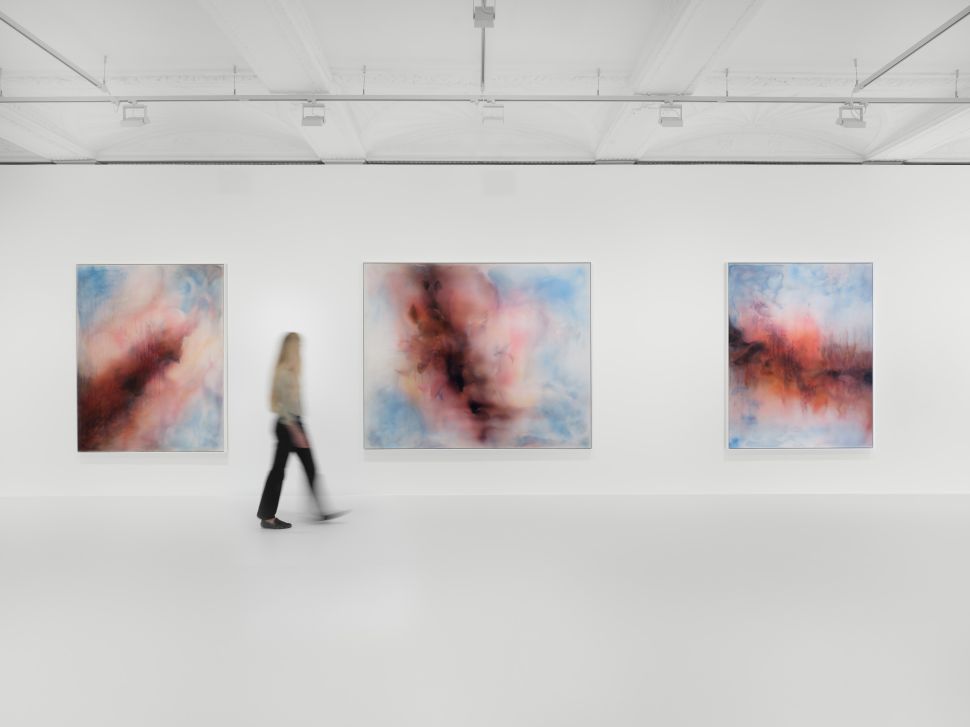
Inspired by time spent in the Lascaux caves, “The Sky in the Cave” at Thaddaeus Ropac in London invites visitors to pursue a multisensory journey through the space, following frequencies as they materialize in different forms through Beer’s signature Resonance Paintings, monumental 16mm films and soundscapes. The gallery becomes an immersive environment in which sound and image are experienced fluidly as inseparable, both emerging from a similar blending of the subconscious and the sensorial.
Rather than depicting sound, Beer’s Resonance Paintings are physically shaped by it, as vibrations act directly on pigment and frequencies are translated through the alchemy of painting. In the process, a fleeting, intangible moment of sonic flow becomes a permanent image and a tangible physical experience, connecting voice, music, memory and matter while highlighting the vital entanglement among them. “One thing I learned when I first began painting this way was how clear and powerful the relationship between music and image could be. Why not crystallize that and allow people to see an accumulation of sound?” Beer reflected during the London Gallery Weekend opening.
The entire show, like his most recent works, has been deeply informed by his formative experience working in the prehistoric cave at Lascaux, in the Dordogne, where he eventually discovered a primordial connection among image, ritual and sound. During his time in this magical environment, under the mentorship of and in continuous dialogue with Jean-Michel Geneste, the former chief curator of Lascaux, Beer began to identify a relationship between the locations of the Paleolithic paintings and the points of greatest acoustic resonance. Working with his voice to make the cave itself sing, and drawing on his deep awareness of where sound is and how it moves physically through space, becoming an embodied sensation, Beer began to understand how Paleolithic people, more than 17,000 years ago, were not painting randomly. Rather, these works may have resulted from their acoustic and physical responses to that space as part of a ritual.
Beer explained that the cave became central to the project because of its powerful acoustic properties and its status as a space that precedes modern nations, cultures and languages. For him, the cave is not simply a French or archaeological site, but a shared origin point for art, sound and human expression. “I started to notice that there are more paintings and more human activity in the places where the most powerful resonance occurs,” he recounted. “If he is right, that means that people were singing those exact same notes 17,000 years ago. It also means there was a relationship between art and music in the very first marks in the world.”
He brought singers into the cave as part of his process. “It is a shared origin of art,” he explained. Spending long hours underground, singing and recording with eight different performers, Beer encountered sound as something elemental and transformative, in continuous evolution but also deeply universal in the way it interacts with and resonates through bodies of all kinds.
Beer’s work has long explored resonance as both an acoustic and emotional phenomenon, but the cave project intensified his interest in the ways vibration can connect bodies, voices, objects and historical time. “Finding this relation so deep in our history, almost as part of our DNA as human beings, was the background to this work,” he says. These reflections found their first translation in the critically acclaimed installation Resonance Project: The Cave, which he presented at the 17th Biennale de Lyon (2024-25) and which is now touring the globe, first to the National Gallery of Finland in November before heading to other locations in Europe and Asia.
What is interesting about the cave work, resonance and sound is what has not changed. The note of that cave has not changed for 17,000 years. The harmonics of the human voice have not changed for 200,000 years, Beer explains. “Biologically, in terms of our voices, we have been the same for 200,000 years. If you spoke to someone from 100,000 or 200,000 years ago, you might not understand a word they were saying, but the instrument would be the same, and it will still be the same far into the future, even as we begin to adapt our bodies technologically,” he says.
For Beer, resonance is not just a metaphor in his work; it is a physical fact, a scientific truth and also an emotional and creative force. His paintings represent the most accessible translation of this entanglement. During lockdown, when museums were closed and his projects were canceled, Beer recounts returning to early experiments with vibrating surfaces. Experimenting in the studio, he began to treat the canvas as a surface capable of revealing sound. By placing a speaker beneath a horizontal canvas and allowing pigment to move in response to specific frequencies, he developed a painting process in which sound directly generates visual form. “I realized I could treat the surface of the canvas as a way to reveal the sound itself, and I started to paint,” he said. “If you were at a concert and could somehow see the sound, you would see vibrations: the surface of a column, circles, geometry, shapes,” he said, reflecting on how, even now, as we speak, words fill the space with geometry. “The bones of your ear are vibrating, hearing that geometry and telling you that it is speech.”
A 16mm film combines footage of the prehistoric cave paintings with the artist’s painting process: pigment caught mid-motion, patterns forming and dissolving in real time. Shots he filmed inside the cave combine, through the already fluid medium of video, with the warm chromatic vibrations of his painting. “It is something that has been around forever and has been demonstrated for about 300 years, but seeing matter move on the canvas through vibration is still totally magical to me. I get lost for weeks doing this,” he added.
The first paintings Beer created with this technique were monochrome, in blue and white. “I spent two years painting in monochrome. It was like learning an instrument: you have to learn your scales and harmony,” he admitted. “It was almost like studying painting in Italy, where they do not let you pick up a paintbrush for the first year, and you can only draw. I gave myself that discipline.”
While these paintings may appear chance-based, they result from a very disciplined, almost scientific process. Beer compares the process to playing jazz piano: after years of practice, he knows which notes produce which forms, how colors and pigments respond to particular frequencies and how harmonies or dissonances can build, distort or cancel visual structures. “Some marks in the show look almost as if they were painted with a brush, and that is because I chose that particular note, with that particular color, at that particular frequency,” he pointed out, noting how, in each canvas, there are at least a hundred notes. “The low notes create large forms, and the high notes create small forms.”
This is also why scale matters, as each canvas functions almost like an instrument. A large painting has a broader range, allowing the viewer to become immersed in the image and allowing more complex frequencies and forms to unfold. Smaller paintings can still work, he notes, but they have a more limited range, just as smaller instruments do. Beer’s painting process is both organically pure and scientifically precise, as if he were trying to reattune himself to a more expansive tempo of nature. Here, he also introduced pigment from the cave: manganese oxide, charcoal and red ochre, the same kinds of pigments used in caves thousands of years ago.
“I wanted to express the feeling I had in the cave: going into the earth expecting it to be cold, dark, damp and difficult, but after eight hours resonating with music, realizing that this dark place was not dark or complicated in that way,” he recounts. “It was like being in the Sistine Chapel, looking up at these beautiful, complicated drawings merging with the rock.”
Hanging in a separate room, the main body of work—large atmospheric canvases—appears to move from earthier, darker tones toward light, echoing the experience of entering the cave and discovering an unexpected expansiveness. Beer connects this movement to the relationship between sound frequencies and light frequencies. Although sound waves and light waves are physically different, he is fascinated by the fact that human beings perceive only a small portion of both spectrums. In his paintings, sound frequencies act on pigment and light, producing images that can evoke abstraction, landscape or atmosphere without illustrating anything literally. “For me, the parallel between frequencies of sound and frequencies of light is magical,” he argued. “I use frequencies of sound to adjust frequencies of light until an image emerges, and some of the images look as if they could have come from the history of abstract painting or landscape painting. A symphony without words is just vibrations, and yet it can evoke so much.”
Beer accepts that this process could even be linked to Turner and Monet. “When Turner painted a sky, for example, he was using mud, minerals from the earth and oil medium, and turning them into air: not just any air, but an expanse of sky so large that we can hardly imagine it. That is light frequency,” he said. Beer’s own project with the Impressionist Festival and the Musée de l’Orangerie encouraged him to move beyond monochrome and approach color more directly. He said he imagined Monet might have been either horrified or intrigued by the idea that vibrations themselves could act on pigment and light. “I spent a long time watching people look at the Water Lilies. Those paintings are bordering on abstraction. They are layers of color, and Monet painted them for 30 years, which is an amazing obsession. He was also painting waves: when he looked at his pond, he was looking at vibrations on the surface of the water and what they did to light.”
The show is called “The Sky in the Cave” because it is about going into the cave and finding yourself not enclosed at all. Time feels compressed, and space feels expanded, he adds, pointing to a painting that may look very romantic. To him, it comes from the feeling of being inside something so solid and earthly that the earth itself begins to vaporize. “The whole show is about that feeling: something physical and precise, like resonance, which is a scientific truth, connecting me to the singers I was with, and then connecting us to people we know almost nothing about. Suddenly, our cultural contribution, whether it is a song in Arabic or a movie song, or Rufus Wainwright’s earliest musical memory, enters that space. The whole piece is about music that we inherit and cannot choose.”
Beer connected this to James Turrell’s idea of “seeing ourselves seeing,” suggesting that his own work asks whether we can also hear ourselves hearing. Hearing, for him, brings in language, music, selfhood and perception. By making resonance visible, he hopes to heighten awareness of the vibrations that surround us and of the ways we are entangled with spaces, objects and one another.
At the same time, focusing on what is constant and universal—resonance, harmonics and the fact that these new paintings by Beer represent harmonics that could be found anywhere in the world and at any point in history—brings a reassuring sense of permanence and universality. But as soon as one expresses oneself through music, art or language, one is no longer universal, he also argued. “You are incredibly specific and anchored in your time, geography, context and narrative.” Yet it is when we learn to see the world through someone else’s eyes, or hear the world through someone else’s ears, that it challenges our own subjectivity. “That is important to me. When I make a cave resonate, or when I let people hear sound differently, even for a second, they are invited to hear the world differently, or to understand how they hear the world differently.”
Ultimately, it is also about feeling connected to something through these paintings. “When you see the vibrations and understand that they are literally all around you, there is a strong sense of resonance,” Beer pointed out. “It is a word we use all the time: this thing resonates with us.” His exhibition is extremely dense, both sensorially and philosophically, touching on the very origins of human expression—between instinct, ritual, language, imagination and the connections among them. “I think I will always be digging into our origins, but I am also interested in our destination,” Beer shared toward the end of the walkthrough. To him, this is a good way to think about what is coming next.
