
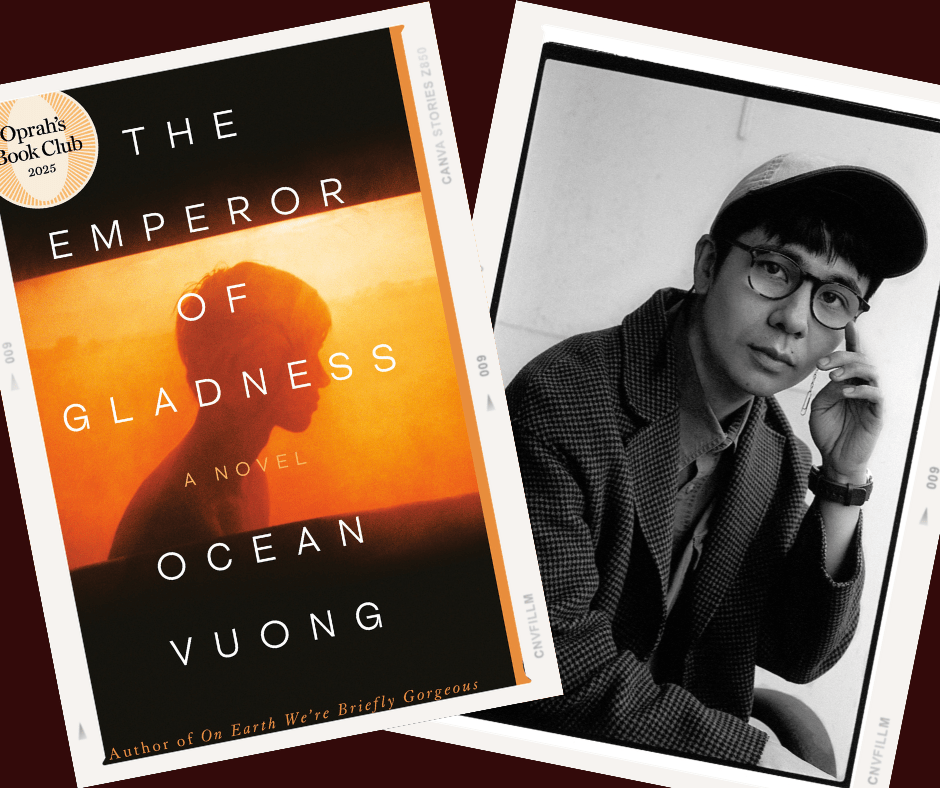
The world demands definition, certainty and arcs of triumph, yet best-selling writer and professor Ocean Vuong offers something very different. His novels and poetry catapult readers into the ineffable, often jolting them into unprecedented perspectives. He employs metaphors that disrupt thought and open the heart, drawing us into the lives of the working poor, the people upward mobility would rather not think about. He stays with an image or a feeling and asks, “What else?” In Vuong’s most recent book, The Emperor of Gladness, he writes about the post-industrial town of East Gladness, Connecticut: “We pay taxes on every check to stand on the sinking banks of a river that becomes the morgue of our dreams.”
Vuong came to the U.S. at two, learned to read English at 11, was the go-between translator for his mother and grandmother—women who filled him with tenderness and the hauntings of the Vietnam War—and has become one of the most celebrated authors of his generation. His trajectory is the redemption story America loves, and yet, he questions the very crown he wears. “I’m still perplexed as to why the works have taken off in the way they do,” he reflects. “To me it’s all like niche material—gay, sad descriptions of New England weather. Why are there millions of copies across the world… I’m glad, but I don’t know why.”
Perhaps because as much as people crave certitude and answers, it’s the questions that make us feel alive. Vuong is the author of two poetry collections and two novels. His debut collection, Night Sky with Exit Wounds, won the T.S. Eliot Prize, among others, and Time Is a Mother was a Griffin Prize finalist. He is a recipient of the MacArthur “Genius” Grant. His first novel, On Earth We’re Briefly Gorgeous, a New York Times best-seller, has sold over two million copies in 41 languages. His newest, The Emperor of Gladness, is an Oprah’s Book Club pick, a finalist for the Dublin Literary Award and is out in paperback now.
The Emperor of Gladness follows 19-year-old Hai, a college dropout struggling with addiction, who stands at the edge of a bridge, ready to jump, when he’s distracted by an old woman wrestling with a laundry line. When the wind takes a bedsheet, he calls out and gives himself away. Grazina, a Lithuanian immigrant still plagued by World War II with bouts of dementia, talks him down and takes him in. She offers Hai a room in exchange for his caretaking, and the two form an unlikely bond. With a second chance at life, he gets a job at HomeMarket, a fast-casual restaurant, where he meets a cast of quirky characters he laughs with and roots for, all of them just barely getting by.
I met Vuong this spring at the National Poetry Series dinner at Balthazar, where he was one of the readers. I was seated at a long banquette, flanked by writers, although there was an empty seat next to me. When Vuong popped up from under the table, I felt like I’d won the lottery. We had a wonderful conversation, which we’d pick up a month later over Zoom. I had spent days immersed in his writing. So when he appeared on screen, I found myself tearing up. I apologized.
He replied: “That’s what it’s about. The culture fetishizes this steely, objective thing. But nothing is objective. No journalism is objective. Joan Didion was so radical in proving that. She’s like, ‘I’m a small woman in a room looking at the world, and that needs to be understood.’ So much of my work is about that. I’m grateful for your experience and for opening with this vulnerability. Why fake anything? Everyone gives us a form to present ourselves in. That’s the easy way. It’s always available. Who has the courage to break from that model?
Thank you. You’ve talked about being drawn to the threshold, the moment between the rose and the bud, the in-between that we’ve been taught to ignore, because it has no name. How do you write toward that?
I don’t know when I realized this. Maybe it was my study of Zen Buddhism, where there were these Zen koans that would say things like, “The grass is not green”… “An elephant is only big when it’s next to something small.” What those koans do is destabilize definition. When you look at words, which we use as signs, literally signs to get us places, everything in between the bud and the rose lasts much longer. And yet, we don’t care to have a name for it. So much of life is like that. We say childhood, adolescence, adulthood. But is it just that simple? So much of that time was defined as one word, childhood. But what is grieving inside that space? Experience is infinite and words are finite.
The tension is how do I use finite material to capture the infinite? It shouldn’t be possible. I think it’s about being skeptical of the words, which is a strange thing for a poetry professor to say. But is the word enough? You’re given childhood and adulthood, but is that enough? For most people, that’s fine. That’s serviceable. Let’s move on. Let’s get a job. Let’s do things. But the writer would say, “I don’t think that’s enough.” I don’t think the dictionary has two poles there. I’m insistent that there’s so much in the middle. And then the task is to pay attention to that, to be present to that, and ask, “What else? What else is there?” And when you lean in, you think, “Oh gosh, there’s no definition for this thing between.” But it’s incredible. Look at the rose. Look at it. It’s not even rose-like anymore. It’s self-destructing into rose. How do I describe that?
You have so many beautiful metaphors in your work. You juxtapose life and death, and you almost feel them simultaneously. How do you construct that? What’s your process?
I think metaphor is one of the oldest forms of thinking. That’s what I insist on, that it’s not just writing, it’s thinking. You can look at a building and see a gravestone. “Whoa.”
So I think, do you have enough courage to make the jump and be silly? Because as soon as you say something like that, you have departed from the mimetic world that everyone sees. You are now risking something antithetical to what’s there. You have ventured into the land of different thinking, and now you have to follow that. Can you sit in that discomfort, hold that silliness, and then follow it through to a historical reality? And if you can stay there and describe it, you say that it’s suddenly ironic that an island that was achieved and realized through attempted Native American genocide and the burial of enslaved people would then resurrect gravestones as a way to realize itself as triumphant.
And it’s often an intervention in thinking. It’s a disruption. It’s a tear. Isaac Babel said, “The sunset is a beheading.” You’re like, “What?” If it’s provocative enough to feel true, the mind snags on it, and you think, “Wait a minute, maybe the sun does roll away from the earth like a beheaded head.” And now we’re in this different space. Thinking is where I’m most interested, but it takes courage. I tell my students, “You’ll find a way to write a strong metaphor. You can use simile, or the colon, as Pound did. But the harder task is, have you looked at the world deep enough to come up with something that has correspondence and dissonance?” Most people misunderstand that metaphor is only about correspondence, that agreement. But it’s actually also the dissonance, the fact that a building will never be a gravestone. So both the resonance but also the refusal. That’s tension. It will never be completely coincided.
It seems as though that tension itself is also a threshold.
A refusal to resolve itself. Anne Carson talks about this in a beautiful book called Eros the Bittersweet. She says that lack of correspondence is actually where Eros, the idea of love and desire, is strongest. It’s not in the final touch. That’s why in the Sistine Chapel, they don’t touch. It’s much more powerful when the hand reaches for the beloved rather than touch the beloved.
I want to get to your books. I reread On Earth We’re Briefly Gorgeous alongside The Emperor of Gladness. They’re very different, and yet the themes are similar. On Earth reads more like a poem or a meditation, where Emperor is a more structured novel. What are your thoughts on the two?
I always thought that the two novels were kind of twins. Fraternal twins. They’re in the same womb, but they have different kinds of makeups. Emperor is kind of like a sly prequel. If the first novel is a document masquerading as a novel, it’s poetic because it’s really a letter. A letter is a document from one person to another. The second novel is really a novel, third person. So my question was, if Little Dog wrote a letter to his mother, what novel would he write if he had to write a first novel? So I was doing a kind of puppetry. If the speaker in On Earth had to truly write a public-facing debut, what would he say? The Emperor of Gladness is his public, and On Earth is his private document. It’s the same consciousness with two different facing interiorities. That excited me.
Everyone else said, “Oh no, you’ve got to tell another story. Do sci-fi. Make a big radical leap.” I said, “No.” It’s the same story, but from a different angle. My whole career so far is just to prove to myself what I always believed but did not truly know, which is that our questions—as inexhaustible as they feel—when will you find the end of them?
There’s this anxiety of reinvention that is a kind of capital drive, incongruent or even false to life itself. You see it in the cereal aisle. “Now better tasting.” You just need more sugar. “Now new packaging.” We fetishize constant renaissances that are fabricated. We do change in life, but not at the pace of the market.
You’re also very funny. You’ll have these killer lines. I’ll be sobbing and then burst out laughing.
That’s life. It should all be there, right? On Earth, I did not want to be funny there. I did not have the chops to be funny. It’s also dealing with the stories of the women who raised me. I didn’t feel like I had the right to invite laughter onto their stories. Emperor is more my experience. So I was like, “Oh, you can laugh at me, because I think I am funny.” My life is funny. And there’s a kind of absurdity to the humor. You can tell I grew up as a millennial watching The Office. The Office is very imbued into that story. And then the challenge is, can you have office humor in an opioid crisis, around houselessness and dementia? And I’m like, “Well, yeah, because it happens.” In fact, you might need it to survive through those things.
How do you define autofiction?
Beautiful. One of the questions I really wanted to explore in Emperor was, who is a legitimate storyteller? Fiction is lying. Autofiction is lying. Dementia is a kind of lying. How much of it is truly displaced memory? She’s telling a kind of story as well when she’s having flashbacks of World War II. She’s a kind of novelist too. The people in that world lie to each other, not because they’re evil, but because they have nothing else to give. Sometimes they lie because the reality is too shameful. It’s too painful to face the truth.
And I think, on a larger ethos in our American puritanical culture, we fetishize purity and honesty. Our politicians are congratulated for thinking the same way for 40 years, as if that’s a good thing. The career suicide for a politician is to be a flip-flopper. So we perform truth. But of course, in the back rooms, our politicians make separate deals. They lie to us all the time. The worst thing you can be in America is a fraud. You could murder, and people could debate whether it was justified. Was it self-defense? But fraud, forget it. The judgment is over. The trial is just a procedure at that point. Whereas in Catholic countries, the imagination is much more metaphoric, and there’s much more openness to a nebulous morality around deception. Christ, his body is bread. It could be blood. The saints perform miracles.
But then you could call deception a metaphor.
Yes. And so what I’m asking is, what is truth? Whose truth is revered? A novelist is a revered liar. But someone who goes to the welfare department and exaggerates their poverty (what do you exaggerate from a nine to a 10?) is suddenly a horrible person, a freeloader on government assistance. The core of that disgust with the welfare state, for so many upper-middle-class Americans, particularly on the right, is deception. It’s not that we hate poor people necessarily. It’s that poor people lie. But the heart of it is that the deception is sometimes necessary to get past that threshold, because there’s a bureaucratic judge. There’s almost an Olympics of suffering. Speaking as someone who’s been in a welfare office and a heat assistance office, you have to do this indignity where you show up and be put together enough to be worthy, to prove to the officer that you’re worthy of assistance, that you’re contributing to society, but also strategically be poor enough to be deserving of this help. Meanwhile, everyone around you, deceiver or not, is poor enough to not be doing well. So who gets to be a legitimate liar, and who doesn’t?
What’s interesting is that the right, who are so worried about deception, elected the biggest deceiver probably known to humankind.
And what was his moniker? “Promises made, promises kept.” It’s like a hallucinatory, surreal dreamscape where you can just say that, run with it, build your career on lies and it would still work. That’s the power of the propaganda of purity. As long as you can perform purity, it doesn’t matter.
There’s a big difference between truth with a capital T and purity.
And truth with a capital T has been recruited. His social media company is called Truth Social. That’s what I mean. There we go. You found it. Definition. We all know there’s many different truths. There are different spaces between truth, and yet we have only one definition of it. And we are in a battle of definitions, because the words are not enough.
And Facebook took Meta.
They’re going to go find us after this comes out. We’re going to be on a list. We’re calling them out too closely.
Let’s talk about the title of The Emperor of Gladness. There’s a haunting scene where they are killing hogs that have lashes like humans. It’s almost as though they’re killing themselves, for the sake of survival, and they don’t even get the bonus. And then there’s the story about England winning over the emperor of Japan with pork, with religion coming in behind it. How does that relate to the title?
The book destabilizes the title. If you saw it on a bookshelf, The Emperor of Gladness, you’d think, “I’m in for a good mood. What could go wrong with a book called that?” But being the poet that I am, I think this is a wonderful way to upend the title’s definition. In the first chapter, you realize the town of Gladness doesn’t exist. It’s now called Millsap. So East Gladness is a kind of lost thing. To be east of Gladness is to be east of nothing. To be east of a ghost. So now you’re the relic.
Like the emperor’s cloak.
Right. So now it’s less triumphant. And when you learn about the hogs, you realize they’re not called emperor hogs because they rule over anything. They’re named after the person who will consume them. And is that also what it means to be named in America? To be named after the thing that will consume you and spit out your bones for profit? It’s an elegiac title. To be an emperor of gladness is to be named after something that will consume you. Meanwhile, the center of that thing doesn’t even exist. This triumphant title is full of holes, and it collapses under its weight. And maybe that is what the American Dream is, that wonderful, provocative moniker that collapses as soon as you start to live in it.
Do you think even the rich are caught up in that machine, ultimately consumed by it?
I think so. The difference between the one percent and you and I and most Americans is that they cannibalize each other eventually. But their consumption destroys the rest of us. They can only eat each other. Meanwhile, they eat all of us. And the little extension of that metaphor is Linda Mcmahon’s campaign, which the hogs are involved in. She orders those hogs for a fundraising dinner for a $50 million campaign that she will lose anyway. So it’s for what? Who truly wins? The emperor will die after eating all those hogs. And that gets us into a more spiritual, existential question that the book asks at the end. The boy is looking up at the sky, and he’s trying to tell his mother that it looks just like the inside of a body. The sky is as immense and endless as all of us.
This is while he’s simultaneously lying to her, pretending he’s in medical school and in the middle of dissecting a corpse.
And the only way he could keep up that lie was that he went into a slaughterhouse with his coworkers. So in a way, he’s performing autobiographical fiction. He’s using real experience to perpetuate it. The book is really about fiction as a philosophical form. Grazina and Hai are two novelists stuck in this world, both of them making things up. At the end, they realize that they were both novelists who never wrote anything. And that’s what I really wanted to hope for. Not, “We’re Ocean Vuong, best-selling novelist.” No. We’re all novelists.
I come from storyteller women who never wrote anything down, but they were novelists. They had exposition. They had character development, they had detail, they had dialogue. They even made voices. They were like one-woman shows when they were telling these stories in the kitchen. As a writer who has moved through class mobility, I’ve noticed that everybody is a storyteller, but only certain people who have entered certain spaces are congratulated for it, whereas other stories are not revered or legitimate.
This is the first book you wrote entirely after your mother’s death. Are there any words you’d want to share about her presence in it and how that might have been different for you?
A writer’s life informs their work even in subtle ways. I wrote this entire book after my mother passed, and I thought, “How do I represent her in a way that feels true?” Her presence is ghostly in the book. She’s alive, she’s on the phone. Every decision he makes is involving her, but she’s never there. That feels true to how she feels after death. She’s always around. I always think about her. The thereness is gone, but the presence is there. So I wanted to mimic that feeling without writing a dead mom book.
Sony, Hai’s cousin, is obsessed with the Civil War. His father fought for the losing side in Vietnam, so he relates more to the American South because they were defeated, without it seeming to click that the South was fighting for slavery.
Sony’s character is foundational, because it shows that history is also a kind of fiction. The Lost Cause films, like Gettysburg, have been praised as being historically very accurate. And it is. And yet it lies by omission. Slavery is not centered in that film. Robert E. Lee, played by Martin Sheen, is seen as this benevolent, spiritually torn genius. And that sways an American child like Sony, who thinks, “That’s also my father, someone who fought in the Civil War for the South, who lost.” So when you remove the horrors from your historical textbook, you can create a kind of propaganda, even if you’re telling the truth.
So Sony is torn. “Why do I love and relate to the South? Because the film made me feel that.” He represents American historical turmoil from the textbook to the film and the media. He doesn’t know how to resolve it. And that to me is the most honest representation of American historical embodiment, where we don’t know what to do with a country founded on slavery and attempted Native genocide. But we hold it all. He becomes that unresolvable vexation of American life.
America wants the triumph story. Rags to riches, the happy ending. Your book doesn’t give us that.
I knew what I was getting into was risky territory, as an American, as a storyteller, as a teacher. And it’s been proven true. A lot of readers have written to me really upset. And I understand, because we have made it so that we come to literature or film or art as a mode of uplift and repair. There’s some really primordial beauty to that. It goes with our allegiance to prayer, to song. You go to these things in turmoil for pain to be alleviated. But it could easily be captured by the market. And at this juncture in the 21st century, American art has been expected to perform this commodified pain relief, a kind of opiate, a kind of Advil. And I thought the worst crime I could do, as someone who grew up in the working poor, was to write a story of the working poor that just makes the reader feel good. Or even worse, to say, “Oh, it must be so noble to be impoverished, so we don’t have to be. It builds character. So let them go to the welfare office and build character.” I had to find this balance of telling the story with dignity and truth, and to have transformation without change.
I did feel that transformation. I walked away with an open heart, even though the book ends with him in a dumpster, looking up at the sky. You tell us what happens to everyone else—the whole cast at the grocery store—but not Hai and his mother. Why?
That was a really important trajectory, and it’s quite deliberate. He starts the book looking down on a river, and he ends looking up at the sky. That’s the transformation. And that’s so simple that most people say, “That’s not enough. He has to pull himself up by the bootstraps, get a scholarship, become a doctor, confront his mother, she forgives him.” But I said, “No.” That is enough. That is major. The decision to not kill yourself, even if your life ends, is major. He started with the idea to take his own life, and he ended without having that idea ever again.
He empties out his bank account and gives the money to Sony to get his mother out of prison. I wasn’t sure if that was generosity and an emptying of self that’s almost a renewal, or if he was closing out because he was ending his life.
I’ll say this. There are three possible endings to this book, and there is textual proof for all three. I don’t mean to be coy about it, but it’s not important to me what happens to Hai. It’s up to your interpretation. That’s another kind of formal impulse of mine. Often we want the protagonist to be the closer, the individual who drives the story. Instead, the individual here is what brings us into the community. It’s a kind of Trojan horse. We use Hai to tell a communal story. I wanted to de-center the protagonist. He gets us in, but he doesn’t get us out. The story is about the community.
I was talking to Oprah and Gayle in the back, and they had this debate and tried to force it out of me. They’re like, “Tell us.” They had two different interpretations. I said, “I will not. I will not. It’s not important.” But that’s what I want. I wanted that debate. It’s like what is a legitimate life?
Let’s say he does die. So many people do early on. They die tragically in the sense that they die too soon. There are people who die days out of the womb, months. But it doesn’t mean they had a tragic life. That’s what I’m getting at. He’s lived a life where he steps away from the edge of the bridge, and then for these nine months, he is the center of someone’s life. I’ve talked to so many mothers and fathers who’ve lost their children to opiates and addiction, and they feel there’s so much tragedy around it. And I have to tell them, “Look, I’ve had friends, I’ve lived through it, even though it looked absolutely tragic the entire time from where you’re standing—and it’s not easy, I’m not saying it’s all Froot Loops—but chances are your son and daughter and child was really important to somebody. They were the center of someone’s life even while they were going through this. Just because they had a tragic death does not mean their entire life was worthless and tragic.” It was filled just like Hai’s in these nine months. That’s if we assume he died.
At the National Poetry Series you said, “On my most naive and optimistic days, which are few and far between, I know that our species’ oldest invention is poetry. I believe poetry came first. And I also believe it will come last. It will be our final act if we ever get to do it.” Can you say a few words about that?
If the Anthropocene could be bracketed by two poems, it would still be worth it, despite all the damage we could do. And I do believe poetry is what rises out of the rubble. Even a post-apocalyptic rubble. Let’s say there’s absolute nuclear war, and there are only a few stragglers who won’t make it because it’s too much. I believe that they would chant and sing and poetry would be the final act.
