
As the Mamdani administration works toward what it says is a more equitable distribution of homeless shelters throughout the city, advocates in neighborhoods with multiple facilities are going to court to stop the city from adding more to their plate.
Fourteen residents of Sunset Park and Greenwood Heights in Brooklyn filed lawsuits recently, claiming the approval of a 200-bed single men’s homeless shelter there was not based on a proper “Fair Share” analysis and environmental review.
The facility, HELP Quarterstone, will be located at 225 25th St. near Fourth Avenue and is set to open “possibly in October,” according to HELP USA developers at a recent public meeting.
The new facility joins a dense grouping of shelters already operating in the area, with five shelter facilities already within half a mile of the proposed site, including a shelter for families with children, three commercial hotels used to shelter single adults and a commercial hotel used to shelter families with children.
“We are being accused as NIMBYs — it’s totally wrong, in my opinion,” said Hakan Topal, an organizer with Greenwood Heights Association, which has spearheaded the legal effort. Topal and the other plaintiffs used artificial intelligence to write their initial legal complaints because they are representing themselves pro se, or without an attorney.
“We deeply care about these populations, but we cannot have the burden all the time. You cannot put six, seven, eight shelters within a five, six-block radius,” he said.
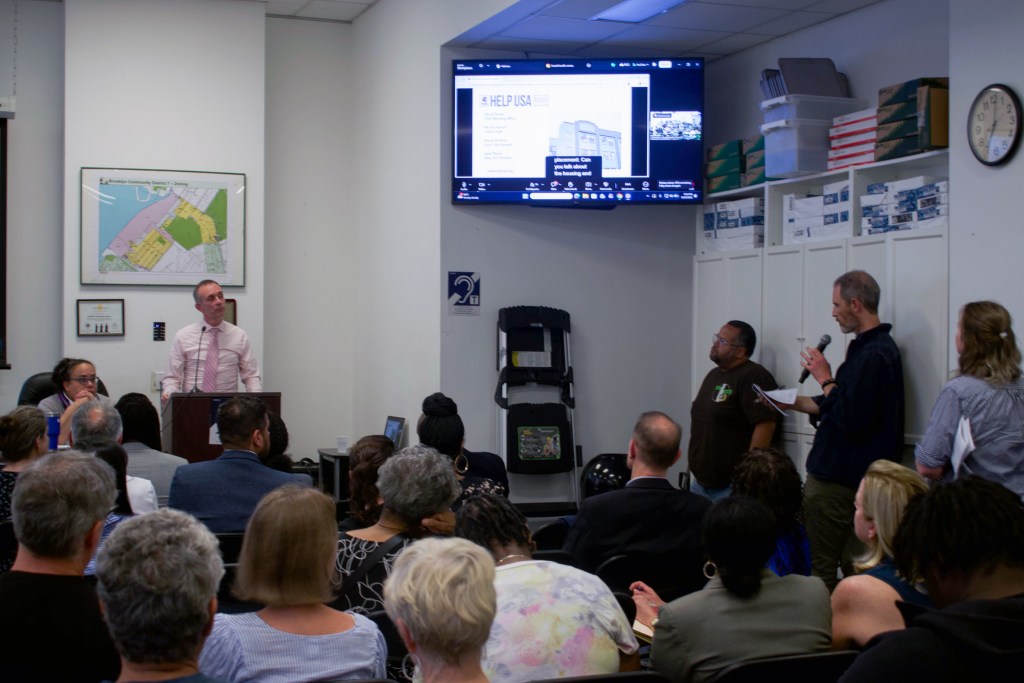
Greenwood Heights residents have been fighting a HELP USA shelter on 25th Street in Brooklyn, June 10, 2026. Credit: Nancy Jiang/The City Reporter
With the addition of HELP Quarterstone, Sunset Park as a whole would be home to at least 11 shelters, according to the lawsuit. The proposed shelter, located near a daycare and the 25th Street R subway station, has prompted public safety concerns from local business owners.
The lawsuits are the latest in a long-running challenge for City Hall and the Department of Homeless Services: Meet the urgent need to get New Yorkers without homes into beds each night, while trying to make sure all of the city’s neighborhoods host some of them.
The Push For Change
At a recent Brooklyn Community Board 7 meeting, Chris Gonzalez, chief strategy officer at DHS, noted a “shift in prioritization” in siting shelters, with a focus on “think[ing] more critically about where we’re putting these facilities.”
That means ensuring “that every community is doing its fair share and has adequate safety net resources to support their neighbors in need,” said Nicholas Jacobelli, deputy press secretary at the Department of Social Services, in a statement to The City Reporter.
“We are proud to report that we have identified a shelter location in every community district, and as these new sites come online, we will be better positioned to change our footprint and phase out the use of sites in oversaturated districts that this administration has inherited,” Jacobelli said.
One of those new shelters is in Bensonhurst, where in March the city pushed ahead with opening a facility — the first in the district — despite fierce opposition from residents, including Councilmember Susan Zhuang, who allegedly bit an NYPD officer at a protest of the facility.
DHS told The City Reporter has notified residents of the last two Council districts without shelters that facilities are coming. They are District 29 in Queens, including Forest Hills, Rego Park, and Kew Gardens, and District 51 on Staten Island’s South Shore.
Meanwhile, the homeless crisis continues — and the city faces enormous pressure to fulfill its “right to shelter” mandate, which requires the city to guarantee emergency housing to homeless individuals.
The number of extremely low-income households has climbed, growing by over 91,000 over the course of the Adams administration, according to the Coalition for the Homeless’s 2026 State of the Homeless report. Eviction filings have jumped from a pandemic low of 42,110 in 2021 to 114,832 in 2025, according to the report.
Last year, 194,531 people cycled through the shelter system — the highest rate in history, according to the report.
“The city, right now, does not have nearly enough shelter beds to get in compliance with the law,” said David Giffen, executive director of the Coalition for the Homeless, speaking of the “right to shelter” mandate.
The result? More shelters will open in places like Greenwood Heights and Sunset Park, where residents feel seriously overburdened — without a legal definition of what that looks like.
The lawsuit, with 14 separate complaints, along with letters of support from Councilmember Alexa Aviles and U.S. Rep. Dan Goldman, claims that the city violates its Fair Share mandate and that the Fair Share analysis used in the shelter’s approval process relies on data more than a decade old.
The “Fair Share” charter, adopted in 1989, mandated the city make a concerted effort to ensure that communities are both getting their fair share of amenities like parks and libraries, and doing their fair share to confront and help solve citywide problems like homelessness. The charter, however, does not define what oversaturation might mean or provide specifications on the number of shelter facilities allowed in a neighborhood.
Reports have shown that a small number of neighborhoods are taking on many more beds than others. A 2023 citywide audit and geospatial analysis by former Comptroller Brad Lander found that three facility types — childcare, fire stations, and police precincts — were generally distributed evenly, but that parks, waste transfer sites, social services, and homeless shelters were not.
“Homeless shelters are heavily concentrated, with some communities taking on 100 times more shelter beds than others, and four community districts having no shelters at all,” said the report.
Often, locations are dictated by developers, who submit proposals to the city based on property value and potential profit, according to Stewart Wurtzel, an attorney who has represented many New Yorkers who have sued over “fair share” cases in the past.
Chris Banks, now a Council member representing Brownsville and East New York, once led the Greater East New York Coalition during a similar “fair share” case.
Banks wanted to expand the required community board notification period for new shelter facilities from 30 days to 120 days, and subject shelter approval to the city’s core review process that incorporates public feedback.
A 2017 push to reform Fair Share by updating its criteria died on the vine and faced pushback from homeless advocates who argued they would encode barriers to build shelters into law, without mechanisms to make it easier to site locations elsewhere.
For now, the residents in Greenwood Heights hope their lawsuit will force the city to reconsider. But their chances are low.
“I think they ultimately will lose the case because … housing is a human right,” said Banks. “Most judges will side with opening up a shelter to provide housing for people who are in need, and they would ignore the interests of the community, who say, ‘We just want notification.’”
In the de Blasio years, many such lawsuits hit the city over new shelters. But none successfully stopped a shelter from opening.
“In every instance, we prevail,” Social Services Commissioner Steve Banks said in 2019. “But litigation does delay.” Banks is now corporation counsel, the city’s top lawyer.
“At the end of the day, the city, the mayor’s office, needs to follow their own rules, right?” said Topal. “That’s our problem with them.”
Theresa Watkinson, the chief operating officer at Baked in Brooklyn, a bakery located down the block from the proposed shelter site, says she has feared for the safety of her 200 employees and her business after a break-in a few years ago, the sexual assault of a former employee last year on her way to the 25th subway station, and repeated instances of tip theft. It’s unclear whether the incidents were related to nearby shelters.
“The question is if we want to move out of state now,” Watkinson said in an interview. “We’re Baked in Brooklyn. It’s sort of like Brooklyn is forcing us out. The city is forcing us out.”
Others, like 43-year-old John Santore, a resident of Sunset Park since 2015, believe compliance with Fair Share is a “legitimate” request, but he thinks the narrative is off-kilter.
“I just don’t think we should frame this entirely in a negative way, like a shelter is inherently bad,” Santore said. “If you’re in a shelter, you’re not necessarily a danger. People who are in shelters have jobs, for example.”
“Nobody did any background check [when I moved here]. Nobody knew anything about me,” he continued. “I just moved onto the block, so we should extend that same courtesy to people who are in a shelter.”
Our nonprofit newsroom relies on donations from readers to sustain our local reporting and keep it free for all New Yorkers. Donate to THE CITY today.
The post Brooklynites Sue Over Shelter Burden as City Hall Vows for ‘Fair Share’ Everywhere appeared first on The City Reporter.
