
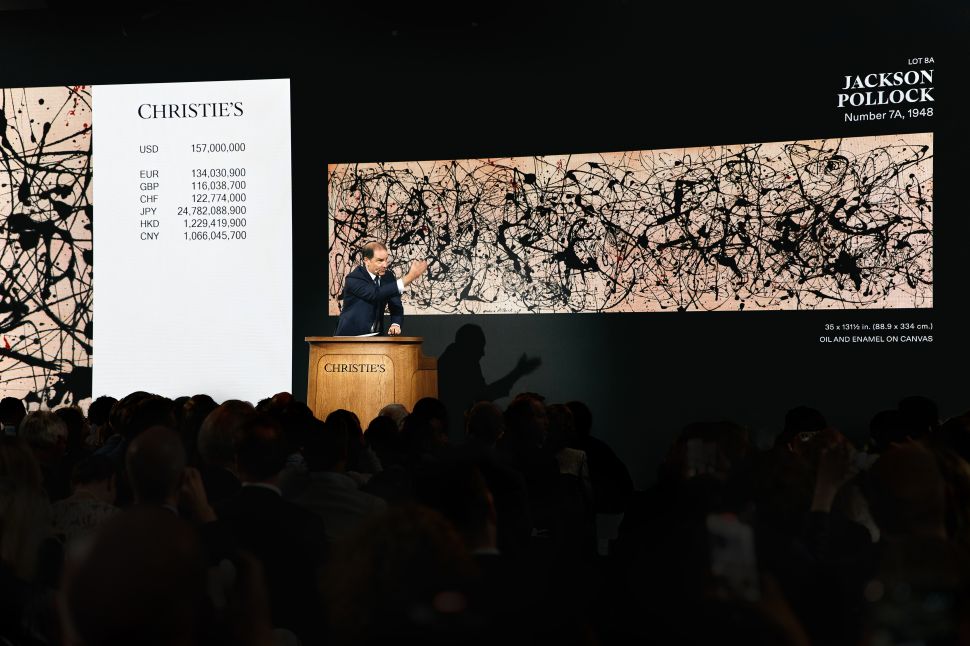
Following the euphoric start of New York’s spring auctions last week with Sotheby’s $433 million result, Christie’s topped $1 billion in a single evening with the historic blockbuster S.I. Newhouse sale and the house’s 20th Century Evening Sale in rapid succession. The night closed with a 97 percent sell-through rate, as deep bidding, prearranged guarantees and irrevocable bids kept the rhythm going over a two-hour marathon session.
Leading the night were three eight-to-nine-figure results, all from media mogul S.I. Newhouse’s art collection. Pollock’s Number 7A (1948) achieved $181.2 million, while Brancusi’s iconic museum-grade Danaïde sold for $107.6 million, both setting records for the artists. Similar Brancusi works are held in the collections of the Philadelphia Museum of Art and the Centre Pompidou, while the monumental 131.5-inch composition was the largest drip painting by Pollock in private hands. The other top lot came from the collection of another defining and legendary patron, Agnes Gund: Mark Rothko’s monumental No. 15 (Two Greens and Red Stripe), which, from a $60 million starting bid, hammered around the same level as the Mnuchin Rothko sold just days before, at $85 million ($98.4 million with fees).
Masterpieces: The Private Collection of S.I. Newhouse
The 16-trophy Masterpieces: The Private Collection of S.I. Newhouse sale achieved $631 million against a presale estimate of $462 million. The results bring the cumulative value of the collection to just over $1 billion with previous sales in 2018, 2019 and 2023 totaling $415.7 million—a cumulative value just short of the late Paul Allen’s $1.7 billion blockbuster result in 2022.
Adrian Meyer kicked off the session with a seminal painting by Picasso, Tête de femme (1907), which, from its starting bid of $4 million, initially seemed to stall around its estimate at $6.5 million. Suddenly, however, bidding reactivated, leading it to a $12 million hammer on the phone with Maria C. Los, deputy chairman and head of client advisory, Americas, closing at $14.4 million after fees, against a $6-8 million estimate. The Picasso bronze sculpture Tête de femme (Fernande) then rapidly climbed from its $28 million starting bid to hammer just above its low estimate at $41 million, or $48.4 million after fees. Homme à la guitare, a signature example of Picasso’s Synthetic Cubism, then rapidly hammered at its low estimate of $35 million, likely to its guarantor, reaching $40.9 million after fees.
After Brancusi’s Danaïde hammered at $93 million ($107.6 million after fees), becoming the second most expensive sculpture sold at auction, an equally iconic Piet Mondrian, Composition with Large Red Plane, Blue, Gray, Black and Yellow, hammered at only $34 million, just shy of its $35-55 million estimate. More heated bidding accompanied Joan Miró’s Portrait de Madame K., previously owned by Max Ernst, which eventually landed at $46 million, or $53.5 million after fees, against its $25-35 million estimate, while Matisse’s vibrant Robe noire et robe violette hammered at $29.5 million ($34 million after fees).
From there, the room moved toward the night’s defining moment: Jackson Pollock’s Number 7A (1948). Opening at $82 million, the work immediately drew multiple phone bidders and went on for over seven minutes, pushing the price upward in steady million-dollar increments as Meyer joyfully declared, “It’s a feast.” The bidding climbed million after million, with Christie’s global president Alex Rotter ultimately taking it to nearly $155 million before the hammer came down at $157 million. Newhouse acquired the masterpiece in 2000 from Alfred Taubman, the former owner of Sotheby’s, for an undisclosed sum. Last night’s result eclipsed the artist’s previous record: $61.2 million for a black drip painting sold at Sotheby’s in 2021 during the Macklowe collection sale.
The momentum continued across the lots more closely tied to the Postwar period. Francis Bacon’s Study for Portrait I (after the Life Mask of William Blake) opened at $2 million and hammered at $4.8 million, comfortably within its $4-6 million estimate, or $5.9 million after fees. Robert Rauschenberg’s Levee followed, hammering at $5.8 million and meeting its estimate with fees, selling for $7.2 million, while Jasper Johns’s Figure 2 hammered just above estimate at $7.2 million, or $8.9 million with fees, on the phone with Christie’s chairman of Europe, Giovanna Bertazzoni. Deeper bidding and more drama accompanied his iconic Gray Target, once in Ileana Sonnabend’s collection: opening at $12 million, it rapidly climbed to $24.5 million against a $20-30 million estimate, selling for $28.8 million after fees. Yet not every Pop lot found the same heat. An additional Jasper Johns work, Alley Oop, previously owned by Rauschenberg and included in the Whitney Museum’s 1974 Pop Art exhibition, sold in the room for a $4.7 million hammer, or $5.8 million after fees, below its $6-8 million estimate. High expectations also accompanied Andy Warhol’s Do It Yourself (Violin): it opened with a chandelier bid at $17 million and eventually hammered in the room for $22 million, or $25.9 million after fees, comfortably meeting its $20-30 million estimate.
The 20th Century Evening Sale
The 20th Century Evening Sale totaled $490.3 million, selling 96 percent by lot and 99 percent by value, led by two of the season’s top consignments: three lots from Agnes Gund’s collection and a Renoir from the Lorinda Payson de Roulet dynasty. The session opened at a more measured pace with two Picassos. Portrait de Jacqueline hammered at $2.3 million, or $2.9 million after fees, while L’atelier found slightly stronger traction, hammering for $5.6 million against a $3-5 million estimate, or $6.9 million after fees.
The Agnes Gund masterpiece group generated a different kind of energy, beginning with Joseph Cornell’s Untitled (Medici Princess), which, from its $2 million starting bid, hammered on the phone with Rotter for $5.6 million, or $6.9 million after fees, against a $3-5 million estimate. That momentum carried into a superb 1961 Cy Twombly, described as one of the finest Roman-period works to come to auction. Opening at $30 million, it initially struggled to build momentum, inching only to $37 million before finally finding its rhythm and landing at a $39 million hammer, just short of its $40 million low estimate but surpassing it after fees, selling for $45.5 million.
The unquestioned centerpiece of the Gund material, however, was Rothko’s epic No. 15 (Two Greens and Red Stripe), which Gund acquired directly from the artist’s studio. Starting at $60 million, the painting drew intense phone bidding to reach an $85 million hammer price ($98.4 million with fees). In total, Agnes Gund’s collection realized $150.8 million.
The top Impressionist and modern material that followed delivered solid but mixed results. While Monet’s Pommiers, Vétheuil more than doubled expectations, hammering at $16.5 million after five minutes of bidding against a $6-8 million estimate, the highly anticipated rare Renoir, La femme aux lilas (Portrait de Nini Lopez), was met with limited bidding. From its starting bid of $15 million, it sold shortly after with Vanessa Fusco on the phone for $24 million, likely to the guarantor, reaching its $25-35 million estimate only after fees.
Then came the last announced but one of the most anticipated lots: Roy Lichtenstein’s 1964 Anxious Girl. Opening at $32 million, the painting ultimately hammered at $39.5 million with Rotter on the phone, just shy of its $40-60 million estimate, before selling for $46 million after fees. The painting was clearly covered by both an irrevocable bid and a third-party guarantee, which likely secured the result.
Across the 48 lots, most of the following works landed within estimate, with a few moments of outperformance and new records later in the sale. One of these was Alice Neel’s Mother and Child (Nancy and Olivia), which, from its modest $1.2-1.5 million estimate, fetched $5.7 million, eclipsing the artist’s previous record of $3 million, also set at Christie’s in 2021. The work had been in the same collection since 1984 and was featured in the artist’s 2021-2022 survey “Alice Neel: People Come First,” which traveled to the Metropolitan Museum of Art in New York, the Guggenheim in Bilbao and the de Young Museum in San Francisco.
Also conservatively estimated at $1.2-1.5 million but then flying much higher was Remedios Varo’s fascinating Energía cósmica (Inspiración), which sold for $4.5 million, setting a new benchmark for a work on paper by the Spanish Surrealist, as access to canvases has become rare amid the current demand for her and Leonora Carrington. Other medium records were set by Henri Matisse’s ink-on-paper Nature morte, fougères et grenades, which achieved $4.8 million, and Maquette for “War of the Future” by Russian Constructivist Aleksandr Rodchenko, which achieved $1.5 million, setting a new record for a work on paper by the artist and becoming his second-highest price at auction.
Among the lots that also surpassed their initial estimates was Agnes Martin’s The Desert, one of the rare early examples of her famed grid paintings from the mid-1960s, which sold for $9.2 million against its $6.5-8.5 million estimate. Warhol’s Botticelli-inspired Venus also fetched $9.1 million against its $5-7 million estimate, as did a group of other Impressionist gems from the Joan Whitney Payson collection, including Pissarro’s Meule et vaches dans le pré à Éragny, soleil couchant, which sold for $4.1 million against a $1.2-1.8 million estimate; Edgar Degas’s Enfants et poneys dans un parc, which sold for $5.4 million against a $1.5-2.5 million estimate; and Childe Hassam’s view of French and American flags, Across the Avenue in Sunlight, June 1918, which fetched $10.4 million against a $6-8 million estimate.
Overall, the evening saw a strong but not runaway result, underscoring the broader tone of the sale: confidence had returned, but bidders were still choosing their battles carefully. While both sales delivered solid results, the big numbers often had astute negotiations and carefully scripted operations behind them, securing the sales but not always yielding extraordinary or entirely surprising results, past the Pollock and Brancusi. “This fierce three-way bidding battle driving the Pollock towards $200 million is something we haven’t witnessed in years,” Philip Hoffman, chairman and founder of The Fine Art Group, told Observer. He reported an excellent evening for their clients at the sale’s close, adding that the result is a clear signal that serious capital remains deeply committed to the very finest works of art. “Tonight reinforced everything we believe about the enduring power of iconic, museum-quality works at the top of the market. When the right work comes to auction with the right conditions, the depth of demand is extraordinary.”
Yet if breakaway prices for trophies by Pollock and Brancusi were not entirely surprising, and the overall results were solid and healthy, some of the quieter masterworks offered tonight realized prices more modest than their quality might have warranted, according to Christopher Gaillard of Gurr Johns told Observer. He pointed in particular to Gustave Caillebotte’s Le Déjeuner, which sold for $8.6 million. “Kept by his family and off the market for over a century, it is as modern a painting as one could wish for, ravishing in its compositional complexity and execution. The buyer has walked away with a prize,” he noted. Gaillard said he would also have expected a touch more for Agnes Gund’s Rothko, which he described as one of the most beautiful paintings offered this season. “With its contemplative palette and quiet power, it appeals to a more nuanced eye than that of a buyer seeking a brighter color combination,” he said.
It’s worth noting that while Sotheby’s previous sale had seen active participation from Asia, Christie’s evening appeared to affirm American buying power, with most lots secured by specialists based in the region. That distinction, however, should perhaps be attributed less to a broader geographic shift than to each house’s different market strengths. Sotheby’s has built a particularly strong presence in Asia for the contemporary and postwar categories, while Christie’s has long consolidated its American and modern market base.
The auction marathon continues today (May 19) with Sotheby’s Modern Evening Auction.
