
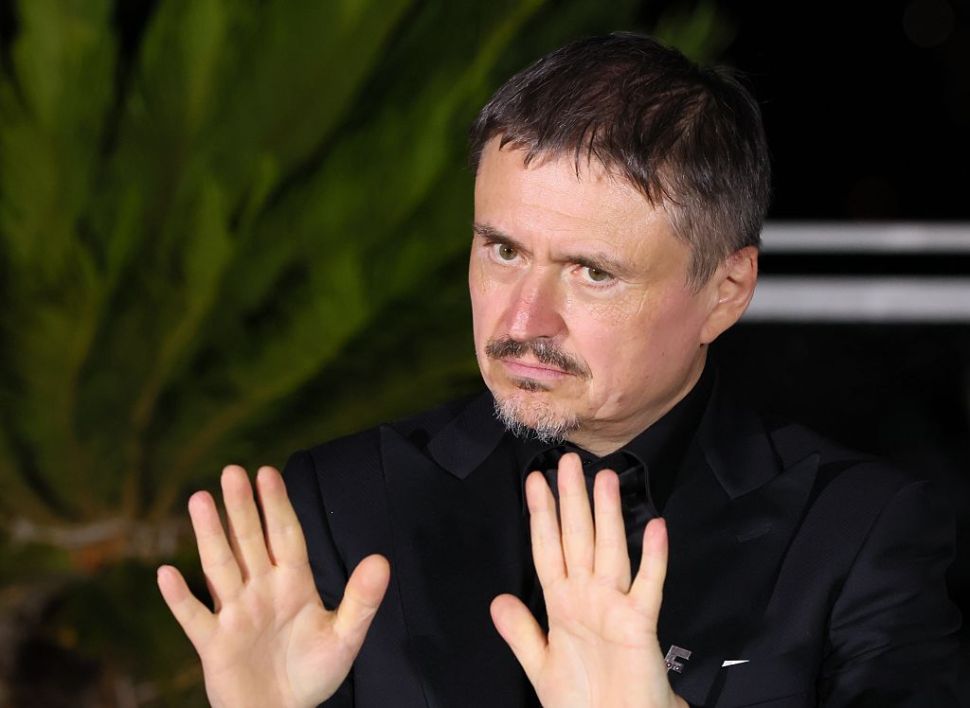
One of the unexpected triumphs of this year’s Cannes Film Festival was Cristian Mungiu’s bracing family drama Fjord winning the Palme d’Or. In a rare feat, the Romanian filmmaker has now won Cannes’ top prize twice. “It’s already wonderful to get one Palme d’Or,” he told French TV network Brut minutes after leaving the awards ceremony. “To get two Palme d’Ors? It’s—I don’t know, a bit of a waste?” He laughed sheepishly. “There are so many wonderful directors who never got it.”
The writer-director earned his first Palme for 2007’s 4 Months, 3 Weeks and 2 Days, a nerve-shredding drama about a young college student’s attempt to get an illegal abortion during the late 1980s, when communist leader Nicolae Ceaușescu still ruled Romania. This latest prize for Fjord elevates Mungiu to a rare club of two-time winners—only nine other filmmakers, including Francis Ford Coppola, have ever achieved it over the festival’s 79-year history.
But even more surprising, in a year where a third of the traditionally left-leaning competition films featured L.G.B.T.Q. characters, Fjord is not a plea for progressive values—it’s a critique of them. Specifically, it’s a portrait of liberal extremism that prides itself on tolerance but is prone to a lockstep dogmatic ideology reminiscent of the totalitarian groupthink that controlled Mungiu’s homeland for decades.
In the film, mixed-nationality parents the Gheorghius—IT consultant husband Mihai (Sebastian Stan) is Romanian, housewife Lisbet (Renata Reinsve) is Norwegian—move with their five children from Romania to a small town in Norway. The religious couple hope to give an idyllic, pastoral upbringing to their Bible-quoting brood (two teenagers, two tweeners and a baby), despite the family’s gradual realization that the community is quietly but staunchly secular.
But when a schoolteacher sees unexplained bruises on one of the children, government agents step in and immediately separate the kids from their mom and dad, putting the minors in foster homes until the local court determines whether or not they are being abused. The forced separation lasts months. And a cloud of suspicion instantly hangs over the now-tainted, instantly “othered” Gheorghius—whose preference for a Romanian “Familia Traditionala” is regarded not as old-fashioned conservative values but as a threat.
Norway’s aggressive government intrusion into family matters might seem melodramatic to the point of incredulity, but is actually rooted in fact. “I read the first articles about such situations some ten years ago,” said Mungiu at the press conference following the film’s premiere. “I finally started documenting them four years ago. I went to Norway and talked to the people involved in those such situations: the police, judges, NGOs, journalists. After ten years of attempts, I wrote, like, three pages before sending the story to Sebastian. And I told him, ‘I think finally we have something that we can do together.’”
Stan, a familiar face in Hollywood for his Marvel movie appearances as Bucky Barnes (aka the Winter Soldier) and Oscar-nominated in 2024 for his turn as Donald Trump in The Apprentice, seems an odd choice to play the lead in a subtitled arthouse film. But the Romanian-born actor has been a longtime fan of Mungiu. “I became aware of Cristian a long time ago,” said Stan at the press conference. “I think the first time we met was when he screened Graduation at the New York Film Festival. I brought my mom!”
That 2016 film, which won Mungiu the award for Best Director at Cannes, follows a doctor who tries to influence his daughter’s final exams and secure her a college scholarship. As is typical in his films, Mungiu uses Graduation to examine how overbearing institutions seed corruption among those in positions of power and detrimentally affect personal lives. In Fjord, the same goes for a Norwegian point of view that bristles at foreigners’ belief systems—especially when they’re right-leaning.
“You’re talking about discrimination, right?” said Stan. “I grew up with a pretty traditional Romanian upbringing. So I kind of understood a lot of what was going on in the script. How are we all dealing with it? I think the only way to do it is just to remain as honest as possible and to think about your own morals and your own values and, and be the example that you want to see in the world.”
Mungiu insisted that Fjord isn’t meant to condemn Norway. If anything, he gives them credit for recently revising some draconian laws to be more humane. “It’s important for me to say that the legislation in Norway has changed in between the moment when I started investigating and the moment when I shot the film,” he said. “This is not a film about a conflict between Romania or Norway or anything like this, or a criticism of Norwegian society. This is way more complex for me and more sophisticated. It’s about the limits of your intimacy and freedom, and what happens when your personal values do not match the values of the society in which you wish to live in this global world.”
American journalists in Cannes were wondering whether a film so sympathetic to religious conservatives would play well in the U.S. or be suffocated by a liberal-leaning press that might feel uncomfortable with the film’s political nuances. This Palme d’Or win now gives Fjord more oxygen to breathe. Further fortifying its place in this fall’s awards-season conversation is its domestic distributor, Neon, which, remarkably enough, has released all of the past six Palme d’Or winners—and led two, Parasite and Anora, to Oscar wins for Best Picture.
“I couldn’t have made the reverse story of this film, about some progressive people living in a traditional society. Because there, you don’t have any rights,” added Mungiu. “You can only do this in a democracy. Freedom means that you can follow your values, even if you live abroad and you live in the middle of a different society.”
