
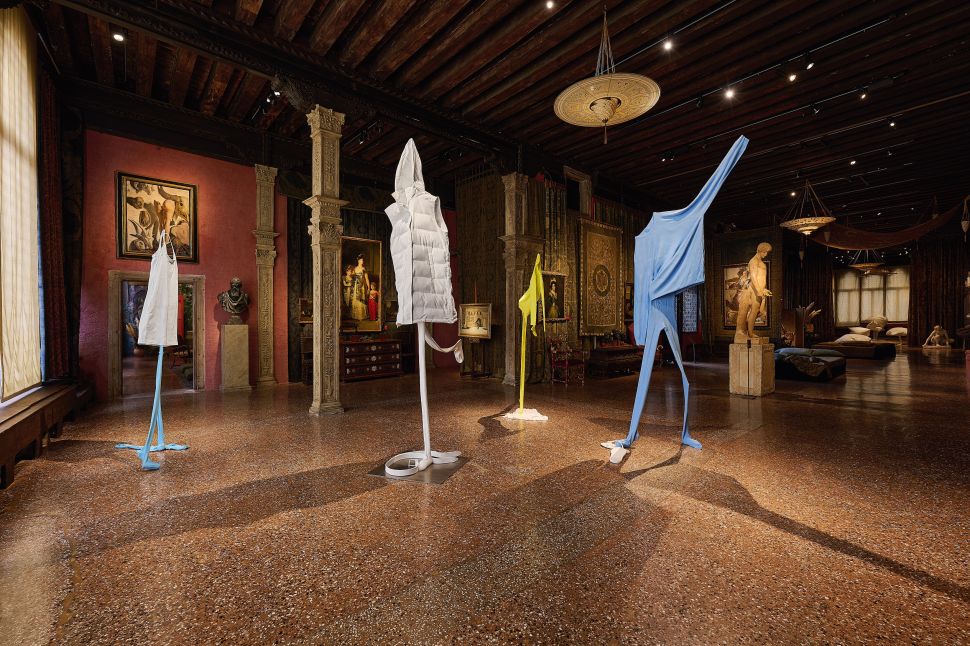
During the Venice Biennale, Austrian artist Erwin Wurm unveiled his latest show, set in the richly eclectic framework of the Fortuny Museum, a Gothic-inspired palazzo transformed by the Spanish-born artist, designer, inventor, stage designer, photographer and textile innovator Mariano Fortuny into a Gesamtkunstwerk, or total work of art.
As one of the city’s most atmospheric and revealing museums, Museo Fortuny offers what could be described as a quintessentially Venetian experience, condensing so many layers of the city into a single place: decadence, craftsmanship, theater, textile culture, cosmopolitanism, collecting and artistic reinvention. Interacting with this layered context, Wurm staged one of the most successful site-specific interventions among all the Biennale’s collateral events, running concurrently with his latest show at Lehmann Maupin in New York, “Double Dream,” on view through June 6.
After the frenzy of the openings, Observer joined Wurm to contemplate the absurdist, playful characters installed around the rooms of Fortuny’s palace and to discuss the central themes of his sculptures: the social body in relation to its surroundings.
Wurm admits to having been immediately drawn to the “madness” of the space itself, its loud mix of tapestries, copies, historical references and decorative elements: “It’s very eclectic. There are great tapestries, great views, but also copies and copies of copies. The way everything comes together creates a strange atmosphere. With my work, I didn’t have to think too much because I immediately felt what would fit here.” His own sculptures, in fact, are ‘substitutes,’ as he describes them. “The people are missing; only the dresses remain. They become dancers, prayers, or whatever you want them to be.”
The new works on display participate in a choreography in the space, dancing and floating as they playfully take over the scene. Fortuny also designed theater stages, and one can feel that theatricality in the architecture, Wurm notes. Yet the space is heavy and dark, so he wanted to create the opposite—something lighter. “That’s why the works expand outward through color and form. These very thin creatures could even resemble birds. It was really about counterbalancing the heaviness and darkness of the architecture.”
Over the years, Wurm has been building his own lexicon of recurring figures. Yet despite what most might assume, his work is not primarily about the body or the role of sculpture in translating its presence. “I’m working on the human entity,” he specifies. “The body, psyche, spirituality—all these things together create something.”
Even when the person is missing, as in the works downstairs, the sculpture still reveals part of a personality, he notes. Wurm’s work is therefore less about sculpture and representation than about the very notion of identity and how people express themselves through clothes, posture and objects. Clothing is especially important to him because it simultaneously defines identity and functions as an empty shell, much like classical sculpture, which appears massive but is often hollow beneath a thin bronze skin. In the Venice show, he plays with this idea, with garments that are already bodies in motion, entering into relation with Fortuny’s own passion for fabrics as cultural statements.
Reflecting on his artistic formation, Wurm recalls how he initially wanted to become a painter but was unexpectedly placed in a sculpture class. “It was a disappointment at first. After six months of frustration, I thought, maybe this is a challenge, maybe I should accept it,” he recalls. “When I was young, the sculptures I saw in public spaces were just monuments covered in pigeon shit. That was my first relationship with sculpture. I had to rediscover it for myself.”
From that point, Wurm began seriously questioning what sculpture is. This investigation led him to think about mass, volume, surface, skin and materiality, eventually resulting in his “One Minute Sculptures,” which became the starting point for his experimental, non-canonical approach to the medium.
Pushing against any traditional notion of fixed form and extending sculpture into the performative and living realm, Wurm used these works to provide viewers with instructions for actions or poses to be performed with ordinary objects. Ephemeral by nature, they functioned as living performances, allowing him to challenge the formal boundaries of visual language and blur the distinctions between art and everyday life, viewer and participant, performance and monument.
Once we consider these early works, it becomes clear how, at the center of his practice, there is an abiding interest in how sculpture can relate to society and everyday life. “We all live inside specific social structures. I grew up in Austria in the 1950s and ’60s, and I started asking myself how sculpture could address society,” he states. “For example, when we eat, gain weight or lose weight, we’re already performing sculptural actions, changing volume and changing content.” Starting from these observations, he began connecting sculpture to social behaviors, identity, status and cultural conventions. Clothing, in particular, fascinated him as an empty form that cannot stand on its own, yet one through which we define ourselves. “We communicate social status, coolness and identity. Cars do the same thing. Houses do the same thing. These objects and themes form my universe—our universe.”
Wurm connected this interest directly to his fascination with modern architecture, which he described as inherently sculptural because of its use of cubes, volumes and plastic forms. “Look at Frank Lloyd Wright; these architects are working with cubes and volumes almost like sculptors,” he argues.
“When I first created Fat House, I wanted to transform a Viennese house into a sculpture. The house already had a “face”—windows, balcony, entrance. But when I enlarged it, it became something else entirely. It looked like an inflatable castle for children. So I destroyed it and started over.”
Humor has always been a central tool in Wurm’s practice, shaping not only his visual imagination but also the philosophical, psychological and social questions it raises, beginning with the conventions it can dismantle. “Destruction can generate new ideas,” he says. “When I enlarge or melt down houses and cars, I destroy conventions and create something new.” From this comes the Play-Doh-like, playful and almost cartoonish quality of his sculptures. “Distortion is funny. Making something huge or melting it down destabilizes the form and changes our perception of it.”
There is clearly a connection to psychoanalysis and Austrian intellectual history—Freud, Wittgenstein, Viennese Actionism—as Wurm himself acknowledges. From this also emerge the more subconsciously born symbolic presences of The Dreamers, which appear at Fortuny, surrounded by Persian pillows, as much as in the white-cube space of his concurrent show at Lehmann Maupin in New York.
“Absurdity plays an important role in my work,” Wurm acknowledges. “I’m very connected to the theater of the absurd because absurdity allows us to see things differently. If we look at the same chair every day, eventually we stop seeing it. But if we shift perspective and look at it through absurdity or paradox, suddenly the social conventions behind it become visible.”
Everyday actions such as standing still, brushing one’s teeth or combing one’s hair can become sculptural if transformed through framing, duration, pressure or slowed movement. In this sense, his whimsical sculptures also operate as a critique of contemporary society and the performative logic of capitalism, revealing how systems of value and power shape our desires, behaviors and identities, turning our own bodies into passive sculptural forms molded by social pressure.
In fact, Wurm’s starting point is psychological, anthropological and an observation of human behavior. “A lot of my process is intuitive at first: very instinctive, from the gut,” he says. “Afterward, it becomes intellectual because I want to connect the work to the world. So it’s always both: intuition and reflection. And it’s a long process.”
It is through this societal and sociological dimension of his practice that Wurm eventually came to engage with photography, which became an important medium for documenting and circulating these works. “I realized that magazines and media themselves are a form of public space,” he argues. By publishing staged images in art and fashion magazines, he asserted authorship while also extending sculpture into the ‘public space’ of media.
Although Wurm later also experimented with painting, including “flat sculptures,” he ultimately felt that the medium belongs to a different historical and conceptual territory. Similarly, while photography became central to his practice, he always approached photographs as sculptures rather than purely photographic works. Color, by contrast, remained essential. Wurm describes his use of paint and color as a continuation of his original desire to become a painter, noting that many works exist somewhere between painting and sculpture, as if pigments expand into space.
When asked where he sees his practice heading next, he admits he never wants to rely on a single successful idea: “One good idea is never enough for an artist’s life. I’m constantly searching for new ideas within my universe. I never know exactly where things will lead, but that uncertainty is exciting.” Observation remains fundamental to his process: he constantly watches the world around him, studying behaviors, environments and social structures. While he acknowledged using Instagram as a tool, he expressed skepticism toward algorithms and digital addiction, insisting that his real work comes from seeing and observing directly. “Yesterday we were having a dinner with Peter Marino, who said, ‘I’m not a food guy, I’m an eye guy and an ear guy.’ I feel exactly the same. Watching and seeing, that’s my work.”
Toward the end of our conversation, Wurm also shared some reflections on his relationship with audiences. He does not enjoy watching viewers move through exhibitions, as we were doing. The show had just opened to the public and was packed, but rather than expecting a specific reaction, he simply feels grateful when people engage with the work, understand it or choose to live with it.
