
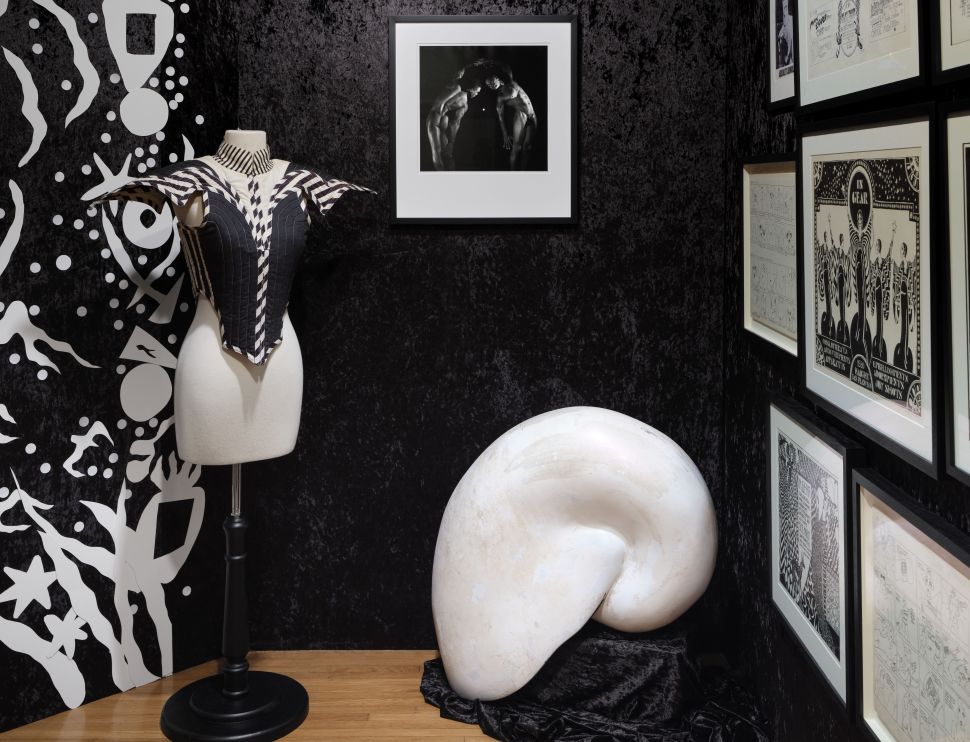
Although still the preferred mode for art display, with its neutrality, distance and clinical clarity, the white cube increasingly feels out of step with work rooted in memory, identity and everyday social reality. Exhibitions are moving out of controlled interiors and into spaces that feel lived-in, unstable, even charged, marking a turn toward immersive, site-responsive environments staged in domestic, commercial and liminal settings. These are exhibitions you don’t just view—you enter, inhabit and ideally get folded into.
This shift is driven partly by material pressures: gallery closures, shrinking budgets and spatial limits. But it is also conceptual, shaped by what I would call an “authenticity urge.” Abandoned storefronts, private homes, architectural landmarks, motels and repurposed theaters carry embedded texture and narrative. These are the pre-social media worlds where we would gather and be, and they resist neutrality. Where context stops functioning as backdrop and becomes material. With NY Art Week on the horizon, there was a foreshadowing here from L.A. Art Week.
At a shuttered 99 Cents Only store, The Hole and Barry McGee turned retail excess into exhibition logic, stacking works across dusty shelves until browsing became choreography and accumulation became form. At Hollyhock House, Ryan Preciado, working with Karma Gallery, activated Frank Lloyd Wright’s landmark as a lived experience, with visitors rhythmically guided through the architecture and sculptural forms. And at the Julia Stoschek Foundation, a gutted theater became a cinematic labyrinth, collapsing moving image, installation and even popcorn into embodied spectatorship.
If these projects sketch a broader shift, Del Vaz Projects, a collaborative team led by Jay Ezra Nayssan, pushes it further toward something more immersive, excessive and emotionally charged. Their practice moves fluidly across exhibition-making, performance and publication, collapsing distinctions into a total environment. Their “dedication to queer artists” is not a mission statement but a method: it structures how space is organized, how people gather and how meaning accumulates.
This approach is fully visible in “Steven Arnold: Cocktails in Heaven” (on through June 6) which treats exhibition-making as a vacillation between meticulous scholarship and spiritual conjuring. The exhibition premiered with a VIP opening co-sponsored by Frieze and co-hosted by Karen Hillenburg and Christine Messineo. The guest list was, quite literally, spectacular: rendered as eight-foot-long calligraphed scrolls, carried by Louis XIV-style attendants in Arnold-painted coats and powdered wigs, who checked off names with panache and oversized quills. The opening was not just an art-world event but a world-building exercise. “It turned into a séance, where [Steven] came to us,” Nayssan remarked. Consistent with Del Vaz’s practice, the project sits between raw sincerity and theatrical, joyful flourishings, which is precisely the point. The opening made visible the deeper commitment to scholarship and world-making that structures Del Vaz.
At the center of the exhibition is a recreation of Zanzabar, Arnold’s former home and studio, remembered as a space of “world-building and genre-bending.” It functioned as home, salon, stage and social organism. Rather than reconstructing it literally, artist Orrin Whalen was commissioned to create an “experimental social container,” a structure grounded in meticulous research but open to instability. Showcasing not only Arnold’s multi-dimensional practice, the show also highlights his artistic community with works by R.A.L. West, Kaisik Wong and Alex & Lee. The goal is atmosphere over replication: a reactivation of a psychic and social field.
At the opening, that atmosphere became dense and tangible. Lighting, spatial choreography and archival material combined into something like the psychic architecture of Arnold’s practice. A long banquet table doubled as altar and stage. Oversized goblets of Ruinart Champagne refracted light across the courtyard. The menu drifted between high and low registers: pigs in a blanket, oysters, Middle Eastern delicacies and Marie Callender-inspired fare. Incense that once burned in Arnold’s studio perfumed the air. Taste, scent and touch were not supplementary but structural.
Nayssan describes Arnold’s practice as a “flattening of aesthetics,” where “multiple visual aesthetics, references, tropes, [and] styles collapse onto one another.” Arnold’s art is not to be simply viewed, but lived and experienced in the context of his multi-layered decadence, East meets West, embracing “pastiche aesthetic.” It is, he notes, both “serious and calculated” and full of “humor and playfulness.” Nothing resolves cleanly; meaning accumulates through excess and contradiction. The exhibition is an invitation to be part of an expansive stage where “every fleck of glitter was accounted for.”
Performance extends this logic. Artists working from archival material were encouraged not to reenact but to reanimate. Tyler Matthew Oyer choreographed figures drawn from Arnold’s parties: a head-to-toe white living statue of David, bodies painted gold and silver shifting between stillness and movement, and a reclining Adonis anchoring the banquet scene in decadent suspension.
“The literal and metaphorical came together,” Nayssan said, as the night unfolded into something closer to a living archive than a reenactment. Arnold’s own description of his studio functions as instruction: “more like Barnum & Bailey fucks Louis the Fourteenth, in drag… it has nothing to do with status and everything to do with faking it, with theater.”
Sound also shapes the environment. A DJ set by Victor Rodriguez wove through the evening, reinforcing the sense that this is as much social choreography as visual composition.
Importantly, the project does not end with one surrealist bacchanalian night. Nude drawing sessions, Steven Arnold’s Sex & Spirit Symposium on April 25 and a powerful publication extend the exhibition into intellectual and communal space, unfolding Arnold’s practice across performance, mysticism and domestic ritual. Participation becomes central: guests do not just attend, they complete the work through presence.
This is where the broader shift becomes clear. The viewer is no longer outside the work, observing from a sterile distance. They are folded into its logic, timing and atmosphere. Spectatorship is not singular, but becomes shared in conjunction with an artist’s work, their spirit and their community.
There are echoes here of earlier experiments, particularly the happenings of the 1960s and 1970s, when artists dissolved boundaries between art and life in domestic and improvised settings. What feels different now is how fully these strategies have been absorbed into formal curated exhibition-making itself. The exhibition is no longer just a container; it is a medium for lived art experience.
Across these projects, immersion is not simply spectacle. It is relational, affective and often unstable. Or, as Nayssan puts it, it “reminds people what is possible when one collaborates, when distinctions and walls are brought down… and when you are not afraid to muck it up.” The white cube, by comparison, begins to read less as default and more as one option among many: controlled, legible, but no longer the only stage in town. Increasingly, the question is not how to display art, but how to build a world around it—and who is invited to inhabit it.
