
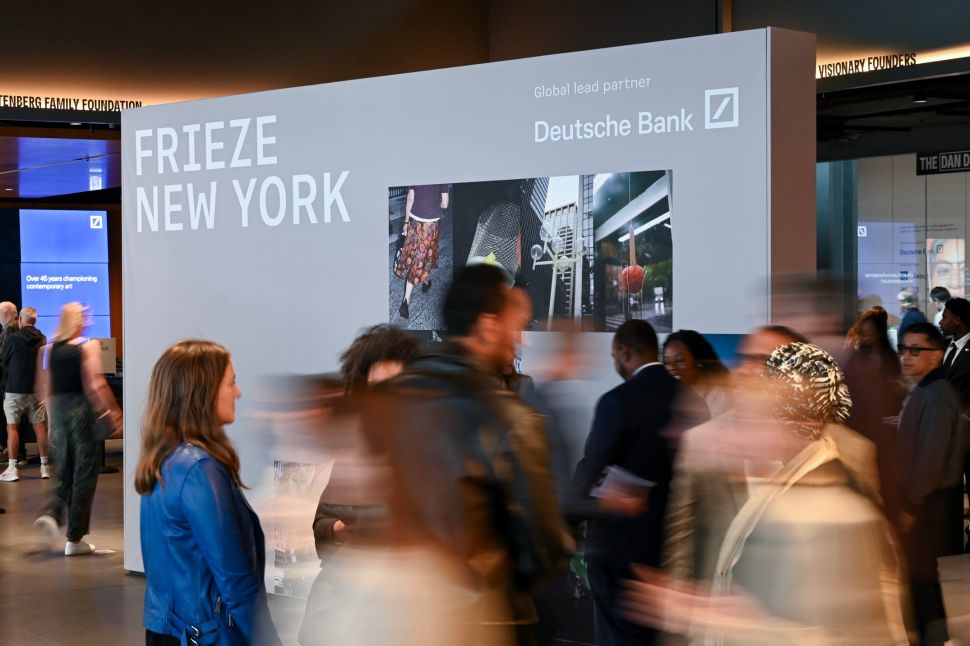
Frieze New York opened yesterday (May 13), part of an expanding ecosystem of more than six fairs taking place across the city and heralding the May auctions, which are expected to bring in more than $1 billion between this week and next. It’s a grueling test of endurance for art enthusiasts, but even more so for the art market. When Observer spoke with the fair’s director, Christine Messineo, ahead of the opening, she was optimistic that the growing constellation of fairs around Frieze would amplify, rather than diminish, its impact. New York, she said, is such a large, geographically complex city that there is plenty of room for other fairs: “We all have different visions, we encounter different audiences, and we have different galleries participating. I think it all supports a larger ecosystem around culture and art in the city.”
Returning to the Shed in the heart of Chelsea, Frieze is hosting 67 exhibiting galleries from 26 countries, with a strong presence from South America, particularly Brazil, alongside international blue-chip names and both returning and debuting New York galleries. The floor was crowded from the early hours, with most VIPs appearing to be American, with some visitors from South America and Asia but almost none from Europe. Dealers reported first-day sales across lower, middle and seven-digit price points, though the rhythm this year is far from bombastic. Perhaps due to the convergence of multiple biennials and general market recalibration, buyers seemed more attuned to artists with true institutional profiles, real support, actual CVs and established names.
Among the blue-chip galleries on the main floor, Gagosian reported a successful opening day, selling works by multiple artists across its roster, including Derrick Adams, Helen Frankenthaler, Gerhard Richter, Adriana Varejão, Stanley Whitney and Francesca Woodman. Meanwhile, Hauser & Wirth staged an all-woman booth featuring seven artists whose work has challenged and reshaped the terms of representation, embodiment and subjectivity in contemporary art. Anchored by a full sequence of Cindy Sherman’s Untitled Film Stills addressing stereotypes in female media representation, the booth also had works by Nairy Baghramian, Louise Bourgeois, Lee Bul, Jenny Holzer and Avery Singer, as well as more meditative, deep-blue pieces by Lorna Simpson in conjunction with her current show at Punta della Dogana, one of the highlights for anyone in Venice last week.
David Zwirner booth at Frieze New York shows large colorful abstract paintings installed around a seating area.” width=”970″ height=”647″ data-caption=’David Zwirner at Frieze New York. <span class=”lazyload media-credit”>Image by Casey Kelbaugh/CKA. Courtesy of FRIEZE</span>’>
Both David Zwirner and Pace opted for tightly focused presentations this year. Zwirner presented a solo booth of Joe Bradley’s expansive abstractions, while Pace staged a conversation between Maya Lin and Leo Villareal, both of whom are preparing to unveil new public art commissions in the U.S. this year. Part of Villareal’s Golden Game series, recently shown in Tokyo, the work created the illusion of depth and space through light and was paired with a new silver sculpture by Lin. Most works, priced between $110,000 and $160,000, had sold by the end of the first VIP day. Meanwhile, White Cube sold multiple pieces, including two works by El Anatsui, an Antony Gormley for £450,000 and a beautiful abstract constellation by Howardena Pindell, Deep Space #4 (2025), for $275,000. Other female artists with solid markets and institutional CVs also found early buyers, including a new painting by Marina Rheingantz, which sold for $250,000; a new sculpture by Marguerite Humeau, priced at £60,000; Louise Giovanelli’s Kohl (2025), which sold for £38,000; and a work on paper by Julie Curtiss, which sold for $35,000. Also in the booth were spiritually charged, labyrinthine cartographies connecting micro and macrocosmos by Shipibo artist Sara Flores, fresh from the unveiling of her Peru Pavilion in Venice; her painting Untitled (Maya Kené, 2021) sold for $65,000.
Perrotin’s booth features a solo presentation of work by Genesis Belanger, whose surreal, fantastical world of objects and eerily animate presences comes to life ahead of her first public exhibition with Public Art Fund, opening June 2 in City Hall Park. This new work explores Belanger’s interest in humanity’s increasingly distant relationship with nature. “As a society, we are progressing quickly in the direction of Artificial Intelligence, so there has become a prevailing nostalgia for these symbols of outdated technology,” the gallery’s senior director, Valentine Blondel, told Observer. “On the other hand, the impulse to use nature to adorn our spaces through textiles and art becomes more essential, which Genesis references in her geometric mosaics and the metal tree Eclipse, which will also be on view in City Hall Park.” The booth also has new works by gallery mainstays Daniel Arsham, Jean-Michel Othoniel and Bernard Frize. On the top floor, Almine Rech is showing a poetic work by modern artist Marie Laurencin alongside contemporary figures Dustin Yellin and Keita Morimoto. Managing partner Paul de Froment said the gallery had an exceptional response on the first day, reporting multiple early sales led by the placement of a significant James Turrell light piece at around $900,000-1,000,000.
Kelly Sinnapah Mary.” width=”970″ height=”693″ data-caption=’James Cohan at Frieze New York. <span class=”lazyload media-credit”>Photo: Silvia Ros</span>’>
Among the standout booths on the main floor was, once again, James Cohan, with a full presentation of work by artist Kelly Sinnapah Mary. Rooted in the Caribbean archipelago of Guadeloupe and in the artist’s evolving understanding of her ancestry, her paintings, sculptures and installations draw together folklore, literature, inheritance, colonial history and the natural world. Moving between intimate and epic formats, Sinnapah Mary builds lush, teeming compositions where floral and human life, fantasy, science fiction and archetype intertwine, challenging the colonial hierarchies that separated the human, animal and natural worlds. Through this rich exercise in mythmaking, personal and ancestral memory become inseparable from the landscape itself, achieving a universality that feels especially resonant today in its exploration of diaspora, kinship and the human body’s relation to a disrupted ecosystem. With prices ranging from $20,000 to $95,000, the gallery sold seven works on the preview day. Nearby, Alexander Gray’s booth leaned into artists with serious institutional traction, presenting new abstract works by Kamrooz Aram, currently on view at the Whitney Biennial, alongside Ronny Quevedo’s multimedia works, which revisit pre- and post-colonial iconographies and Indigenous languages of abstraction, and Bethany Collins’s new paper sculptures, continuing her incisive examination of race, language, power and histories of violence. Miguel Abreu’s booth also presents a dialogue between R.H. Quaytman and Rochelle Goldberg, ahead of a major presentation at Unlimited in Basel.
A few ambitious works added a sound component to the main floor this year, including David Shrigley’s giant gong sculpture, which rang out through the fair at intervals. Presented by Anton Kern, it sold on the first day. Nearby, a small black drum hangs suspended in Esther Schipper’s booth, anchored by one of Anicka Yi’s fascinatingly alien Radiolaria kinetic sculptures and accompanied by new works by Korean artist Lee Bae, whom the gallery began representing last year. Monochromatic charcoal paintings and sculptures by Bae also took center stage in Johyun Gallery’s booth, where they were paired with works by Kim Taek Sang, Hwang Jihae and Kishio Suga in a dialogue highlighting distinct approaches to painterly experimentation and materiality. By evening, the Lee Baes had sold out entirely, with prices between $100,000 and $250,000, with two works by Kim Taek Sang ($10,000-20,000) and one by Kishio Suga ($40,000-50,000).
Another leading Korean gallery, Kukje, brought together both historical Dansaekhwa and more contemporary positions, moving from the disciplined materiality of Korean modernism to artists such as Haegue Yang and Michael Joo, who is also in the current Biennial. By the evening, the gallery had sold two works by Ha Chong-Hyun, in the ranges of $390,000-468,000 and $10,000-12,000; a work on canvas by Kibong Rhee in the range of $90,000-108,000; and a work by Kyungah Ham also in the range of $90,000-108,000. International artists also found buyers, with a colorful sculpture by Ugo Rondinone acquired in the range of $90,000-108,000, a mosaic work by Julian Opie in the range of £45,000-54,000 and a Jean-Michel Othoniel sculpture in the range of KRW 5.5-6.6 million. Tina Kim Gallery also staged a cross-generational Korean presentation, moving from Lee ShinJa’s textiles to Suki Seokyeong Kang, Kim Tschang-Yeul and Ha Chong-Hyun, alongside younger and more adjacent positions such as Maia Ruth Lee, Pio Abad, Davide Balliano, Jane Yang D’Haene and Livien Yin. Sales reflected that range of historical depth and contemporary reach, with the gallery placing a painting by Ha Chong-Hyun for $180,000; a painting by Kim Tschang-Yeul for $120,000-140,000; a painting by Maia Ruth Lee for $70,000-80,000; a textile work by Lee ShinJa for $40,000-50,000; a multimedia sculpture by Suki Seokyeong Kang for $40,000; a painting by Davide Balliano for $32,000; a work on paper by Pio Abad for $20,000-30,000; a ceramic sculpture by Jane Yang D’Haene for $20,000-30,000 and a painting by Livien Yin for $20,000-25,000.
Moving up from its placement last year in the Focus section, Korean gallery G Gallery debuted in the main section with Rachel Youn’s moving kinetic floral sculptures and works by Citra Sasmita, Hwang Sueyon and Maryanto. Several sculptures by Youn found early buyers, as the artist has also just opened a solo presentation in Venice at Scuola Piccola Zattere, presenting the results of her research and production residency. After opening a space in the city, South African gallery Southern Guild returns to Frieze New York for the second consecutive year, bringing together artists working across sculpture, painting, ceramics, installation and photography and reporting several sales in the $20,000-38,000 range, including four print works by Lebohang Kganye, two works by Amine El Gotaibi, two oil-on-canvas works by Mmangaliso Nzuza, a work by Patrick Bongoy and a work by Usha Seejarim.
An absolute must-see in the Galleries section, as ever, is Andrew Edlin‘s booth, which offers some of the most refreshing outsider perspectives at the fair. Standing out are the mysterious astronomical diagrams and cosmological codes by Karla Knight, whose invented languages and satellite-like forms imagine systems of knowledge from elsewhere. Building her own linguistic system of glyphs, diagrams, orbs, satellites and cosmic structures, she creates a visual language hovering between an occult manuscript, a scientific chart, a children’s code and an extraterrestrial transmission. Her paintings and tapestry-like works are priced at $30,000-50,000, including one recently shown at SITE Santa Fe International in a presentation curated by Cecilia Alemani. Resonating with them is the delightfully mysterious storytelling of human-alien encounters in paintings by cartoonist and author Esther Pearl Watson, capturing both the neo-mythologies and vernacular melodrama of American life.
This year, the fair saw a particularly strong concentration of galleries from Latin America, selected after welcoming new gallery committee members from the region: Fátima González of Campeche and Omayra Alvarado of Instituto de Visión. Among them, Mexico City and New York-based kurimanzutto delivered its usual institutional-grade presentation, anchored by a new Rirkrit Tiravanija installation with mussels and John Giorno’s Dial-A-Poem. Mexican gallery OMR also stood out with a vibrant booth anchored by Into the Wild, an enveloping new series of saturated-toned paintings by Pia Camil, in dialogue with a selection of nature-inspired sculptures that includes Claudia Comte’s iconic wood cactus and Tony Matelli’s fragile bronze casts of weeds. After traversing different media and pictorial languages, Camil returns to a surreal, symbolically charged figuration with a series inspired by the regenerative presence of the forest outside her home.
Currently living surrounded by forest, Camil works from direct observation of her surroundings—especially the Guembas, the plantain trees around her home that become symbols of life and regeneration. Across eight paintings moving from dawn to dusk, Into the Wild traces cyclical time and the artist’s daily collaboration with these regenerative plants, understood in syntropic agriculture as a kind of mother tree. Her wild, feminine figures emerge from highly detailed forests, posing with confidence among the flora yet resisting easy objectification by the male gaze. Desire is present but not performed for possession; it unfolds through gesture, proximity and rhythm as bodies inhabit a symbiotic relation with their environment. Priced at $45,000 each, several of Camil’s paintings sold on the first day.
From Colombia, Mor Charpentier presents a stunning new charcoal and embroidery work on unstretched canvas by Nohemí Pérez, from her Abismo series. Here, the seascape is no longer contemplative but a field of crisis and ethical tension: agitated waves occupy nearly the entire surface while small, barely visible human figures dissolve into the vastness. Emerging from the humanitarian crisis of oceanic migration routes, the work also becomes an ecological meditation on human fragility before nature’s immensity. Also in the booth were the dreamy, thickly impastoed paintings of Syrian artist Anas Albraehe, in which bodies dissolve into sleep and surrender to oneiric gravity, resting on clouds that promise a serene refuge amid the uncertainty of our times. More Brazilian galleries are participating this year, reinforcing the fair’s leading role in the Americas. Among them, A Gentil Carioca opted for a red-themed booth featuring Brazilian artists, inspired by the color’s symbolism of power, war, sacredness, desire and transformation. Saturated, physical and insistently alive, the booth combined works by artists including Agrade Camíz, Ana Silva, Arjan Martins, Denilson Baniwa, Laura Lima, Marcela Cantuária, Miguel Afa and Pascale Marthine Tayou into a chromatic environment where color became atmosphere, politics and pulse at once.
Brazilian gallery Mendes Wood DM also reported strong sales on the first day, with works by artists including Sonia Gomes, Mimi Lauter, Paulo Nimer Pjota and Pol Taburet, and only one work remaining in its booth by the end of the day. At its fourth participation at Frieze, São Paulo-based Mitre Galeria has been promoted to the Galleries section, showing some of its most promising painters—Pedro Neves and Diego Mouro—alongside already institutionally recognized artists, including Luana Vitra with her alchemical sculptural universe, who returns to the fair after winning last year’s Focus section. Centered on the theme “Bodies-Territory: Essays of Tomorrow,” the 12 Brazilian artists presented engage with political, social, historical and environmental urgencies as living material to be reimagined and transformed. By the end of the day, the gallery had sold nine works across media, priced between $5,000 and $36,000. “We were especially happy that, already on the first day of the fair, we placed nine works in important U.S. collections, something that speaks not only to the strength of the artists, but also to the resonance of these conversations beyond Brazil,” sales director Flavia Cardoso told Observer, describing their participation as a valuable opportunity to share a deeply contemporary Brazilian perspective with a wider international audience.
Another Brazilian gallery, Vermelho, presented a rich group booth of South American artists, including Carlos Motta, whose drawings anticipate sculptures from The Air of Life, made in collaboration with Amazonian artist Higinio Bautista and currently included in his mid-career survey at OK Linz. Inspired by legends of shamans who take animal form to protect their people and their lands, the powerful tiger drawing on view opens onto a cosmology of transformation and guardianship. Also in the booth are Tania Candiani’s embroidered Root Systems, which turn the hidden architectures of plant ecosystems into tactile cartographies, alongside works by André Komatsu, Edgar de Souza, Iván Argote and Ximena Garrido-Lecca, whose bronze tapestry crystallizes endangered immaterial knowledge into resistant material. At the center is Carmela Gross’s pioneering digital work Luminous Fountains, first presented in 1983 at the 17th São Paulo Biennial, where the artist was experimenting with videotext systems and graphic-electronic language at an early intersection of contemporary art, telecommunications and computing. Nearby, Colombian gallery Instituto de Visión has built a booth around ecological, Indigenous and cosmological thinking, anchored by already institutionalized artists such as Tania Candiani, a window-like nature piece by Pia Camil and a work by Indigenous artist Aycoobo Wilson Rodríguez. Also attracting immediate interest was Carolina Caycedo’s net work Cosmotarraya, currently included in the Venice Biennale. “We had an energetic start, and we ended the first day on a high note,” the gallery’s co-founder, Beatriz López, told Observer.
As usual, the Focus section is the place for discoveries. Winning the prize this year, W Galería presents Seba Calfuqueo, an artist who has become a recurring presence at biennials, having appeared in both the 2024 Venice Biennale and the 2024 Whitney Biennial. Drawing from the pre-Columbian history of the Mapuche people, her work engages directly with colonialism, environmentalism and gender identity, exploring how colonial regimes of extractivism and oppression not only erased entire systems of knowledge but also reshaped notions of identity. Her seductive monolithic sculptures activate Indigenous knowledge and ritual power through the alchemical nature of ceramics and the embodied presence of hair, a material the artist has previously linked to Mapuche cosmovision and the possibility of eluding binary systems. Prices range from $8,000 to $40,000.
Among the galleries debuting at Frieze this year is Sargent’s Daughters, with a solo presentation of Mexico City-based Yeni Mao, whose works also stood out in the Focus section, all priced between $8,000 and $15,000. The booth introduces the artist’s charged sculptural language as an exercise in embodiment and disembodiment, casting and recasting body and infrastructure, where bodily memory, architectural tension and material transformation fold into one another. Mao’s work carries the residue of structure and ritual simultaneously, turning fragments, supports and forms into objects that feel both excavated and newly weaponized, suspended between personal mythology and a broader language of displacement, protection and pressure, and the presentation precedes the artist’s solo exhibition at Museo Anahuacalli in Mexico City coming in autumn 2026.
Also debuting at Frieze, Campeche presents a solo showing of Mexican artist Abraham González Pacheco, whose works draw on archaeology, historiography and Indigenous narratives to distort official histories and foreground the sectors rendered invisible by cultural hegemony. Made with natural pigments, graphite and concrete, the works feel fossilized through accumulation, as if each surface were holding traces of stories still resisting erasure. Memory and ancestral traces operate here as poetic gestures, opening onto the gray areas where facts overflow at the edges of the collective and individual mind. Interested in the voids between the imperfect fragments that compose established narratives, González Pacheco suggests tools for excavating the collective imaginary and finding possible futures in its ruins. Also featured in the just-opened Carnegie International, his works are priced between $8,000 and $15,000.
Buenos Aires gallery Isla Flotante debuts in Focus with Rosario Zorraquín’s liquefied paintings, in which evocations of bodily movement and intra-human contact dissolve into one another through watermarks, soft stains and sketch-like narratives. Occupying a fluid space between figuration, intimate storytelling and healing, the works expand through the booth via their transparent surfaces. Prices range from $6,000 to $20,000. Working to reinforce its institutional threads, Frieze also secured this year the support of the Sherman Family Foundation, which has committed to a five-year acquisition initiative dedicated to the Focus section. Providing $50,000 annually, the fund supports two acquisitions at $20,000 each, with an additional unrestricted $5,000 award directed to each selected artist for production and studio support. “What’s important is that part of the funding goes directly to the artist—not just the acquisition but also production or studio support. It’s about investing in future careers,” Messineo told Observer. Through the fund, the Brooklyn Museum acquired two works by Bettina from Ulrik: Traffic Patterns, from the series Phenomenological New York. (The artist award will be presented posthumously in support of the documentation and preservation of her work) Additionally, the Baltimore Museum of Art acquired three works: Reika Takebayashi’s Both Banks I from Public Gallery, Seba Calfuqueo’s PILLAN SIKILL 1 from W Galería and Joanne Burke’s Festival 7 from Soft Opening. Each artist will receive an unrestricted $5,000 award.
The New York Art Week endurance test continues today, with Independent and TEFAF opening next. Stay tuned.
