
Growing up in Canada, there was a piece of travel advice you’d hear before almost any trip abroad: sew the maple leaf flag onto your backpack. It was a way to signal who you were, and just as importantly, who you weren’t. Sometimes, you’d see Americans do the same. It was an early lesson in the power of symbols. They carry meaning, and that meaning can be easily borrowed. That very tactic has long been used by the world’s biggest sporting events. Embedding national symbols into event identities used to be a shorthand for recognition, pride and belonging. But what once functioned as a creative shortcut has become a risk. As the 2026 FIFA World Cup and 2028 Olympic Summer Games prepare to arrive in the United States, those shifting strategies are playing out on the global stage.
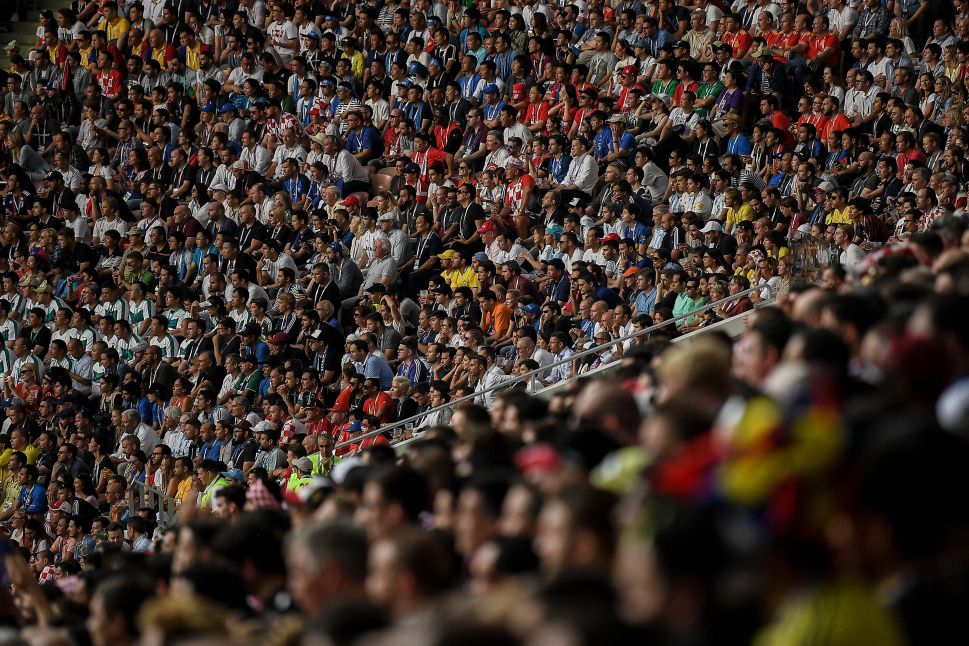
These events are bigger than sport. They are rare global moments that are still capable of commanding collective attention across borders, language and political divides. The identities of these events elevate the matches and competitions to moments in culture. They influence how audiences see the host, how nations see each other and whether those moments ultimately earn their place in public memory and history. When they work, they create a sense of belonging at a global scale. When they fail, they push us further apart.
For much of modern sporting history, getting that identity right was relatively straightforward. Event branding leaned on national symbols—flags, emblems, familiar motifs—to communicate meaning quickly and clearly. Audiences didn’t need much explanation. Looking at the simple red circle of 1964’s Olympics logo, viewers immediately knew they were looking at Tokyo. The symbolism was widely legible and, at the time, largely uncontested.
Today, it is not so simple for two reasons: space and time. The scale is unprecedented. The 2026 FIFA World Cup will span 16 cities across three host nations and reach billions of viewers across fragmented media environments. Historically, major sporting events were smaller, more contained and typically rooted in a single host nation. The default approach, anchoring identity in national symbols, worked because the question of “whose identity?” had a clear answer. That clarity no longer exists.
And then there is time. Host nations are now being selected up to a decade before the event. This gap between the bid and opening ceremonies is long enough to encompass multiple election cycles, leadership changes, geopolitical realignments and major shifts in public sentiment. The political, cultural and social context within which an event identity is conceived is no longer guaranteed to be the one it will launch into.
The LA28 Olympics will open at the height of a U.S. presidential election season, arguably one of the most contested symbolic environments imaginable.
What happens when an event spans multiple countries, each with its own internal divisions? When it unfolds before a global audience, each bringing different cultural interpretations? When meaning is shaped in real time through social media, rather than defined in advance? At that scale, relying on symbols outside your control becomes a risk.
The old playbook worked, for a time. The last time the U.S. hosted both the Summer Olympics and the World Cup in close succession was 1984 and 1994. Both leaned heavily into stars and stripes for their logos, a clear shorthand for American identity, perfectly suited to their moments.
What’s changed since is structural, not merely aesthetic. Social media has democratized how identity is defined, interpreted and contested. Multi-national hosting has complicated the question of whose symbols should dominate. And long planning cycles all but guarantee a mismatch between the world in which an event is awarded and the one into which it ultimately arrives. This tension isn’t new. The Olympics and World Cup have always been shaped by broader social forces.
The 1936 Berlin Olympics transformed national identity into propaganda. At the 1968 Olympics in Mexico City, politics arrived on the podium when Tommie Smith and John Carlos raised their fists, reshaping how the Games were remembered. Initially condemned, the gesture is now honored in the Smithsonian. The Olympic boycotts of 1980 and 1984 revealed another enduring tension: events awarded in one political climate (détente), delivered into another (Cold War).
The planning cycle problem has always existed. What’s changed is the speed and scale at which meaning shifts. So, the question becomes: what replaces traditional national symbolism when it can no longer carry that weight reliably? For 2026 and 2028, the answer is not to abandon identity, but to rethink how it works.
Increasingly, major global events are shifting toward elements that can represent place without relying exclusively on fixed, contested symbols: landscape, geography and the physical and cultural texture of a location. These are less vulnerable to political cycles and remain more stable over time.
You can see this emerging in recent international events. The 2023 FIFA Women’s World Cup, co-hosted by Australia and New Zealand, drew on patterns developed with Indigenous women artists, grounded the visual identity in land, movement and cultural texture rather than overt national symbolism. The result felt more rooted and specific than either nation individually, and, paradoxically, more universal.
The transition logo for the 2034 Winter Olympics in Utah has taken a similar approach, avoiding national and state iconography and drawing instead from landscape and the movement of sport. These systems are designed to evolve: flexible enough to reflect different cities, voices and moments without collapsing into a single rigid narrative.
At the scale of something like the 2026 World Cup, that flexibility isn’t just creative, it’s practical. Sixteen host cities and a tiered sponsorship model, where local markets sell regional partnerships alongside global ones, require a system capable of adapting across audiences and platforms, not a monolith. More than a challenge for 2026 and 2028, this is the future for all global events.
As audiences become more connected, more participatory and more vocal, expectations for authenticity and scrutiny of how identity is expressed will only intensify. The old shortcuts no longer hold. Every host nation will face the same question: how do you create something that feels true, inclusive and capable of bringing people together?
Because that’s ultimately the point. When event identities lean too heavily on national symbolism, they risk reading like tourism campaigns or the home team’s kit. They collapse the distinction between the event and the nation hosting it. The most powerful expressions of national identity come instead from athletes and fans, in the flags they carry, the kits they wear, the anthems they sing. That meaning belongs to them. The role of the event identity is different. It isn’t to represent one nation, but to create a framework in which every nation feels welcome.
Getting that right carries high stakes. These are multi-billion-dollar platforms with once-in-a-generation visibility. There’s no reset if something misses the mark, and in a global environment shaped by polarization, fragmentation and competing narratives of identity, these events carry rare potential to unify. The shift we’re seeing, from designing around national identity to designing for the moment itself, is a response to that reality. A recognition that meaning today is fluid, contested and impossible to fully control. National symbols are borrowed meaning. The strongest identities build meaning of their own.
