
This article was originally published by Healthbeat, a nonprofit newsroom covering public health published by Civic News Company and KFF Health News.
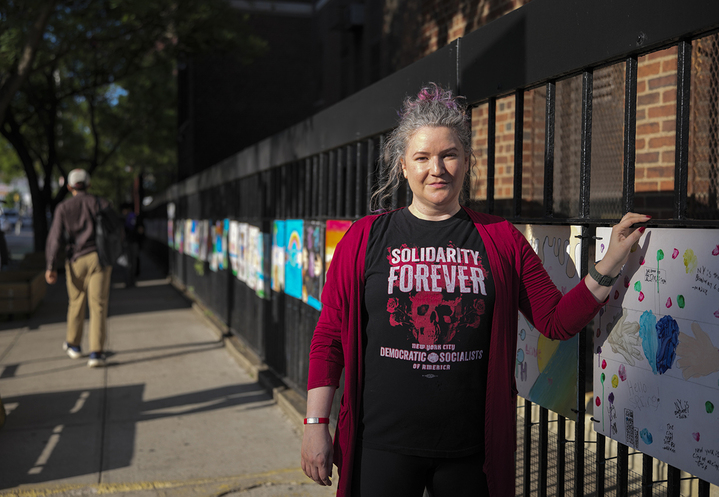
Olivia Killingsworth, an actor and bookkeeper living in Brooklyn has a rare life-threatening genetic condition for which she sees specialists, limits exercise, takes prescribed medication to lower her blood pressure, and monitors her heart rate with a watch.
The 44-year-old is one of some 450,000 New Yorkers who could lose health insurance at the end of the month.
That’s because of a change to the state’s “Essential Plan,” a low-cost health insurance option that covers people who earn too much money to qualify for Medicaid and too little to afford private plans sold on the state health insurance marketplace.
On July 1, New York plans to revert to an earlier plan that will narrow insurance eligibility for low-income residents, potentially leaving thousands suddenly uninsured and looking for coverage options.
Killingsworth and others like her may find themselves in an unusual predicament as they weigh their health insurance options: Do they try to earn more money so they might qualify for a plan that proves to be more expensive or do they work less so they earn less money to be eligible for a separate plan?
“People are really going to be in the situation of making incredibly difficult choices,” said Michael Kinnucan, health policy director at the Fiscal Policy Institute, a nonpartisan think tank that aims to promote sound and equitable fiscal policy to strengthen New York’s economy.
When New York launched the Essential Plan in 2016 with funding from the Affordable Care Act, it was hailed a success. The plan offered no monthly premiums or deductibles, and annual checkups were free. In a state whose monthly premiums for marketplace plans are among the most expensive nationwide, it became wildly popular, now offering high-quality and affordable insurance to 1.7 million New Yorkers.
Of those, about 450,000 are in households making up to 250% of the federal poverty line. That is $39,900 a year for a single adult with no children, like Killingsworth who last year earned around $35,000, or $80,375 for a family of four. The state received federal permission in 2024 to expand eligibility to those New Yorkers.
But the passage of H.R. 1, the Trump administration’s One Big Beautiful Bill Act, changed that. The legislation prompted the state to shrink eligibility and undo its expansion, and the income limit for eligibility dropped from 250% to 200%. There are no changes for the 1.3 million enrollees with income below 200% of the federal income poverty level, or an income below $31,920.
New York City’s Department of Health and Mental Hygiene estimates that 233,000 New York City residents will lose their Essential Plan coverage. The New York State Department of Health, which worked with the Urban Institute, a think tank in Washington, D.C., on its projections, anticipates between 150,000 and 200,000 will become uninsured.
New Yorkers who lose their insurance can go to a federally qualified health center — typically a community health clinic — for preventative care, dental care, and other services and pay on a sliding scale. Or they may visit a medical school that has a student-run clinic offering free or low-cost care.
With so many suddenly losing their insurance, there will be plenty of blame to go around.
“The responsibility for those losing coverage rests squarely with House Republicans, and now New Yorkers are beginning to feel the impact,” New York Health Department spokesperson Danielle De Souza said in a statement.
Killingsworth and health advocates like Kinnucan disagree. They argue that Gov. Kathy Hochul didn’t do enough to preserve coverage in the budget for Essential Plan enrollees. Lawmakers said she could have dipped into funds that she had set aside for her January budget proposal. But the argument failed to gain traction in negotiations.
“We had an opportunity in the state budget to prevent it,” said Kinnucan. “There’s this weird thing that happens with policymakers, where healthcare in theory is some sort of entitlement program that you can cut, but the people who use healthcare are sick and they really need help.”
Rare Connective Tissue Condition
In 2019, Killingsworth was diagnosed with Ehlers-Danlos Syndrome, or EDS, a rare group of connective tissue disorders. She has what’s referred to as the vascular kind, which means her connective tissue is very fragile, particularly in the blood vessels and organs. That type of EDS runs in the family and can cause life-threatening complications, such as an aneurysm, and affects roughly 1 in 100,000 to 200,000 people, according to the Ehlers-Danlos Society, an advocacy organization that aims to promote awareness about EDS.
“I’m a 44-year-old woman with the joints and connective tissue of a 74-year-old,” said Killingsworth, who has dyed parts of her graying hair purple.
Killingsworth hasn’t performed as an actor since 2021 but is hoping to return to the stage or TV soon. Treatment keeps her busy.
Care requires visits to a niche cardiologist and a vascular specialist, both at Mount Sinai on the Upper East Side; she consults them on taking long bike rides and is under orders not to over exert herself.
She also sees a physical therapist almost weekly who specializes in EDS, one of the few in the city, if not the country. Each visit runs $250. The physical therapist, the owner of a Brooklyn studio, doesn’t accept insurance like many other physical therapists, because she believes it would limit the quality of care. It’s a stretch for Killingsworth to pay out of pocket, but she can make it work because her other healthcare has been covered.
Killingsworth’s father was diagnosed with EDS, and she believes her aunt likely had it, dying at the age of 70 in 2018 because of an aortic rupture, Killingsworth said. Her aunt’s inheritance allowed her in 2022 to pay cash for her one-bedroom apartment in Brooklyn’s Kensington neighborhood where she lives with her two cats. She paid $521,000, public records show.
Killingsworth realizes that she is lucky enough to live in one of the world’s most expensive cities without having to pay a mortgage or rent. That recognition compelled her to participate in an organized protest in April outside Hochul’s office in Midtown Manhattan. A member of the Democratic Socialists of America who canvassed for Mayor Zohran Mamdani when he ran for office last year, Killingsworth was part of a group arrested in the April demonstration on trespassing charges, which were later dropped.
“I have a college degree, I have a lot of skills, I can do a lot of stuff,” Killingsworth said. “I know that there are lots of other people that aren’t from that position and are facing much worse conditions. They don’t have the same options that I do. So that’s one of the reasons that I wanted to go out there and take that arrest.”
Killingsworth joined the Essential Plan in 2024 and it was a godsend. Because of her yearly salary of around $35,000, she qualified for a plan for New Yorkers whose annual income was more than 200% of the federal poverty line and less than 250% of the federal poverty line. The annual income is between $31,920 and $39,900.
If she were to purchase a plan through the marketplace, she would pay more.
According to a calculation on the marketplace offered by New York state, Killingsworth is eligible for more than 60 plans. The NYS Health Department says that consumers with income between the 200% and 250% poverty line will be eligible for a plan with an estimated average premium of $220 after tax credits and a deductible of $2,150.
If Killingsworth were to pursue one of these plans, she says she would stay with her current insurance whose services she has liked. One estimate she obtained shows she could pay a monthly premium of $432 after tax credits with an annual deductible of $2,050 — reaching a minimum of $7,234 total, or 20% of last year’s income. This doesn’t include costs for imaging, specialists’ visits, or her physical therapy sessions.
She is inclined to see if she can join another tier on the Essential Plan.
There is no monthly premium or deductible, and the maximum out of pocket is $350. A visit to see her cardiologist would cost $25.
To be eligible, Killingsworth would need to work fewer hours so she could earn less money. Her annual salary can’t exceed $31,920.
Trenton Daniel is a reporter covering public health in New York for Healthbeat. Contact Trenton at [email protected] or on the messaging app Signal at trentondaniel.88.
Our nonprofit newsroom relies on donations from readers to sustain our local reporting and keep it free for all New Yorkers. Donate to THE CITY today.
The post How One Brooklynite Is Grappling With Her Essential Plan Health Coverage Ending appeared first on The City Reporter.
