
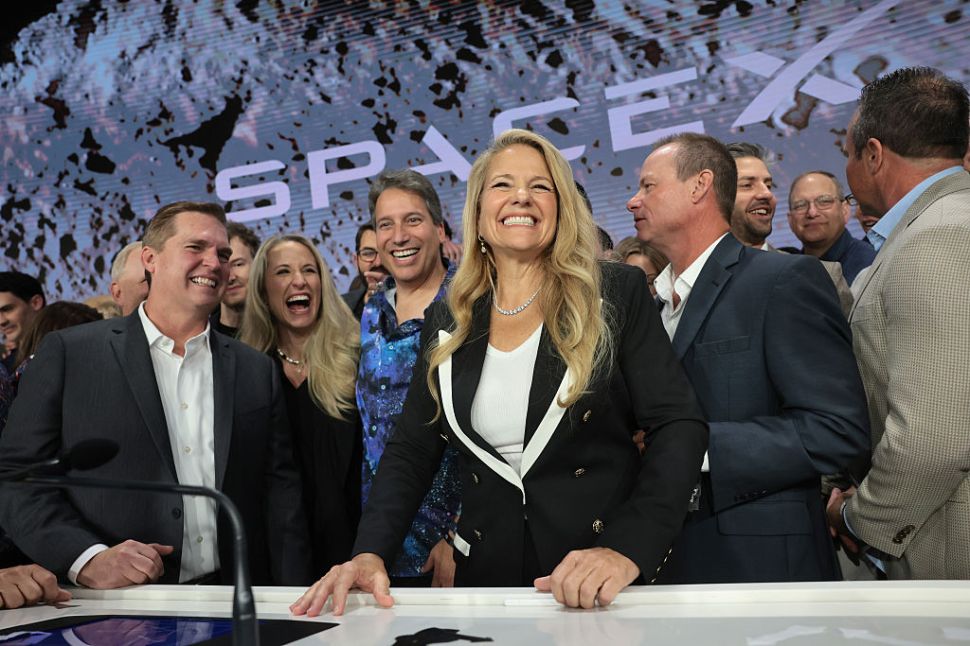
SpaceX, is joined by company leadership as they ring the opening bell at the Nasdaq Marketsite at the launch of the company’s initial public offering (IPO) on June 12, 2026 in New York City. ” width=”970″ height=”647″ data-caption=’Space President Gwynne Shotwell (C) rings the opening bell at the Nasdaq Marketsite at the launch of the company’s IPO on June 12, 2026 in New York City. <span class=”lazyload media-credit”>Spencer Platt/Getty Images</span>’>
Days after SpaceX hit the public market, Elon Musk’s mega-company announced plans to acquire Anysphere, the parent company of A.I. coding agent Cursor, for $60 billion in the third quarter of this year. Behind Cursor are four former MIT classmates in their mid-20s. All co-founders became billionaires in November following a $2.3 billion funding round that valued the company at $29.3 billion. With each holding roughly a 4.5 percent stake, a SpaceX acquisition would push their net worth to about $2.7 billion each.
Michael Truell, Sualeh Asif, Arvid Lunnemark and Aman Sanger founded San Francisco-based Anysphere in 2022 after meeting at MIT. In just a few years, their flagship product, Cursor, has become a widely used tool for building A.I. coding agents, now adopted by 64 percent of Fortune 500 companies, including Nvidia, Adobe and even competitor OpenAI. Global research firm Gartner has positioned it as a leader in enterprise coding tools alongside OpenAI, Anthropic and GitHub.
The move comes nearly two months after Cursor, which has been working closely with xAI to integrate its technology into the Grok assistant, granted exclusive acquisition rights to xAI’s now parent company SpaceX. If the $60 billion deal falls through, SpaceX has agreed to pay Cursor $10 billion for their collaboration. The deal caps a rapid rise for a team that went from university classmates to major players in the A.I. race within just a few years.
Michael Truell, CEO
The 25-year-old co-founder and CEO attended New York’s Horace Mann School before enrolling at MIT in 2018. He interned at Two Sigma, Google and Octant before dropping out in 2021 to co-found Cursor. In 2020, Truell was recognized as a Neo Scholar alongside Aman Sanger, with Neo later becoming one of the earliest investors in Cursor’s $400,000 pre-seed round.
“There was going to be an opportunity for all of coding to change in the next five years and for all of software development to flow through models,” Truell said in an interview for Y Combinator’s AI Startup School in San Francisco last year. “It felt like no one working on the space at the time was really taking that seriously.”
Sualeh Asif, Chief Product Officer
Originally from Pakistan, Asif attended the country’s prestigeous prep school, Nixor College, where he graduated as valedictorian in 2018. At MIT, he worked as a research assistant at the Supertech Lab and the Computer Science and Artificial Intelligence Laboratory (CSAIL).
“In general, over a 1–2 year time frame, I expect that the way people will code will change,” Asif said in an interview with A.I. researcher and entrepreneur Lukas Biewald on his YouTube series Gradient Dissent last year. “In the short term, that seems really scary, but it’ll be this gradual process and will be extremely natural to everyone.”
Aman Sanger, Chief Operating Officer
Sanger attended Horace Mann School with Truell before enrolling at MIT in 2018. He interned at Google and hedge fund giant Bridgewater Associates prior to graduating and was also named a Neo Scholar in 2020.
“A lot of the work for Cursor has been just experimenting with what is possible,” Sanger said in an interview with venture capitalist Rajan Anandan. “For everything that you may see in the product, there’s ten failed experiments of what didn’t work.” Sanger said he began coding at age 14.
Arvid Lunnemark, Co-founder
Lunnemark, 26, graduated from Malmö Borgarskola High School in Sweden in 2018 before attending MIT, where he worked at QuantCo, Stripe and trading firm Jane Street. In October 2025, he announced his departure from Cursor to found a new venture, Integrous Research, focused on building safer A.I. systems. He reportedly retains his founding equity stake, allowing him to benefit from the potential acquisition.
While still in stealth mode, Integrous Research says it is “devoted to protecting individual human freedom before, during and after the start of the superintelligence era” and believes that “by the time the superintelligence can do that research for us, it may already be too late.”
