
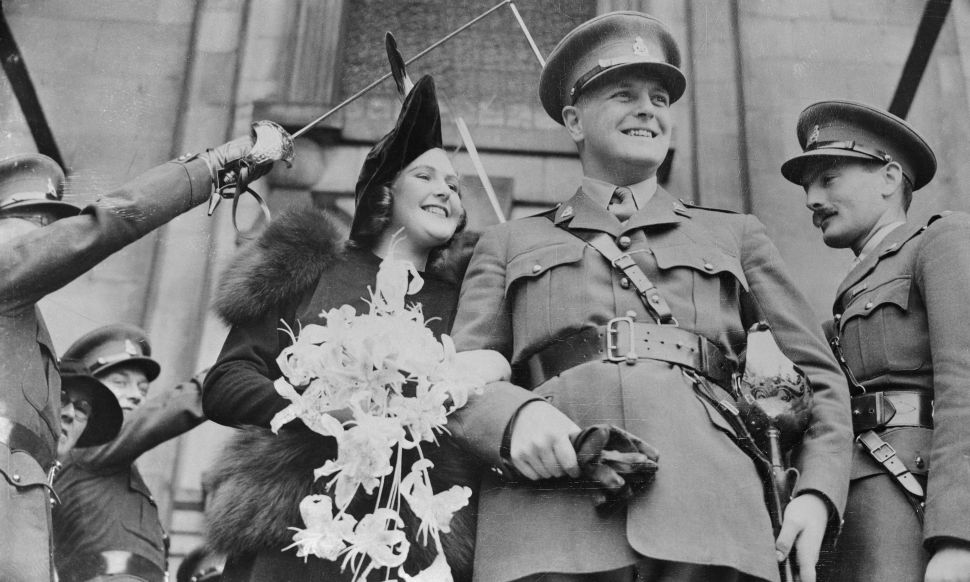
Pamela Harriman looked like a normal person. If you saw her on the street, you might consider her modestly attractive, nicely dressed and well groomed. You would not be so cruel as her very uncharitable obituary, which claimed, “red-haired but with a tendency towards dumpiness, Pamela Harriman was far from being an overwhelming beauty.” Yet it is unlikely that you would spin around and declare that this was a bombshell, hardened by plastic surgery, lip filler, Ozempic and general torturous manipulation of the flesh into what we now think of as a sex object.
Yet almost every powerful man in the mid-20th century fell in love with Pamela Harriman.
She was born Pamela Beryl Digby in Hampshire on March 20, 1920, the eldest child of 11th Baron Edward Digby. After an infancy spent in Australia, where she learned to talk by mimicking a parrot, she returned home to England at the age of three. Her parents were occupied with horticulture and hunting, and she was bored in a way that, she claimed, was only alleviated by the arrival of Americans. There was not an excess of study going on during these adolescent years. Pamela would later note, “I belonged to a generation in England where they didn’t think women needed to be educated.”
The author Truman Capote—and again, to learn about Harriman is to read people just rattling off a shocking number of unkind sentiments—claimed, “She has no intellectual capacities at all. She’s some sort of marvelous primitive. I don’t think she’s ever read a book or even a newspaper except for a gossip column.”
Still, she managed some time at a boarding school in Munich and the Sorbonne in Paris and then returned to London for her debut. In 1939, she married Randolph Churchill, the son of Winston Churchill, three weeks after meeting him. This came as something of a surprise to everyone, as Churchill was nine years older than her and, at the time, considered one of the most eligible bachelors in England. The actress Ann Margret would explain that Pamela was “very conniving, very manipulative.”
Another friend would claim that Pamela’s approach was simpler: “She wore high heels and tossed her bottom around.”
The author Nancy Mitford claimed Pamela as “a red-headed bouncing little thing, and a joke among her contemporaries.” Future biographers would say, “He [Randolph] didn’t love her… but she looked healthy enough to bear his child.” And he was terrified he would be killed during the war.
Randolph revealed himself to be an alcoholic, a philanderer and a compulsive gambler. The marriage produced one son in 1940, but wasn’t happy, and certainly neither of them was faithful. However, it was at this time that she began drawing a coterie of powerful men. She became a “confidante of the senior Churchill” during this era. Her other admirers, who came to visit her at 10 Downing Street while her husband was at war, included Dwight D. Eisenhower and the broadcaster Edward Murrow.
It’s possible they loved her because of the aforementioned bottom swinging. But England was not exactly short on women willing to swing their assets at Winston Churchill and Dwight D. Eisenhower during World War II. Many of those women looked more like Lana Turner than Pamela ever could. It seems more likely that Pamela’s appeal stemmed from her willingness to pay attention. Whether Pamela ever read a book (and I strongly suspect she did), men all talked about how special she made them feel. To be with her was to feel as though they were the only person who interested her. She had a true genius for listening to people, particularly men, when they were talking. She was brilliant at remembering details they told her and asking about them later. Years could seemingly pass, and she would remember her last conversation with someone as though it were yesterday, and it was the best conversation she had ever had.
This is an unspeakably seductive quality.
Attention is often inseparable from love. Yes, we want to see someone else as beautiful and compelling. But we also deeply want to see ourselves as profoundly interesting. Every man who spoke about Pamela would say some variation of the sentiment that, when they were with her, they felt they were the most interesting person in the world.
Truman Capote quipped rather dismissively that Harriman was “a geisha girl who’s made every man happy.” But, surely, everyone who has quietly tuned out when someone boring is droning on knows that it is no easy thing to be.
And this was culturally important. During WWII, when America’s involvement was still uncertain, Winston Churchill was desperately trying to enlist American allies. Pamela began an affair with the American businessman Averell Harriman, who was at that time not only one of the wealthiest men in America, but also the administrator of the aid program to Britain during the war. At night, over cards, she would debrief Winston Churchill on Harriman’s thoughts and plans while they played cards.
For this, she was dismissed as “a mercenary sex obsessive” and someone whose “politics were only between her legs.” I prefer to consider this spy craft. For all those critics who really want to dismiss Pamela as a slutty slut who slutted around, people seem to feel differently when Roald Dahl did the precise same thing. He was a real-life honeypot charged by MI6 with seducing powerful American women to try to raise support for Britain during the war (and who claimed that congresswoman Clare Booth Luce “screwed me from one end of the room to another for three goddamn nights” in the course of his assignment). Pamela’s other lovers during this period included the broadcaster Edward Murrow, the American ambassador Jock Whitney, Major General Fred Anderson, who commanded the American bombing force, and the head of CBS, Bill paley. Supposedly, she kept in her safe “love letters from three separate participants in the Yalta conference.” Information obtained from all these people flowed directly to Churchill.
Christopher Ogden, one of Pamela’s biographers, noted, “If her love life had not been so flagrant, she might have been given a hero’s medal.”
Pamela moved to Paris after the war. She began sleeping with Gianni Agnelli, the head of Fiat and “Italy’s uncrowned King.” He set her up with a beautiful car and apartment. Meanwhile, during their relationship, Averell Harriman had given her an allowance of $20,000 a year or about $350,000 today. He was surprised to find, years after their break-up, that his secretary had never stopped sending the checks. All this prompted her husband, perhaps sardonically (though no one seems to think Randolph Churchill was particularly perceptive), to attest, “How clever she was to manage so adroitly on her meagre allowance.”
Pamela and Randolph divorced in 1946. Pamela converted to Catholicism in the hopes of convincing Agnelli to marry her. However, Agnelli informed her that he could not, as a Catholic, marry a divorced woman. So, she began simultaneous relationships with the Baron de Rothschild of the banking family, and the shipping magnate Stavros Niarchos. The affair with the Baron ended when his wife sideswiped Pamela’s car in a Paris street. As for Pamela, when asked if one could expect fidelity from any man, she replied, “I guess one’s always hopeful but, being European, I doubt that it’s true.”
By this time, Pamela had become so scandalous that when the Queen of England visited France in 1957, Pamela was not invited to any of the events. The British ambassador’s wife even declared, “I will not have that tart at the embassy.” Truman Capote had begun snickering that men were happy to sleep with Pamela, “but they won’t marry her.” And as she approached age 40, her peers thought it unlikely that anyone would propose.
She married again. As soon as she decided she wanted to. After Pamela moved to New York in 1959, Slim Hayward (better known as Slim Keith) suggested Pamela attend the theater with her husband, Leland Hayward. He was the Broadway producer who had financed South Pacific and The Sound of Music. Leland was immediately struck by what he called “her extraordinary attention span.” Friends said that Pamela “went from knowing absolutely nothing about Broadway to being able to quote box-office grosses in about two weeks.” Leland promptly divorced Slim, prompting her to hate Pamela for the rest of her life.
In her marriage to Leland, Pamela apparently showed “geisha-like devotion.” The critic Laurence Lerner noted that Pamela, “turned out to be a terrific wife.” The marriage lasted for 11 years, until Leland’s death in 1971.
One day after Leland’s funeral, she resumed the relationship of her youth with Averell Harriman. Leland died in March, and Pamela and Averell (who was now 79 and single) were married in September. She moved to his home in Washington, DC. Just as she had taken an interest in theater when she was with Leland, she rechristened herself a “political animal,” fascinated by Democratic politics, a passion that continued even after Harriman’s death in 1986.
She arrived at a particularly bleak moment for Democrats, when Ronald Reagan’s presidency was quickly followed by George H.W. Bush in 1988. Jay Rockefeller claimed that when Pamela Harriman entered the scene, “the Democratic party was just gone, blown out of existence. And suddenly there was Pamela, very calm, very strong, saying ‘come on, let’s put this party back together again.’ And she did.” She raised $12 million for Bill Clinton’s 1992 presidential campaign. “She was one of the most unusual and gifted people I ever met. She was a source of judgment and inspiration to me, a constant source of good humor, and charm, and real friendship.” There is nothing to indicate that there was a romantic connection between the two, which, taking both their temperaments into account, is genuinely surprising.
When Clinton won the election, he appointed her the U.S. Ambassador to France, where “it was widely assumed that she would be the social figurehead and leave the Embassy diplomats to do the real work.” That was incorrect. She was able to smooth over normally prickly relations between France and America to an extent that The International Herald Tribune wrote that Harriman was, without question, “the most successful American political ambassador of the decade.” When she passed away in 1997, French President Jacques Chirac said of Harriman’s ambassadorship that it was “probably one of the best since Benjamin Franklin and Thomas Jefferson.”
Pamela had a skill. Her charm, her interest and her willingness to make other people feel interesting did not diminish with age or experience. It was not something she lucked into through bottom swinging or, if she’d lived today, finding the right lip injector. It was a bona fide talent. In a self-absorbed world where people report increasing levels of loneliness, her generosity in simply paying attention to others and allowing them to feel special is a skill many of us would do well to cultivate.
Oh! And she also slept with Frank Sinatra.
