
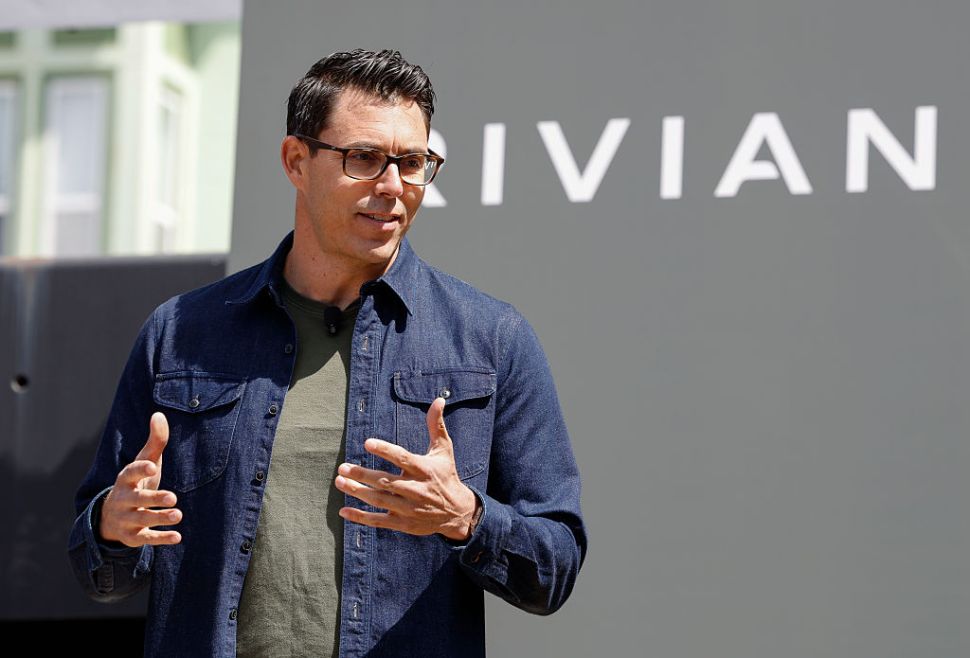
Rivian CEO RJ Scaringe in a navy blue casual shirt” width=”970″ height=”658″ data-caption=’RJ Scaringe says Rivian’s R2 will help drive its push to Level 4 autonomy by 2028, powered by real-world data and rapid A.I. advances. <span class=”lazyload media-credit”>Kimberly White/Getty Images for Rivian</span>’>
Rivian has officially launched its long-awaited R2 SUV after years of development and mounting market anticipation. Smaller and more affordable than its flagship R1, the R2 is positioned as a mass-market vehicle, with projected annual sales exceeding 50,000 units. But CEO RJ Scaringe is aiming beyond volume, emphasizing that the technology powering the vehicle matters as much as the vehicle itself. “We want people looking to say it’s the best car I can buy in that price range, and by virtue of that, it’ll draw new non-EV customers who have historically been on the sidelines, because the product that spoke to them,” Scaringe told a selected group of press, including Observer, at a test-drive event in Park City, Utah, last week.
Part of that appeal comes from Rivian’s A.I.-first approach, which the company believes will resonate with customers. Rivian has been building and training its own A.I., powering everything from its self-driving system, called Universal Hands Free (UHF), to proprietary datasets that help owners locate reliable chargers on road trips.
Like Tesla, Rivian’s system learns from real-world driving data collected from customer vehicles, meaning every R2 on the road improves the company’s A.I., and each improvement enhances the system’s autonomous capabilities. During the roundtable, Scaringe said Rivian is targeting Level 4 self-driving by 2028, a timeline more aggressive than most of the industry considers achievable. He argued this is possible because A.I. models are improving rapidly.
“I think the world is conditioned to say, yeah, sure, autonomy is a few years away,” Scaringe said. “But I think it’s actually finally true.”
While hands-free driving on divided highways is now common in modern vehicles, most systems do not extend to local roads (with the exception of Tesla). Rivian’s UHF system uses a multimodal sensor suite, including 10 external cameras and five radars, to provide a 360-degree view for safer hands-free driving. By contrast, Tesla relies on eight cameras and no radar or ultrasonic sensors for its FSD system.
Rivian’s system is smooth and confidence-inspiring on the road. It integrates with GPS to anticipate upcoming curves, helping keep the smaller SUV stable at speed. On highways, automated lane changes allow the vehicle to pass slower traffic, though that feature is not yet available on smaller roads.
On two-lane roads, the driver-assistance system handles curves well. Rivian says that with the rollout of UHF version 2 later this year, the R2 will be able to handle stop signs, traffic lights and off-highway lane changes. By the end of 2026, executives said point-to-point hands-free driving, where the car navigates a full route after a destination is entered, will be available to customers enrolled in Rivian’s Autonomy Plus program, which costs $2,500 for a lifetime membership.
Volume is critical to training Rivian’s A.I.
Yet Rivian’s autonomy ambitions depend on scale. Scaringe noted that fewer than five Western companies are building large A.I. foundation models trained on extensive real-world driving data—and Rivian is one of them. Every R2 and R1 Gen 2 on the road contributes to that dataset. Both vehicles will receive the same self-driving updates simultaneously, meaning existing owners are also part of the company’s training infrastructure. Rivian said UHF has already been used nearly 4 million times across more than 14 million miles since its rollout.
Rivian’s production plans reflect the scale needed to sustain this data flywheel. Its plant in Normal, Ill., which already builds the R1 and commercial vans, has added a third production line for the R2, bringing total capacity to roughly 160,000 units. A second plant under construction in Georgia will add another 300,000 units of capacity across the R2, R3 and additional vehicles built on the same platform.
The backdrop of a softening U.S. EV market
EV adoption in the U.S. has slowed since Trump regained the presidency due to a mix of cultural, political and economic factors. According to Cox Automotive, electric vehicle sales fell 27 percent year over year in the first quarter to 216,399 units. That’s also down 7.8 percent from the previous quarter, though an improvement over Q4 2025, suggesting the post-incentive drop is beginning to stabilize.
Scaringe argued the numbers reflect limited choice rather than weak demand. “More than half of the total EV market share is Tesla, across two products, one of which launched in 2016 and the other in 2019,” he said at the roundtable. “That does not reflect a market that’s being served in a healthy way. It reflects a market that has far too little choice.”
He added that U.S. EV adoption trails Europe by three to four times and China by nearly tenfold, where a broader range of options has driven mainstream uptake. The R2 is designed to close that gap, targeting buyers cross-shopping vehicles like the Toyota RAV4 and Subaru Forester—consumers who are not opposed to EVs but have yet to find a product that resonates.
If Scaringe is right, the R2 will serve as a critical test case. The company is betting that a high-tech, A.I.-first vehicle at a more accessible price point can bring genuinely mainstream buyers into the EV market. The next few quarters will show whether that bet pays off.
