
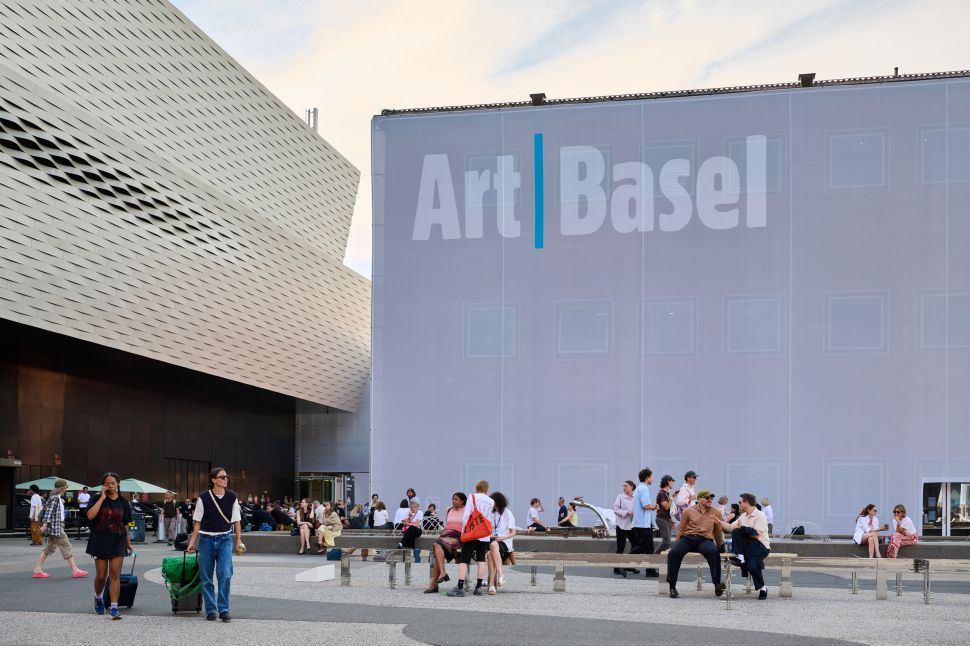
The OG Art Basel has long been the main market test for not only the European market but also the global market. It opened to VIPs yesterday (June 16) with a mood far less bombastic than in years past. Spirits were high, certainly, but the audience was much more regional and selective. To combat what could be perceived as a contraction, given fewer visitors from the U.S. and Asia, the fair has tried to restore a sense of eager anticipation by launching a new initiative that kept selected major works unseen—no digital previews, no PDFs—until the fair opened to ensure visitors’ first encounters with the year’s presentations would be in person.
And there are plenty of masterpieces waiting to be encountered, though it’s unclear whether these are Basel exclusives or will reappear in Paris. The top sale of the VIP preview day was made by Swiss powerhouse Hauser & Wirth, which sold a 1963 Picasso for a remarkable $35 million. The gallery’s booth, taken as a whole, has great range, with a Picasso plein air work paired with an impressive Lucio Fontana slashed canvas, a sought-after abstract Richter and a sculpture by Louise Bourgeois. By 4 p.m., the gallery had also sold a Cy Twombly at $5 million, a Louise Bourgeois at $2.5 million, a Maria Lassnig at $1.75 million, a Piero Manzoni and a Zeng Fanzhi at $1.5 million each, an On Kawara at $1.4 million and works by Ed Clark, Isa Genzken, Günther Förg and Henry Taylor at roughly $1.2 million each. Gallery president Iwan Wirth described the first day of the 2026 edition of Art Basel as the strongest they had ever had. Other reported sales included works by Amy Sherald at $850,000, Christina Quarles at $800,000, Rashid Johnson and Cindy Sherman at $750,000 each, Nairy Baghramian and Luchita Hurtado at €600,000 and $600,000 respectively, Charles Gaines at $595,000, Nicole Eisenman at $575,000, Lorna Simpson at $425,000, Zhang Enli at $350,000, Lee Bul and George Rouy at $300,000 and £300,000 respectively, Pipilotti Rist at $230,000, Phyllida Barlow at $200,000 and $50,000, Ambera Wellmann at $150,000, Uman at $120,000 and a smaller George Rouy at £75,000.
Almine Rech also sold a Picasso—an Art Basel premiere—in the $6,000,000-6,500,000 range, alongside a painting by Serge Poliakoff (€600,000-700,000), a dynamic abstraction by Martha Jungwirth (€550,000-600,000), a ceramic by Pablo Picasso ($350,000-450,000), a painting by Ha Chong-Hyun ($400,000-450,000), a painting by Javier Calleja (€350,000-400,000), a painting by Youngju Joung ($75,000-80,000), a painting by Ji Xin ($65,000-75,000) and a work by Taryn Simon ($35,000-40,000). “There’s a really good energy at the fair this year, and we’re happy to have made notable sales on this first day in Basel,” Rech told Observer, noting how the new Basel exclusive initiative created some anticipatory excitement. The gallery also placed two sculptures by Leonora Carrington (€170,000-200,000 each) following the announcement, just days earlier, of a new collaboration between it, the artist’s estate and rossogranada to exclusively represent the Surrealist internationally.
David Zwirner anchored its booth with a large Joan Mitchell from 1992, a small Rothko from 1968, a golden Judd from 1969 and a Chamberlain, along with works by Victor Man and Ruth Asawa. The gallery reported a strong first day, with primary-market sales led by an Isa Genzken installation in the Unlimited sector, which sold for €1.2 million to a European museum, and two new paintings by Victor Man, one of which sold for €1 million. Other first-day primary sales included three Josef Albers paintings at $650,000, $800,000 and $850,000; a new Luc Tuymans painting for $800,000; a Steven Shearer painting for $700,000; a Chris Ofili painting and a new Amy Sillman painting for $650,000 each; two new Lucas Arruda paintings for $280,000 each; a new Dana Schutz painting for $350,000 and a work on paper for $100,000; two paintings by Francis Alÿs; a new Lisa Yuskavage work on paper for $320,000; a new Suzan Frecon painting for $250,000; two Philip-Lorca diCorcia photographs for $50,000 and $30,000; works on paper by Al Taylor and Tomma Abts for $30,000 each; an Alice Neel print for $20,000; and six Wolfgang Tillmans works priced between $12,000 and $100,000. The gallery also reported a busy first day on the secondary market, placing works by Njideka Akunyili Crosby, Joan Mitchell, Yayoi Kusama, Gerhard Richter, Richard Serra, Jean-Michel Basquiat, Cecily Brown, Josef Albers, On Kawara, Donald Judd, Ruth Asawa, Victor Man, Dan Flavin, Cy Twombly, Sigmar Polke, Michaël Borremans, Francis Alÿs, Lucas Arruda, Mamma Andersson, Suzan Frecon, Elizabeth Peyton, Raymond Pettibon, Carol Bove, Yu Nishimura and Tomma Abts.
White Cube also reported a good first day, led by Lynne Drexler’s Untitled (1960) at $2.5 million and Doris Salcedo’s Untitled (2008) at $1.25 million. Other sales included Cai Guo-Qiang’s large Blue Pine Forest No. 1 (2022), which occupied an entire wall with a price tag of $750,000, alongside a Tracey Emin painting from 2017 for £750,000, a sculpture by Antony Gormley for £600,000 and Isamu Noguchi’s Figure Emerging (1982/84) for $450,000. The gallery also placed Mona Hatoum’s Still Life (medical cabinet) VII (2026) at £185,000, Ibrahim Mahama’s Kulala (2026) at €100,000 and Sara Flores’s Untitled (Maya Kené 13, 2023) (2023) at $90,000. By Monday, the gallery had also placed an installation by Tracey Emin, Knowing My Enemy (2002), presented in the Unlimited sector, for £1.25 million.
Austrian dealer Thaddaeus Ropac pointed out that there were fewer Americans in the aisles than in years past but clarified that what was more significant was the number of important collectors from across Europe buying very actively. The gallery placed several works on the VIP preview day, including Pierre Soulages’s Peinture 146 x 97 cm, 31 janvier 1954 (1954), which sold above $3 million, a stunning Helen Frankenthaler dated 1982 that sold in the range of $3 million and a Lucio Fontana, Concetto spaziale, Attese (1965), for €1.8 million. Also sold by end of day were Georg Baselitz’s Ach, Mädchen grün (2010), with an asking price of €1.2 million; a Robert Rauschenberg ($950,000); Sturtevant’s Warhol Flowers (1990) (€750,000); a Robert Longo homage to Baselitz ($750,000), alongside works by Frank Auerbach (€700,000), Antony Gormley (£450,000), Martha Jungwirth (€250,000, €200,000 and €100,000), ZADIE XA (£80,000), two other Georg Baselitz works (€85,000 and €70,000) and an Oskar Schlemmer (CHF 55,000). The gallery chose Art Basel as the venue to announce its representation of the estate of Leoncillo, one of the most important Italian sculptors of the postwar period, celebrated for transforming clay into a vehicle for the expressive ambitions of modern art, ahead of a dedicated show at its new Milan gallery in September.
If the death of Georg Baselitz in April of this year translated into swift sales, the impact of the even more recent passing of David Hockney on the market has been palpable at Art Basel. On preview day, GRAY sold his Studio Interior #2 (2014) for $8.5 million, an iPad drawing from “The Arrival of Spring in Woldgate” series (2011) for $650,000 and Kenneth Noland’s No End (1961) for $2 million.
American postwar abstraction sold particularly well on preview day, but with a new mythology and a more feminine inclination. Yares Art reported sales of Helen Frankenthaler’s Gliding Figure (1961) for $2 million, a Joan Mitchell work on paper from 1958 for $1.2 million and Larry Poons’s Toccata Mambo (2014) for $190,000.
Dominating Gagosian’s booth was a monumental Henry Moore, Large Four Piece Reclining Figure (1972-73, cast 1984), measuring over 6.5 x 13 x 6 feet. While the sculpture will no doubt take some time to sell, the mega-gallery reported the sale of Willem de Kooning’s No Title, dated 1984, for a high seven-figure sum to an important private collection in Asia within the first hour. De Kooning’s more elegantly minimal abstractions from the 1980s are particularly in demand in Asia, as recently confirmed by Brett Gorvy in announcing the launch of their new in-house auction venture, LGD Hammer with a 1984 work. Another large 1983 work was on view at Skarstedt, alongside a few Picassos and postwar gems, including Warhol’s Mao, as well as rising contemporary stars such as Yuan Fang.
Twenty-five years after her first presentation, Marianne Boesky shared that opening day was one of the best she had ever had, reporting that she had nearly sold out the booth by evening. “I’m thrilled to say that this year’s edition has brought one of the stronger energies I can remember,” she told Observer. “The fair opened with a big crowd and very good vibes, and it stayed busy all day. Collectors have been confident and decisive.” Among the notable placements, the gallery sold a Mary Lovelace O’Neal painting from 1990 to a European museum. The gallery also placed a painting by Celeste Rapone for $85,000, four Jammie Holmes paintings in the range of $50,000-60,000, two Tianyue Zhong paintings by the newly represented Boesky Gallery artist for $30,000, two Hannah Van Bart paintings in the range of $35,000-45,000 and Aubrey Levinthal paintings in the range of $18,000-36,000.
Despite recent headlines generated by its downsizing, Pace also reported a highly successful first day, selling 20 works in the early hours. The fair marked the international debut of the new collaboration Pace Di Donna Schrader Galleries, and demand was particularly strong for contemporary names, with sales of works by Robert Longo ($750,000), Kenneth Noland ($500,000), Loie Hollowell ($450,000), Nigel Cooke ($385,000), Elmgreen & Dragset (€260,000), Joel Shapiro ($250,000), Marina Perez Simão ($195,000), Alicja Kwade (€175,000), Arlene Shechet ($130,000 and $130,000), Pam Evelyn ($95,000), Mika Tajima ($90,000), Maysha Mohamedi ($75,000), Lauren Quin ($75,000), Mao Yan ($68,000), Yto Barrada (€40,000), Irving Penn ($40,000 and $25,000) and Trevor Paglen ($7,500). The gallery also placed a monumental sculpture by Torkwase Dyson, Way Over There Inside Me (A Festival of Inches) (2022), presented in the Unlimited sector in collaboration with GRAY gallery. More historical pieces placed during the VIP preview included a Kenneth Noland priced at $500,000 and Lynda Benglis’s Power Tower (2019) for $1.4 million.
There were several overlaps in names and sales with San Francisco power dealer Jessica Silverman, who also placed a new painting by Loie Hollowell for $450,000 and a work by Trevor Paglen on opening day, alongside works by Judy Chicago ($225,000), Atsushi Kaga ($125,000), a porcelain butterfly-wing sculpture by Rebecca Manson for $120,000 coming from her recent solo and a Kaga work on paper for $26,000. Other major sales included three 2026 paintings by Clare Rojas in the range of $60,000-90,000 each, Hayal Pozanti’s A Sudden Surprise of the Soul (2026) for $80,000, two 2026 paintings by Julie Buffalohead for $50,000-55,000 each, two handmade pigment-on-linen works by Rupy C. Tut for $55,000-90,000 each and two editions of Woody de Othello’s bronze sculpture the unknown has never let me down (2026) for $50,000 each. Also placed were Rebecca Ness’s Abe in the Ring (2026) for $60,000, Andrea Bowers’s 2026 acrylic-on-cardboard work for $38,000, Marilou Schultz’s Bold Fire (2026) for $40,000, three Trevor Paglen photographs for $7,500 each and two works on paper by Koak for $6,000 each. “Day one of Art Basel has proven once again that the Swiss fair is unparalleled in deepening our global relationships,” Silverman told Observer at the end of the day. “We sold 28 works destined for Europe, Asia, and America. Our spacious, prime corner location gave us a fantastic platform to showcase new and historic works by artists on our roster and to connect with curators and collectors.”
Meanwhile, Brussels powerhouse Xavier Hufkens placed Couple (2002), a Louise Bourgeois sculpture of two floating figures embracing, for $2.2 million, three editions of monumental owl sculptures by Thomas Houseago for $550,000 each and several other works. As Hufkens shared in a statement, “Art Basel remains the most important fair of the year… It starts strong, and it stays strong.”
Gladstone also reported strong results, placing a work on paper by Marisa Merz for €500,000, just as the artist is being celebrated with an extensive three-venue survey starting at Castello di Rivoli in Turin. Other sales included an epic painting by Robert H. Colescott ($275,000), one of Elizabeth Peyton’s always-in-demand portraits ($875,000), multiple watercolors by Ugo Rondinone ($55,000-60,000 each), two paintings by Rachel Rose ($65,000 and $35,000), five silver metallic prints by Carrie Mae Weems ($125,000) and a new, captivating painting by Andro Wekua (€100,000).
Upstairs, the booths turned toward the contemporary and grew more ambitious, starting with Esther Schipper’s strong presentation of mixed-media installations, video and a striking new work by Simon Fujiwara inspired by The Birth of Venus. The booth also had works by Anicka Yi, Pierre Huyghe and Philippe Parreno, along with Ryan Gander’s “machine to imagine simultaneous views of multiple characters’ actions, narratives and associations.” Still, the upstairs section felt much quieter than the fair’s more active ground-level traffic.
Perrotin sold more than 41 works on the preview day, including one at $1.5 million, and a further 40 works were already reserved. The opening of the art fair marked the debut of its new collaboration with Danish artist Jeppe Hein, with an entire section of the booth dedicated to his work, including his metallic balloons wrapped within a fully painted wall of his inhale-exhale waves, priced between $10,000 and $400,000.
Italian power dealer Massimo De Carlo confirmed how, even after more than 20 years of showing at Art Basel, the fair remains one of the most important moments of the gallery’s year. “The market is cautious, but we’re seeing positive responses, and you can feel an energy,” he told Observer. “You come here with the artists and the works that represent you, and that’s what we’ve done.” The gallery is presenting a significant new work by John Armleder in Unlimited, while its booth is eclectic and wide-ranging, with a special focus on Italian artist Pietro Roccasalva. There were several sales during the preview, including Elmgreen & Dragset (€200,000-250,000), John Armleder (€100,000-130,000 each for three works), a painting by Pietro Roccasalva (€50,000-100,000), Ferrari Sheppard ($50,000-100,000), Xue Ruozhe (€20,000-50,000) and Lily Stockman ($20,000 each for three works).
New York gallery P•P•O•W sold more than 10 works by Grace Carney, Kyle Dunn, Ishi Glinsky, Hilary Harkness, Sanam Khatibi, David Wojnarowicz and Martin Wong for a combined total in the range of $500,000-750,000, most going to collectors in the U.S., Canada and Norway. The gallery also sold Ishi Glinsky’s Inertia – Here and Home (2026), a large-scale sculpture presented in collaboration with Chris Sharp in the Parcours sector and installed theatrically in a street-facing window gallery on Clarastrasse. Priced at $50,000-75,000, it went to a prominent U.S.-based collector with a private foundation.
South Africa’s Goodman Gallery is celebrating its 60th anniversary at Art Basel, as well as more than four decades showing at the fair (it was notably the first African gallery to participate). Anchored by a monumental equestrian sculpture by Yinka Shonibare, the booth has works by key names on the gallery’s roster, and day-one sales included works by William Kentridge, Carrie Mae Weems, Alfredo Jaar, Atta Kwami and Pamela Phatsimo Sunstrum.
Filipino gallery Silverlens made its long-awaited debut at Art Basel after more than a decade of trying to get in, the founder told Observer; this was the first Basel appearance for several of its Filipino artists, among them Geraldine Javier, ahead of her New York solo exhibition in September. Particularly striking was her installation Mt. Maculot. “All that you touch, you change. All that you change, changes you.” (Octavia E. Butler) (2025), which brings together 267 pieces of hand-embroidered, eco-printed fabrics, leaves, flowers, natural dyes, threads, treated wood and postcards, with canvases stacked in clusters like trees in a forest to form a mountain. Nearby, her “Shades of Grey” series channels anxiety about the climate crisis through muted grays and blues, punctuated by earthy tones and eco-printed plants, signs of the artist’s still-persistent hope in humanity. Also making her Basel debut with Silverlens was Nicole Coson, who was previously shown by the gallery at Art Basel Miami Beach.
The Kabinett sector also delivered focused, interesting offerings this year. Deborah Schamoni presented a focused installation of significant works by Bracha L. Ettinger, a leading figure in contemporary art and feminist psychoanalytic theory, timed with a pivotal moment in the artist’s career following her recent retrospective at K21 in Düsseldorf, her exhibition at the Centre Pompidou and the publication of a comprehensive monograph with Skira. Installed against a deep blue wall, a chromatic signature of Ettinger’s exhibition practice, the presentation brought together works on paper and canvas that distill her sustained engagement with memory, trauma and relationality. Central to the booth is Angel of Carriance, Medusa n.1 (2017-2023), a work that embodies Ettinger’s concept of “carriance,” or a form of holding-with and caring for the suffering of the other. Prices for paintings have now risen to €40,000-90,000, while drawings remain more accessible at roughly €12,000-15,000.
Another compelling discovery in Kabinett was Zhi Wei, presented by Beijing Commune. Her solo project “Shell” unfolded through textile paintings and soft sculpture, extending across both material and metaphor. At the threshold were snail-like figures, self-protective yet armored, drawing on medieval manuscripts, hermit crabs exchanging borrowed homes and Hermann Finsterlin’s utopian spirals, each suggesting its own crisis of knowledge, existence or humanity. The use of fabric is also tied to her personal material history, as her parents worked in the textile industry: her practice turns fabric into a way of containing entropy, memory and inherited worlds. Works are priced around €34,000.
Colombian gallery Casa Reigner dedicated its Kabinett section presentation to Luz Lizarazo, wrapping the presentation in wallpaper that is, in fact, a “skin” made from women’s nylon stockings, framing her gouaches and sculptures as a meditation on feminine energy, solidarity and the cycles of nature. Titled “The Force of the Feminine,” her versatile body of work—drawings and breasts cast in bronze—references diverse aspects of the feminine realm: intuition, instinct, nurturing essence and sensuality. Through her practice, Lizarazo reveals the strength of the feminine as something deeply tied to life, healing and creation, while pointing to the persistent imbalance between the feminine and the masculine in a society still shaped by patriarchal structures.
Richard Saltoun booth at Art Basel shows Maninaâs paintings on white and red walls, with several framed Surrealist works arranged around a bench.” width=”970″ height=”728″ data-caption=’Richard Saltoun. <span class=”lazyload media-credit”>Photo: CHOREO</span>’>
But as usual, the boldest presentations are in the curated sectors, Feature in particular, dedicated to discoveries and rediscoveries from the 20th Century. Standing out among the booths, Richard Saltoun presents works by Manina, a recently resurfaced Austrian-Italian Surrealist whose market remains relatively accessible, with prices ranging from roughly $13,000 to $200,000. Born in 1918, Manina began painting in 1946 after meeting Frida Kahlo. Facing rising antisemitism in France, she fled to Los Angeles in 1938 with her husband, the screenwriter Robert Thoeren and remained there for the next decade before moving to New York. Returning to postwar Europe in 1952, first to London then Paris, Manina settled in Venice, where, with her second husband, the French Surrealist poet Alain Jouffroy, she founded the first Surrealist group in the city. Gaining early recognition for her dream-like visions, Manina exhibited at New York’s Hugo Gallery in 1951 alongside René Magritte; the gallery was run by Alexander Iolas. She subsequently exhibited at Jean Cocteau‘s “Galleria Cocteau” at the Jardin du Palais Royal in Paris the following year. André Breton admired her work, though she resisted formally aligning herself with the Surrealist movement. Now newly rediscovered, the gallery is working with the estate to position her as one of the more compelling historical finds in the section.
L.A. gallery Château Shatto is leaning into the work of Aboriginal artists Mabel Juli Wirringgoon, Freddie Timms and Ramsey Ramsey. Given founder Olivia Barrett’s Australian background, the presentation felt like a natural way to tap into the rising institutional and market interest in Aboriginal art. Rooted in ochre tones and deep relationships to land, memory and ancestral knowledge, the works are priced between roughly $18,000 and $60,000, even though the artists are all of the same generation as Emily Kame Kngwarreye, whose works are already in the high six-digit range.
Another standout is Rosa Elena Curruchich, the first female Indigenous artist from Guatemala, presented by Proyectos Ultravioleta. Her grandfather had begun painting to document ceremonies and transmit cultural knowledge, but that visual tradition had largely been reserved for men. As the only female painter in her community, Curruchich at one point faced rejection and even sexual abuse, eventually moving to the outskirts, where she continued painting and turned the practice into a personal mission. The works are much more than folklore: they are intimate acts of witness, preservation and self-assertion. Following her inclusion in Adriano Pedrosa’s Venice Biennale in 2024, her first solo institutional exhibition is now slated to open at MASP in São Paulo in October, adding momentum to a presentation that emphasized small, direct encounters with history, gender and Indigenous memory. All priced at $10,000, the gallery had already sold nine works by evening.
Japan’s Kotaro Nukaga offered another strong rediscovery with Saori Akutagawa, also known as Saori Madokoro, whose dyed-fabric works extend modernist abstraction into the realm of imagination through her fantastical alien figures and cosmic abstractions. Priced between $40,000 and $100,000, the artist has recently been acquired by leading institutions in the country and broader region, including M+ in Hong Kong.
The Premiere sector offers more opportunities for discovery, dedicated to new artistic productions. Particularly compelling here is the intuitive timeline of Dora García presented by La Veronica, in which politics, collective psychology and speculative prediction collapse into an escalating vision of self-destruction. The work moves through projected historical ruptures and future catastrophes: total ecological collapse by 2050, the end of capitalism by 2060, the end of the nuclear family, the abolition of marriage and the end of heteronormativity. The polar bear’s extinction arrives later, in 2100, followed by the precession of the Earth’s poles by 3050 and, finally, total human extinction by the year 10,000. It is both absurd and chilling, an ominous prediction that reads more as a fever chart of contemporary anxieties.
SpazioA booth displays a floor-based installation made of coiled and scattered natural-looking materials, small sculptures on plinths and a hanging textile work.” width=”970″ height=”626″ data-caption=’Spazio A. <span class=”lazyload media-credit”>Photo: Andrea Rossetti, courtesy the artist and SpazioA, Pistoia</span>’>
SpazioA from Pistoia, Italy, is spotlighting the work of Chiara Camoni, timed with her Venice Biennale momentum. With works ranging from drawings at €6,000 to sculptures at €25,000 and a full installation priced at €75,000, the presentation shows how her poetic universe can hold together ritual, material intelligence and an almost devotional relationship to collective making, inherited knowledge and interspecies harmonious alliances.
Also in the section, Selma Feriani presented a group of promising Tunisian artists, anchored by a large canvas by Monia Ben Hamouda, priced at €35,000 and timed with her spectacular installation at the Biblioteca Nazionale Marciana, curated by Fondazione Bvlgari. With her seductively dynamic abstractions, Ben Hamouda’s work confronts her generational Muslim heritage through what she has described as a shamanic process, producing paintings that function as gestural exorcisms of the expectations imposed by tradition and the politicized present. Produced in Tunisia with soil gathered from different regions of the country, then activated through clay, earth and spices thrown onto the canvas, her paintings operate between love and sacrifice, crisis and fragmentation, ancestral memory and its contemporary reactivation through art. The booth also includes Mohamed Amine Hamouda’s tactile woven palm-fiber sculptures, made in response to the oasis of Gabès in southern Tunisia, the only maritime oasis in the Mediterranean. What first appears almost like a tapestry becomes a reminder of the fragility of that ecosystem and an act of resistance and resilience. The works were priced around €20,000. Nearby, Nidhal Chamekh’s sculptures echo Classical art to reflect on Carthaginian history, navigating between archaeology, ecology and the unfinished politics of place.
Statements is the best sector for emerging voices and new findings. Here, Mumbai gallery TARQ debuts at Art Basel, presenting a solo booth by Indian artist Rithika Merchant, whose dense symbolic language draws on myth, cosmology, ecology and female archetypes. Anchored by a multipanel standing screen that becomes a full mythology, her unique luminous works start at $12,000. Merchant’s art is an exercise in mythopoiesis and worldbuilding, her watercolors becoming portals into a parallel reality, her own speculative cosmological universe.
Meanwhile, Jakarta gallery Rho Projects presents a solo booth by Korean collective ikkibawiKrrr with an installation that traces nature and inherited mythologies as a living field populated by almost prehistoric creatures, hybrid beings and animistic presences moving through vegetal and geological worlds. Their charcoal rubbing technique, which they affectionately describe as “rock n’ feel,” becomes a way to touch time through physical contact with weathered stone surfaces. Continuing their focus on stones and places that endure time through their seclusion from urban life, the installation brings together research conducted across South Korea and Central Sulawesi, Indonesia, developed in an ongoing relationship with communities who maintain unbroken proximity to their ancestral lives, rather than treating preserved relics as heritage.
Last but not least, another booth worth stopping at was Egyptian gallery Gypsum’s solo presentation by Egyptian multidisciplinary artist Hana El-Sagini, centered on a sculptural installation of braided bronze forms and wall reliefs that spread through the booth like hair, roots, veins and nervous systems in states of rupture, renewal and growth. Drawing on her experience of breast cancer treatment, El-Sagini explores fragility, resilience and regeneration by casting braids in bronze using the same Cairo foundry that worked with her grandfather, the pioneering modernist sculptor Gamal El-Sagini.
What VIP day at Basel seemed to suggest was a market that remains active but is, more importantly, finding more stable and calibrated ground after the speculative excesses of recent years. “Collectors are ready to buy, but they’re being very selective,” art advisor Adam Green told Observer. “That’s the story of Art Basel and the market more broadly. Demand exists, but it’s focused on high-quality works that are priced right. The result is some galleries are selling well, while others are seeing slower sales.”
As Wendy Olsoff, co-founder of P•P•O•W, put it, collectors are looking beyond trends and speculation to acquire works that seriously grapple with ideas that thoughtfully reflect our current moment. “Whether it’s a painting, weaving, ceramic, or video work, what seems to be resonating most are works that challenge the imagination,” she told Observer. “Galleries that have consistently championed diverse voices with conviction and a clear point of view are also being supported,” she added, noting how fairs, and Art Basel first among them, remain spaces where radical cultures are nurtured and promoted in plain sight. Paris or no Paris, the original Swiss edition continues to confirm its importance as a place to take the temperature not only of a market that is evolving, adapting and restructuring but also of a contemporary culture shifting rapidly alongside a society at a fragile historical juncture of major ruptures. Ideally, art can still contribute to the formation of new ways of seeing as older systems continue to collapse.
