
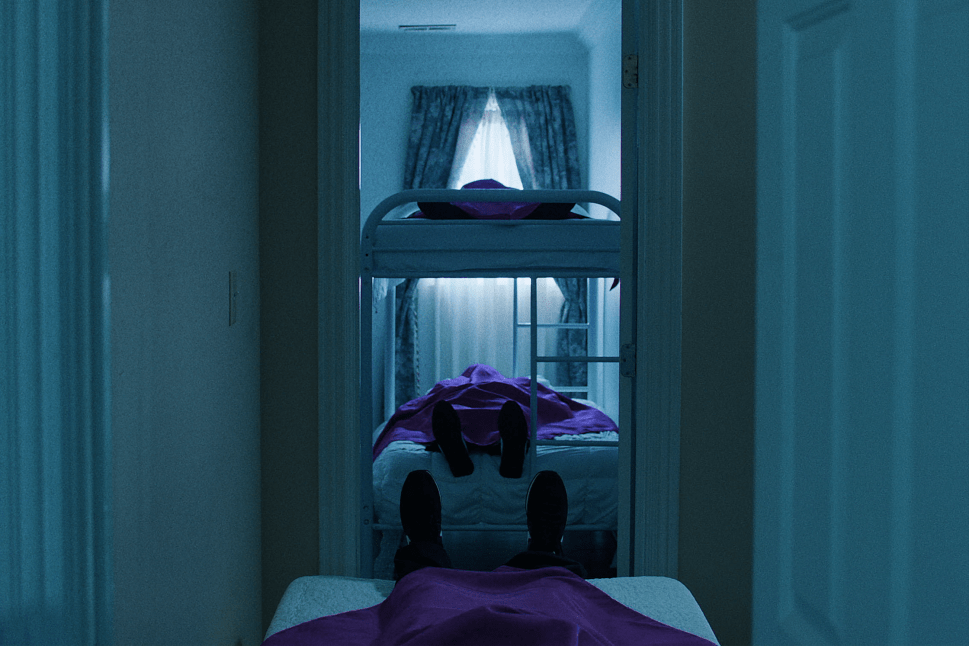
The Leader, Michael Gallagher’s tale of the Heaven’s Gate UFO cult, is too erratic to be absorbing. The true-to-life drama traces the decades-long buildup to the group’s 1997 mass suicide, which the story employs as its opening framing device. However, its haphazard assembly renders this narrative structure a hindrance to real investment, as the movie seldom grows beyond rote observation, despite trying to humanize its subjects.
The film is led by a more-than-capable cast, but they often find themselves restricted by Gallagher’s filmmaking—a product of rigid composition and unstable focus. Tim Blake Nelson plays “Do,” a.k.a. Marshall Applewhite, the group’s founder, whose instructional home videos in his old age are eerie in isolation, but are inserted into the proceedings almost at random, robbing the film of all momentum. This temporal hopscotch is also applied to co-founder “Ti,” or Bonnie Nettles, a matriarch whom actress Vera Farmiga imbues with an icy chill, but whose lone audio interview is similarly scattered throughout the runtime.
The movie feels, in alternating moments, like it was either cobbled together from too little footage or shaved down from far too much, as though it ought to be either a punchy short film or a more detailed miniseries. It’s especially hard to shake the specter of the latter each time it resets and introduces a brand-new protagonist—a different, vulnerable follower—albeit for short periods. These characters (Warren, Michelle and David) are played by Jim Parsons, Grace Caroline Currey and Simon Rex, who are all undoubtedly committed to their roles as lost souls in search of meaning. But every time the movie switches focus to one of them, each of their characters’ stories seems to play out on fast forward—or at least, far more quickly than the one preceding it, as though this three-decade saga were somehow running out of time.
The Leader ★1/2 (1.5/4 stars)
Directed by: Michael Gallagher
Written by: Michael Gallagher
Starring: Vera Farmiga, Tim Blake Nelson, Jim Parsons, Grace Caroline Currey, Simon Rex.
Running time: 104 min.
Although Gallagher grew up mere miles from the site of the tragedy, his persistent curiosity about the case seldom translates to curious artistry. He presents his cult leaders and followers as characters trapped in amber, each frozen by defining characteristics that offer little dramatic possibility. An entire universe exists between the goalposts of doubt and pure fanaticism, but aside from the occasional switch between extremes, the film’s emotional needle remains still, resulting in some painfully awkward moments where the tragedy is subsumed by farce. Sometimes its comedy is intentional (other times, who’s to say), but either way, it comes at the cost of real investment in the characters’ pain.
The Leader is, on its surface, a film about closetedness and repression, between the cult’s ascetic teachings and Applewhite’s apparent queerness, which he rejects, alongside all other forms of sexuality, while unintentionally repurposing traditional family structures and forms of abuse. Along the way, Parsons’s Warren becomes the only character to receive adequate tonal care, as a figure of both mockery and pathos, though this is perhaps owed to the Big Bang Theory actor’s precision at layering empathy with caricatured debasement.
As the group awaits their alleged ascension to outer space—you’d be surprised how little attention is afforded the psychological impact of their Christ-meets-sci-fi beliefs—dramatic scenes appear to be cut short for the sake of a purely utilitarian unfurling. It’s a bizarrely facts-first movie for one that seems to want to get close to its damaged subjects. But in most cases, the edit seldom holds on their closeups long enough to capture what they’re thinking or feeling before tumbling toward the next scene. Consecutive moments can be separated by years or decades, but there’s rarely any resonance between them, or any apparent rhyme or reason for this non-linear telling. Whatever the considerations, the result is shockingly dull, for a tale of people so impassioned that they were willing to kill themselves based on misguided beliefs about the world and about themselves.
What is perhaps most telling about The Leader is that its concluding couple of minutes do, in fact, feature thoughtful artistry steeped in abstraction. And while the rest of the movie needn’t follow this mode (as a biopic, it can be as literal or expressionist as required), its genuinely alluring climax proves that getting inside its characters’ heads, or within their moods, was always a possibility. Unfortunately, by the time this actually happens, it’s too little and too late.
While you might leave The Leader knowing more facts about Heaven’s Gate, by the time the credits roll, you’ll end up with little emotional or even speculative insight into who they were, or why they were, and the despair that led them down this path. It’s a tragedy of facts and details first, rather than one of catharsis or gaping wounds. It’s all bullet points and no sinew, yielding an experience where no amount of expressive performances can come to the rescue.
