
The trenches of World War I set the stage for queer yearning in Lukas Dhont’s Coward, the Cannes competition entry that—despite its numerous pitfalls—won both its lead actors the Prix d’interprétation masculine, or the award for Best Actor. The trophy was well-deserved, not only despite Dhont’s malformed drama, but perhaps even because of it, forcing standout stars Emmanuel Macchia and Valentin Campagne to conjure depth and subtext from the ether; movie magic comes in many forms.
Macchia plays Belgian youth Pierre, a caricatured farmboy lunk whose broad sketching is made immediately effective by the actor’s touching naïveté. Practically lost on the front lines, the character’s forced grins are betrayed by his darting eyes, which always seem to be searching for something—either a way out of his country’s cruel wartime predicament, or some way to formulate the right questions about himself in the first place, and his position in a hypermasculine, militaristic hierarchy.
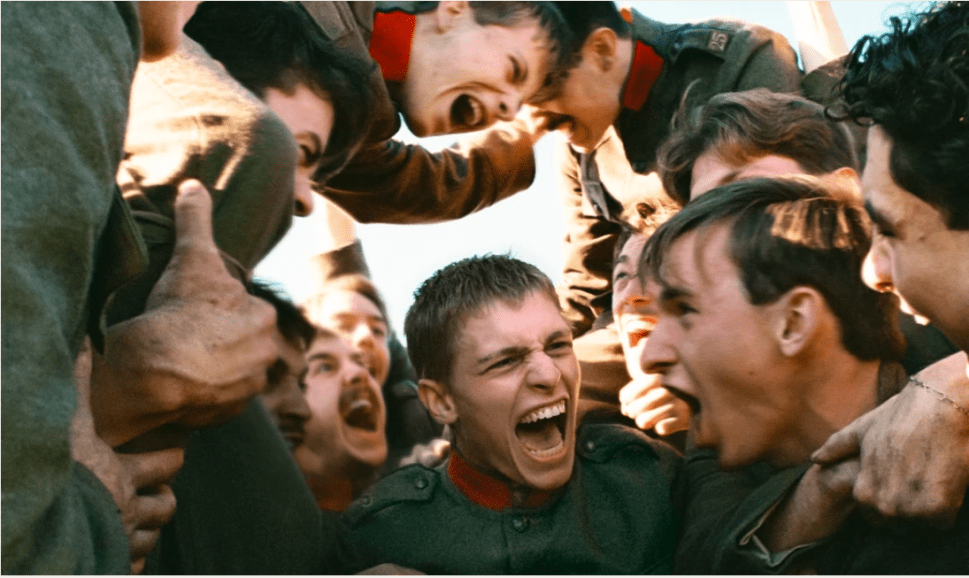
Pierre first lays eyes on the slender, boisterous Francis (Campagne) when the latter—his belly stuffed to appear pregnant—is playfully rushed to the men’s makeshift mess hall in order to pantomime giving birth, while spread eagle across the lunch table. A scene rife with boyish energy, it’s part prank, part celebration, since one of their comrades has just become a father. However, Dhont’s camera can’t help but frequently fall on Pierre’s inquisitive disposition. The ex-farmhand seems to love the façade and bawdy camp (not to mention, Francis’s unfettered confidence in performing femininity), though he’s a far cry from introspecting as to why.
This sets the stage for Pierre being lured away from the mud, the guns, the blood and bombs, and towards Francis’s unit: a group of young men charged with entertaining their conscripted countrymen across the European front to boost their morale. In scenes of wartime chaos, Dhont and cinematographer Frank van den Eeden craft a lurid intensity in the dead of night, a palpable danger from an unseen enemy, matched only by what becomes of young soldiers too scared or damaged to carry out their orders. They’re labelled deserters and executed by their own superiors, further solidifying the walls placed around Pierre should he even think about leaving.
As a straightforward war movie, Coward mostly works. To match the bombast of the battlefield, it summons a raucous energy whenever Francis’s cavalcade of male step-dancers dons dresses to rally the other troops. It’s a film of tremendously thoughtful setups, taking aim at the subtle hypocrisies of masculine prisons while threatening to expose their inherent homosocial allure. However, as a film about two men’s gradual romance, it is often left wanting for a real soul, and a tangible sense of connection between its characters.
In their isolated moments behind closed doors, Pierre and Francis rarely transcend their roles as individual characters. There’s little sense of actual dynamic between them (not to mention, a discernible lack of spark), owed in large part to Dhont’s reliance on dialogue and its rote presentation. In a moment of intimate choreography, Campagne lays his triangular face perfectly within Macchia’s concave sternum, as though Pierre’s heart had been waiting for someone like Francis, but this potentially beautiful moment is made odd and awkward by the fact that the two young actors must work overtime just to make it seem like their characters even like each other.
As the film goes on, Pierre’s questioning of his own identity, as a militaristic pawn, ends up at odds with Francis’s genuine dedication to the cause, as an entertainer who aims to stir up patriotic sentiment. Separately, these make for intriguing stories, but little tension stems from the young lovers ending up practically on opposite sides of war as a concept (to say nothing of the film’s lacking critical approach to the historical intersection of queerness and militarism, which fellow Cannes competition entry La Bola Negra captures far more soulfully). Despite all but establishing an internal tension between entertainment and propaganda, the movie’s political dimensions are surprisingly dulled, a flaw that goes hand-in-hand with its lead characters seldom having to fight against (or even really consider) the larger implications of anything but their own fantasy, though they’re always at risk.
Even when reality comes crashing down on its protagonists, Coward plays less like a film of thorny closeted-ness (or of re-locating queer identity within a broader, tumultuous history), and more like a prescriptive contemporary document of queer wartime cosplay, especially as the battlefield fades from the movie’s purview. All the while, however, Macchia and Campagne remain eminently watchable, capturing fleeting moments of unpredictable thought and action from behind Pierre and Francis’s respective emotional walls—which Dhont, unfortunately, never has them scale. Even at two hours in length, it’s left wanting for real substance.
