
The scent hits you before anything else. Stepping into Manuel Mathieu’s corner of the Arsenale at the 61st Venice Biennale, you enter a low-lit room and are met by a warm, earthy fragrance: vetiver, sourced from Haiti, blended into something unexpectedly comforting. It took me a moment to place it, but the aromatic tingle of it eventually landed somewhere specific—the Vicks VapoRub my mother used to rub on my chest when I had a cold as a child, that powerful, enveloping sensation of being looked after. The immersive installation unfolding around you, Pendulum (2025), though, is more haunting than comforting.
Haitian-Canadian artist Mathieu is one of the few participants in this year’s Biennale showing in both the Arsenale and the Giardini—a feat that speaks to the breadth and ambition of a practice encompassing painting, mosaic, ceramics, film and olfactory art. Invited by late curator Koyo Kouoh, whose theme “In Minor Keys” privileges quiet forms of resistance over grand declaration, Mathieu’s debut at the world’s most prestigious art exhibition feels perfectly calibrated.
Pendulum began as a short film in 2023—winning the top prize at FIFA that year before touring to the New Orleans Film Festival, the Toronto Biennial of Art and the Pérez Art Museum Miami—before expanding into the immersive installation now presented here. In the Arsenale, it takes the form of a double-sided screen suspended in the darkened space, and combined with four life-size fabric figures lying across the floor, each emitting the vetiver fragrance.
On screen, a woman in a white dress and headdress moves through a forest, the fabric of her garment trailing behind her like a wedding train. At moments she opens the cloak wide—arms outstretched, as if she might take flight; at others she wraps it around herself like armor. When I described her to Mathieu as a bride of history, he lit up. “That’s it,” he said. “And what is she marrying?” It’s a question the work deliberately refuses to answer. The dress itself—or one almost identical to it—stands nearby on a mannequin, a cinematic relic made suddenly three-dimensional.
The film cuts, and we are in a field. A group of men maneuver a large white sheet between them, tossing and folding it around objects that turn out to be broken dolls akin to those in the space in the Arsenale—limbs scattered and dismembered. The action is repetitive, exhausting and strangely familiar; it recalled, for me, those parachute games from school P.E. lessons, where the point was collective coordination and the rules were never entirely clear. The men don’t speak to each other. They don’t appear to be communicating at all. They keep going anyway. “They could stop at any time, but they don’t,” Mathieu said. For him, the loop is the message: the inability of individuals to articulate their inner experience to one another is precisely what keeps the cycle turning.
The dolls mean different things to different people—one of the actors saw them as white souls; another was too uncomfortable to name them. For Mathieu, they represent psychological burdens. The question is not what they are but how each person chooses to carry them. The woman who opens the film, walking with the weight of all that fabric, passes it on. The men receive it and don’t know what to do with it. The vetiver, sourced through a fragrance house with access to Haitian-grown material, was designed to make you want to stay inside that uncertainty. “A smell that would embrace you,” as Mathieu put it.
The decision to pair so potentially confrontational a film with something so physiologically soothing is the work’s masterstroke. Olfaction bypasses the analytical brain, Mathieu argues, going directly to memory and emotion. The fragrance also exists beyond the gallery walls—Mathieu is the founder of Manuel Mathieu Parfums, and the vetiver blend is available as a candle, meaning visitors can carry not just the memory of the exhibition but its atmosphere into their homes. Some will carry it more literally: the scent lingers on skin and clothing long after you leave, which feels entirely intentional for a work whose central argument is that history does not stay where you left it.
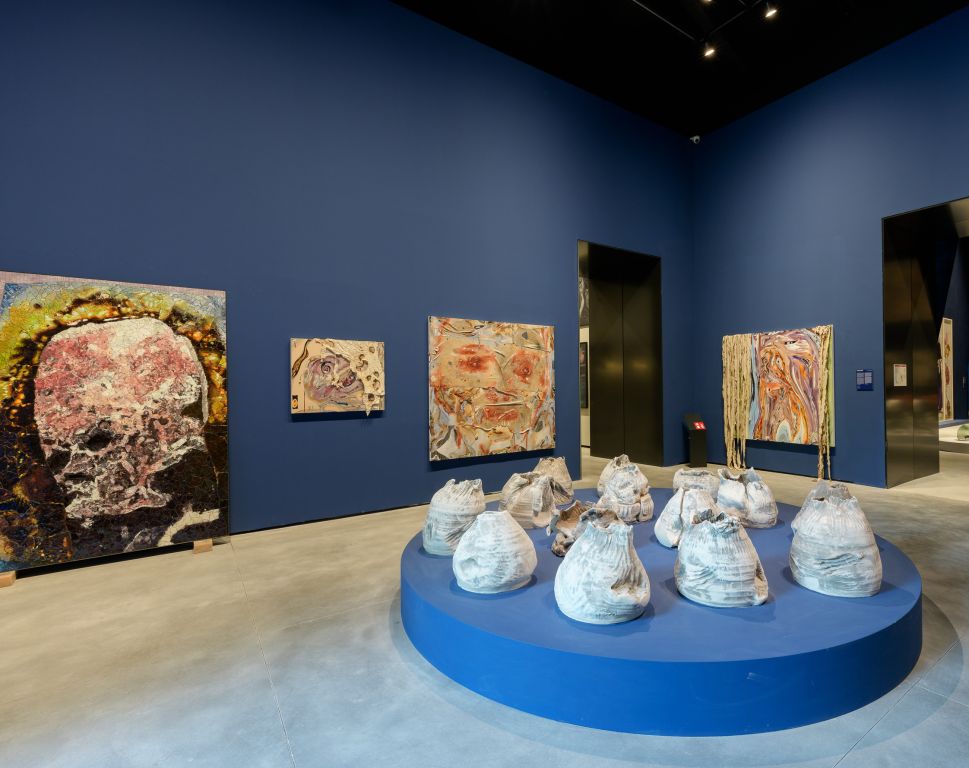
Moving from the Arsenale to the Giardini, the scale and medium shift but the preoccupations remain constant. Physicality (2023) comprises 14 vases at various stages of collapse—forms caught in a state of flux, vacillating and dissolving, as if what they once contained has already begun to slip away. Handmade during a residency in Jingdezhen, China, they are deliberately imperfect, the visible marks of making (literal handmarks) preserved in the surface. Mathieu describes the firing process as a metaphor for transformation—how heat creates new forms, causes cracks, and can destroy while preserving essential elements. His team, he noted, broke an entire clay oven in the process because the works were too dense. They function like archaeological fragments, suggesting buried histories rather than illustrating them, and they demand a different kind of attention than the paintings: you want to reach out and feel the weight of them.
“MANUEL MATHIEU“
Venue: La Biennale di Venezia
Address: Central Pavilion/Arsenale
Runs Through: Nov. 22, 2026
That same earthy, geological quality carries into Abundance and Drought (2024), a large-scale mosaic that from a distance reads as something parched and elemental—cracked terrain, almost skull-like in its contours—before drawing you closer, where the patient accumulation of thousands of hand-assembled fragments gradually reveals itself. The work was developed as part of the research for Le Mont habité, Mathieu’s permanent commission of five monumental mosaics for Montréal’s REM transit network. “The slowness isn’t imposed,” Mathieu said, “but emerges from the work’s inherent complexity.” Both works share a sense of time made visible in material—the labor is the meaning—and in an exhibition context that often rewards spectacle and speed, that feels like a position as much as a process.
The paintings that surround it—Self Preservation (2025), In the Heart of the Revolution II (2025) and the new Genocide (2026)—are built from layers of canvas, paper, paint and, increasingly, burned fabric, a material Mathieu has incorporated into his practice over the past several years. La fenêtre (2025) and The Veil (2025) both use hanging strips of fabric alongside or fused into the painted surface, creating thresholds rather than fixed images: figures appear distorted, as if seen through glass or through the scrim of memory itself. In The Veil, scorched cotton is pressed directly into the paint, obscuring and perforating the image beneath. The fabric carries a specific historical charge—cotton is inseparable from the economies of enslaved labor—and to burn it is to refuse its original function, to transform a material of exploitation into something else: a scar, a rupture, a refusal.
Genocide stopped me in my tracks—not least because of the context in which I encountered it. The day before the Biennale’s official opening, the Art Not Genocide Alliance coordinated walkouts across at least a dozen national pavilions in protest against Israel’s participation. To move from that charged atmosphere into a room containing a painting of that title—its surface organized like a degraded grid of archival photographs, faces pressing through layers of fragilized paper only to dissolve into abstraction—was to feel the word’s weight land in real time. Down the right-hand side of the canvas, suspended on a black string, hangs an object curved like a scythe, but with a certain bone-line quality. It is hard to say exactly what it is, and Mathieu seemed content to leave it that way. “It could be an instrument,” he said, “it could be a residue of that violence—a finding from that violence.” The ambiguity is the point: whether it is a tool of killing or a relic of it, something has already happened here.
“It’s an instrument of erasure that is being used more than ever these days,” Mathieu said plainly when we spoke. The painting doesn’t illustrate a single event but situates genocide within a longer continuum, linking the photographic documentation of atrocity to its gradual failure to hold meaning across time: images fade and records become illegible. The faces beneath the surface are present but unidentifiable, echoing Mathieu’s earlier work, 1954/Flats and Sharps (2016), which referenced the year François Duvalier came to power in Haiti, its colorful forms punctured by sanded black voids acting as visual black holes, standing in for lives and narratives erased by violence. Genocide extends that grammar into the present tense. For Mathieu, these are not separate histories but a single pattern, repeating under different names, in different geographies and across centuries.
His practice, across both venues, insists that history is not the past. It is a loop—like the men in the field, like the recurring structures of domination he traces from Haitian dictatorship to contemporary violence—that continues until someone finds the language to name it, or better yet, to stop it. Whether art can provide that language is a question he wisely leaves open. What it can do, this exhibition argues persuasively, is make the loop visible: in the weight of a ceramic vessel, in the slow accumulation of mosaic tiles, in a scrim of burned cotton pressed against paint, in a fragrance that you carry out of the building and into the world.
