
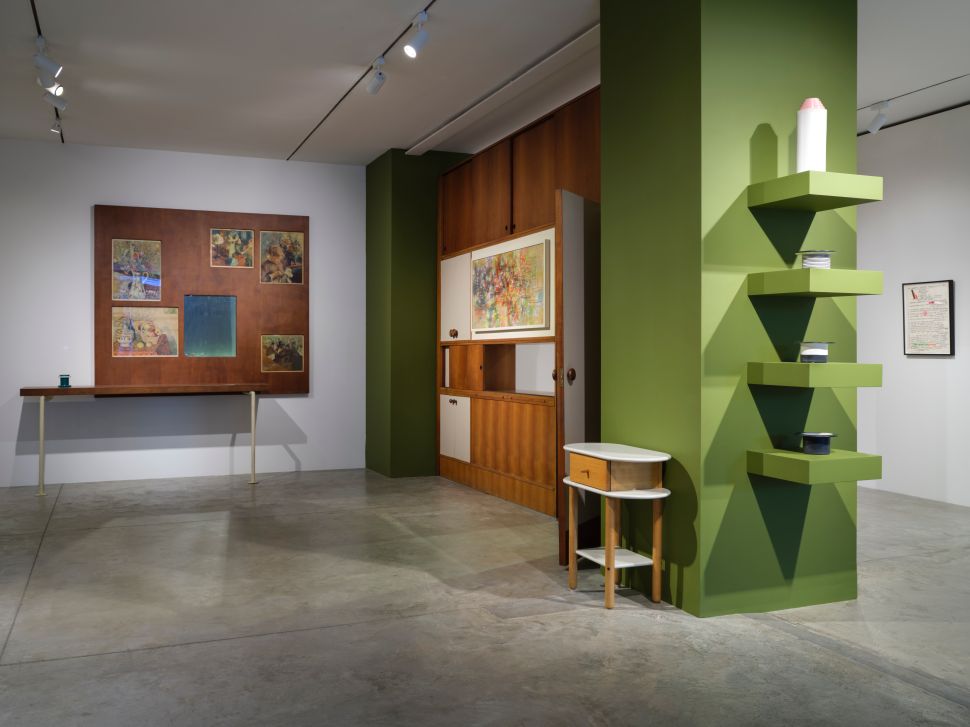
Friedman Benda in New York was one of the very first galleries to put design on the same level as fine art, adopting a business model and approach closer to those of a contemporary gallery when dealing with both the work and its creators. Founded in 2007 by Marc Benda and Barry Friedman, the gallery has played a pivotal role in elevating design to a conceptual, museum-level practice, while, from the very beginning, showing a clear commitment to fostering a more critical understanding of design history. Benda and Friedman’s strategy involved expanding the design discourse beyond its established sources, bringing forward perspectives that had previously been marginalized. Identifying and advancing key narratives at the intersection of contemporary design, craft, architecture, fine art and cutting-edge technological research, the gallery championed a fertile synthesis between leading creative thinkers and makers, moving fluidly beyond disciplinary boundaries.
When we connect during TEFAF Maastricht, Marc Benda is quick to state that “collectible design” is not part of his vocabulary. “What we do is quite simple: we work with design—furniture and objects created by artists, architects, and designers. But the idea of labeling something as ‘collectible’ raises questions. Do you need to tell someone that something is collectible? Is one object inherently more collectible than another? I’m not convinced.”
Benda considers the design works they deal with to be simply art. They have a functional dimension, but he acknowledges that, in working with both artists and sculptors, the similarities in the creative process often outweigh the differences. “The idea of representing design in the same way art galleries represent artists is the core idea of the gallery.” The main difference between design and art, he adds, lies in production. “Design objects are fabricated: they involve processes, materials, and technical constraints. But fundamentally, the creative drive is similar.”
Art historically positioned itself outside the industrial sphere, but in the early avant-gardes, art, design and architecture were perceived on a continuum that shaped the aesthetics of modern life. Even in the postwar period, certain movements—particularly in Italy and France—reintegrated art and artists into an industrial context, drawing comparisons to the Bauhaus approach. The American model, by contrast, tended to enforce a stricter division between art and design. This helps explain why major art galleries have often been reluctant to exhibit designers, despite the commercial viability of their work. This dynamic has shifted over time, as seen in the market rise of the Lalannes after their presentation by galleries such as Ben Brown, Di Donna and Kasmin or of Isamu Noguchi, represented by Pace. This fluid exchange goes both ways, with more contemporary artists engaging with design, as with Adam Pendleton, who has also shown at Friedman Benda.
When Friedman Benda opened, the idea was to represent designers in the same way that art galleries represent artists. At a time when many design galleries focused only on the past—selling vintage works—or on production, Benda sought to avoid dictating output through direct commissions. Rather than asking designers to produce a fixed number of pieces, he aimed to grant them the same creative freedom afforded to artists, opening up new possibilities.
Friedman Benda established its reputation by representing some of the most respected and era-defining designers, including Ettore Sottsass, Ron Arad, Shiro Kuramata and Andrea Branzi. Benda admits that, at the beginning, he felt he had more to learn than to teach. Over time, the gallery expanded to include designers from his own generation and later younger practitioners, creating an intergenerational dialogue across geographies that contextualizes emerging voices while reframing established figures through new perspectives.
“This approach reveals pathways across generations and geographies,” Benda explains, citing the juxtaposition of figures such as Branzi, the Campana Brothers and the younger American designer Misha Kahn. “You begin to see unexpected connections and shared concerns, despite their differences.”
Benda remains focused on continually adding new perspectives to the program: “If you look for someone who fits, very often you find that they do more of the same, as opposed to looking for those who really add, who open new doors in a dialogue. I always wanted to build an encyclopedic program rather than a focused one.” Geography and cultural context also play a crucial role, as designers are shaped by the materials, textures and environments they inhabit. “I’ve worked extensively with Shiro Kuramata and, for over two decades, with Nendo. While they belong to different contexts, both have profoundly shaped Japan’s design culture and influenced global practices.”
To Benda, this kind of material intelligence, deeply rooted in physical experience, is at risk of being lost in an increasingly virtualized world. “Maintaining that connection to objects—physically and even spiritually—is essential,” he says, arguing that design continues to foster valuable encounters.
Yet in building the gallery’s program, Benda is less interested in who “fits” than in who contributes something new. “If you only look for fit, you risk repeating the same ideas. I’ve always aimed for an encyclopedic program that opens dialogues and expands in multiple directions.”
Benda believes the role of the gallerist is similar across disciplines: placing ideas and objects before the right audience. That audience, notably, is not limited to buyers, but includes students, curators and future practitioners, with the understanding that works will have a life far beyond the gallery.
The trajectory of Formafantasma offers a clear example. Friedman Benda supported the Italian duo early on, helping to establish their international presence through exhibitions and fairs, including their recent solo booth at TEFAF Maastricht this March. “Their work is conceptually rigorous and highly focused in a distracted world,” he reflects. “What I offered was a platform, particularly in the United States, and a framework for presenting their ideas.”
Concurrently, Friedman Benda is actively invested in establishing a context and tracing a historical continuum between modernist pioneers and contemporary creators. The gallery’s presentation at TEFAF New York this May, for instance, considered Modernism not as a single coherent movement but as a field of expanding possibilities, from early statements by John Chamberlain and Wendell Castle to a foundational ceramic work by Osamu Suzuki, recent work by Nicole Cherubini and important Shiro Kuramata chairs from the Soseikan Yamaguchi House, shown for the first time in New York. At the center was an early example of Gerrit Rietveld’s iconic Red Blue Chair (1922), a radical object—one of the few still in private hands—that distills the Dutch De Stijl architect’s commitment to clarity, structure and abstraction into a single form.
Benda sees the gallerist’s role as that of an editor in shaping and contextualizing content. “Artists may think everything is good—or nothing is. My role is to say, ‘This is strong,’ and then stand behind what I present. That’s one of the most important functions.” While the recent boom in design has expanded its audience, Friedman Benda’s collectors have always been diverse: established design enthusiasts, art collectors and, increasingly, museum curators. “Many curators came to us early on to build long-term relationships and collections. Museums began engaging with this field earlier than people might assume. Many came to us because they couldn’t buy at auctions and didn’t want to go somewhere with just one piece.”
According to Benda, the design market has expanded significantly over the past 20 to 25 years. After the pandemic, in particular, it experienced a period of exceptional strength, but he also sees it entering a phase of volatility that has accompanied the recent acceleration, particularly in the secondary market and at auction. But collectors now are also looking for greater certainty and information—a shift he views positively, as it leads to more thoughtful decision-making and serves as a counterpoint to the hype. In fact, the biggest challenge for collectors today is distinguishing true quality from mere product. “Because design overlaps with industry and art, it can be confusing. Education is key: seeing exhibitions, reading, and engaging with different perspectives. The more you see, the more your eye develops.”
From the outset, the gallery has operated internationally, spanning Europe and the United States. Today, the design market is global, and Friedman Benda serves a broad customer base through its galleries in New York and Paris. While fairs remain important, Benda admits he wants to do fewer of them and focus instead on more meaningful presentations, including in museum exhibitions.
