
What happens if, for a moment, we adopt the perspective of a satellite orbiting overhead, kilometers away, looking down at our planet from above? It is certainly getting much more crowded up there than it once was. Technological advancement, some of it increasingly inscrutable to ordinary people, has opened an entirely new politics of power and dominion, extending the Anthropocene’s technological hegemony into spaces that are not necessarily human but that we have made ours: the sky and outer space. London-based artist Xin Liu engages with these themes in her latest commission for New York’s High Line, inviting us to empathize with the worldview of a National Oceanic and Atmospheric Administration (NOAA) satellite.
Co-produced with Onassis ONX, NOAA: A Fall Towards Home reimagines NOAA-15 as a sentient being. Through intimate, diary-like entries, Liu gives voice to the satellite as it narrates, with childlike naïveté and curiosity, its journey from Earth-born machine to permanent celestial wanderer. Once tasked with documenting and reporting on our planet from afar, it is abruptly decommissioned and left to wander among tons of astronautic debris, floating through space and contemplating the disillusionment of the failing technological utopia to which it contributed.
Launched in 1998 from California’s Vandenberg Air Force Base as part of NOAA’s Polar Operational Environmental Satellites constellation, NOAA-15 spent decades faithfully recording weather systems, cloud formations and shifts in Earth’s atmosphere—and, by extension, natural disasters. On June 16, 2025, NOAA officially ceased data delivery from NOAA-15, which was formally decommissioned in August of that year, along with other satellites in the model series, as the newer Joint Polar Satellite System (JPSS) took over the low-Earth-orbit weather-observation mission with more advanced instruments and faster data delivery. While this was an end-of-life decision for an aging satellite system—one that already raises questions about the impact of technological obsolescence in outer space—it came at a precarious moment for environmental science and research. In recent months, amid a broader Trump administration effort to shrink NOAA’s research and satellite infrastructure, the Office of Oceanic and Atmospheric Research has been floated for the chopping block as contracts for next-generation satellite programs have been canceled.
After the performance that activated the installation, Xin Liu described this High Line commission as a work born of a desire to shift perspective—not only from Earth to space, but from human certainty to the mediated systems through which we now experience the world. Liu has always worked at the intersection of art, technology and science, using that space to raise broader questions about these tools and their implications for the environment. Originally trained as an engineer, she studied Measurement, Control Technology and Instrumentation at Tsinghua before earning an MFA from RISD and an MS from the MIT Media Lab. “I think there are so many aspects of human experience that can expand beyond our daily life,” Liu told Observer, noting how this desire to humanize the satellite emerged from the way she sees the world. “I feel it is possible to find beauty in unexpected places, but it took me a while to figure out how to share that experience with people.”
That intersection—so crucial at this point in our civilization—is not just a theme but the actual operating system of Liu’s research practice. Using scientific processes, instruments, materials and infrastructures as both subjects and media, she humanizes them, turning them into animated characters within stories we can empathize with, making complex concepts more accessible and closer to everyday life.
She pointed out that much of contemporary life is already mediated by invisible technological systems. Even a simple phone call, she noted, involves a voice being translated into signals, sent through satellites and returned to Earth before reaching another person. “It is this really wild, mundane journey that is taking place all the time, but we are not able to access it because it is invisible, within a silent and often uncodifiable infrastructure.”
At a moment when many people feel anxiety around technology and A.I., Liu sees value in making those systems more perceptible—not necessarily to solve them, but to expose herself and others to their strangeness. NOAA: A Fall Towards Home grew out of her fascination with older satellite technologies from the 1990s. Compared with today’s devices, those technologies now feel clumsy and outdated, but also more tangible and ‘real.’ “They are heavy, almost military devices. Once they are launched into space, those satellites are frozen in time: they remain from the 1990s, while everything else on Earth has fast-forwarded into the twenty-first century,” she reflected, noting that interfaces back then were rougher and users often had to understand at least something about how they worked. Today’s technologies, by contrast, are designed around smooth, frictionless surfaces—seamless interfaces that make interaction feel easy while concealing far more complex systems beneath. “Now it just feels like part of a bigger system, completely integrated into our lives, but we don’t know how it works.”
The NOAA satellites interested Liu because of their changing lives and uses. Originally designed in the 1990s for specific purposes, including disaster response, they were not built for long-term, continuous weather monitoring. “It was more like: ‘There is a hurricane; we have to figure it out,’” she said. Yet as a long, continuous archive accumulated, a new understanding emerged. “Weather becomes climate.”
Now, after their decommissioning, the satellites have entered another phase, drifting while amateur radio enthusiasts, students and hobbyists on Earth receive and interpret their signals. “There is something about the afterlife of technology, and how things change in their properties and relationships with the world as they age,” she argued. “Whoever designed those satellites in the 1990s designed them for very specific reasons, but because they were left there, the satellites took on a whole life of their own. I find that quite beautiful.”
That shift, however, opens one of the central questions of the work—and of contemporary society: how much of our picture of the world is filtered, constructed or manipulated by the devices and infrastructures that mediate it. Liu was struck, for instance, by the realization that certain iconic images of Earth—such as some versions of the “Blue Marble”—are not single photographs but synthesized or composite views. Most people will never see Earth from space, yet such images shape how they imagine their position in the universe. “This is where it becomes interesting, to think about visual culture not just as something you look at, but as something that changes your perspective. For me, the question is: once you start looking at things in different ways, do you misunderstand your own position within them?” she said, considering how so many images of crisis today—from war zones, forest fires or other disasters—are not taken from within those places. “They are always from above. That is a godlike perspective, and there is already a principle of domination in that.”
Despite its sentimental and poetic tone, at the core of this work is a growing tension between technological ambition and human vulnerability: an ongoing unveiling of how the utopian desire for endless technological advancement also exposes our fragility, the interplay between desire and control, and the increasingly visible threats implied by power dynamics.
This is not the first time Liu has addressed the aftermath of scientific and industrial ambition—its debris, exhaust, obsolescence and mutations. In Living Distance (2019-2020), conceived during her residency at Pioneer Works, Liu sent her own wisdom tooth to the International Space Station, making it the protagonist of a performance, two-channel video and VR work. The tooth became a strange personal surrogate: a fragment of the body traveling where the body could not. Through that gesture, Liu collapsed the scale of outer space into something bodily and almost tender, using an extracted body part to reflect on distance, isolation, transformation and the fantasy of human expansion beyond Earth.
With NOAA: A Fall Towards Home, that operation takes on an even more sentimental register. The decommissioned satellite, now deprived of the function it once approached with the naïve enthusiasm of a child discovering the world from afar, becomes an aging figure grappling with profoundly human existential questions: Where is home? Who am I? Where do I belong?
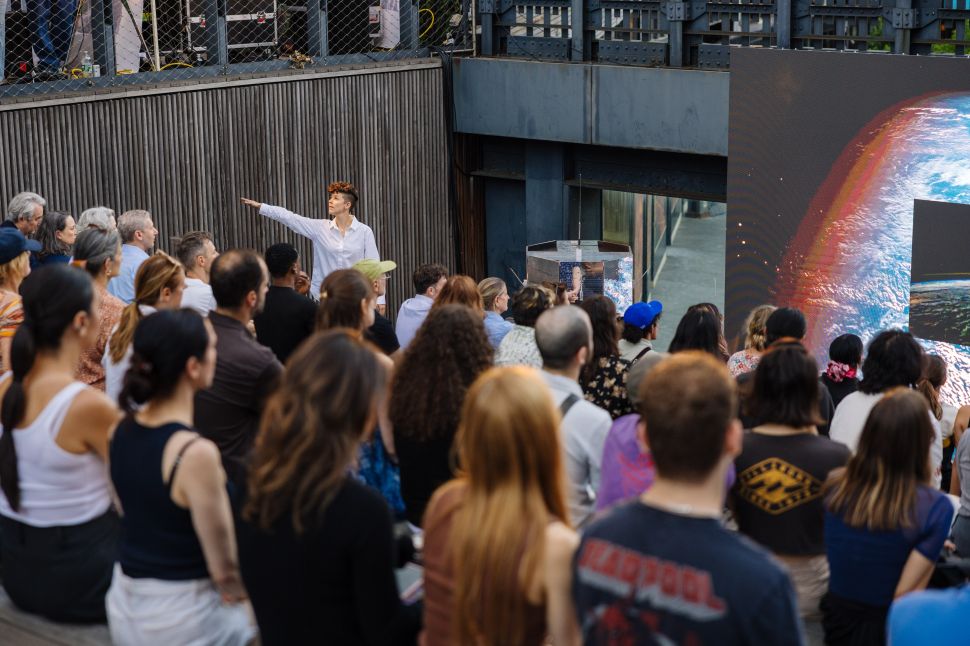
Activated through a series of performances last week, Liu’s work is perhaps described as a multilevel, multimedia epic of storytelling, closer to contemporary opera in the way it draws across disciplines and collaborators to articulate the narrative and its imaginary.
Although she initially imagined the project as a video work, the process of chasing the satellites made her realize it needed a live, embodied form: “It was a very visceral experience. I had to hold a broomstick for ten minutes, pointing at the sky; it’s a very tiring physical experience, and weather-dependent,” she recalled. The work is an attempt to embody these out-of-place life events—and that firsthand physical experience is inseparable from it.
The process began with a script developed through conversations and workshops with an opera director friend. “I was asking her, ‘How do you make a performance?’ and she taught me something really useful: you can tell the same story through one modality at a time,” Liu explained. “You can tell the whole story only using music. Then tell the whole story only using text. Or tell the whole story through movement alone. After those exercises, you glue them together and reassess what you are doing. That is practically what I did.”
Integrating visual and sonic elements—singing, dancing and technology—the commission also marked a new level of collaboration in Liu’s practice. Brooklyn-based composer and vocalist Alex Koi led the sound, working alongside audio engineer and sound designer Kate Siefker and percussionist, composer and synthesist Qasim Naqvi, while dancer and choreographer Leah Wilks conceived the performative component with Liu.
The sculptural piece the team called “15” became one of the work’s key characters. The High Line’s unusual zigzag ramp shaped the choreography, as there was no conventional stage between the screen and the audience. Movement had to occur among viewers, and Liu designed the sculpture to travel through that space. Because the work dealt with satellites, she gave the performers a framework of orbiting gestures: restrained, repeated movements, often traveling back and forth. The sound followed the same structure, returning to the same musical material with changing textures and moods as the story progressed.
Together, they worked through extensive rehearsals until everything fell into place. The space itself, along with the weather, became a character. Because the performance unfolded outdoors, it remained subject to rain, sunset, humidity, car horns, clouds and the city’s shifting atmosphere. The first performance, on Tuesday, June 23, had to be postponed by an hour after rain fell steadily from early in the day until evening. Yet that same weather cycle created the conditions for a brilliantly ignited Manhattan sunset as the backdrop for the work, suspending it in the city’s summer haze and humidity. “I liked the fact that we had to deal with the rain, with delays, with sunset. The work is meant to be experienced in relation to the whole world and the cloud system. It is meant to be like that.”
For Liu, the performance became another form of translation—across media, disciplines and people: “Live performance is also something you cannot replicate. Last night, I could not have commanded the rain to do what it did. There was the smell of humidity and wood, and the sky turned pink behind us. The clouds moved away. It was impossible to reproduce.” Every iteration will be different, beautiful in its own way; the performance is porous—it goes into the space, further highlighting the vital entanglement of human and non-human elements on which all our existences depend.
During the performance, the question arises of whether Liu’s speaking presence is that of a satellite, a human, the artist or something in between. The characters become intentionally interchangeable, in an interweaving of stories from different positions, with continuous role shifts that mirror the work’s broader concern with unstable perspective.
The audience response, Liu said, surprised her. Many viewers found the piece far more emotional than they had expected from a work about satellites. Some cried; others connected the narrative to experiences of immigration, isolation or displacement. One person told Liu that the satellite must be lonely and cold “up there,” a reaction that moved her because it suggested genuine care for an object usually understood only as infrastructure.
That emotional response matters to Liu because the NOAA program and related weather-data systems are so often discussed only in bureaucratic or technical terms. “It was very sweet to see people care about this, because NOAA programs have been defunded in the last two years,” she said, noting that people do not usually feel personally connected to the defunding of a federal program, especially amid so many other crises. “There is so much else going on in the world, but I feel it is important to understand that these devices are instrumental to our understanding of weather systems and climate.”
