
Art people struggle when they have to discuss the work of popular artists. They don’t want to come off as snobs, and most probably have positive thoughts about increased museum attendance. Plus, you never know how the pendulum is going to swing in these matters. In this bear art market, one of the artists to have an unexpected uptick in interest at auctions is Bob Ross, the television painter of those “happy little trees.” Just wait until the kids on TikTok discover the work of Thomas Kinkade.
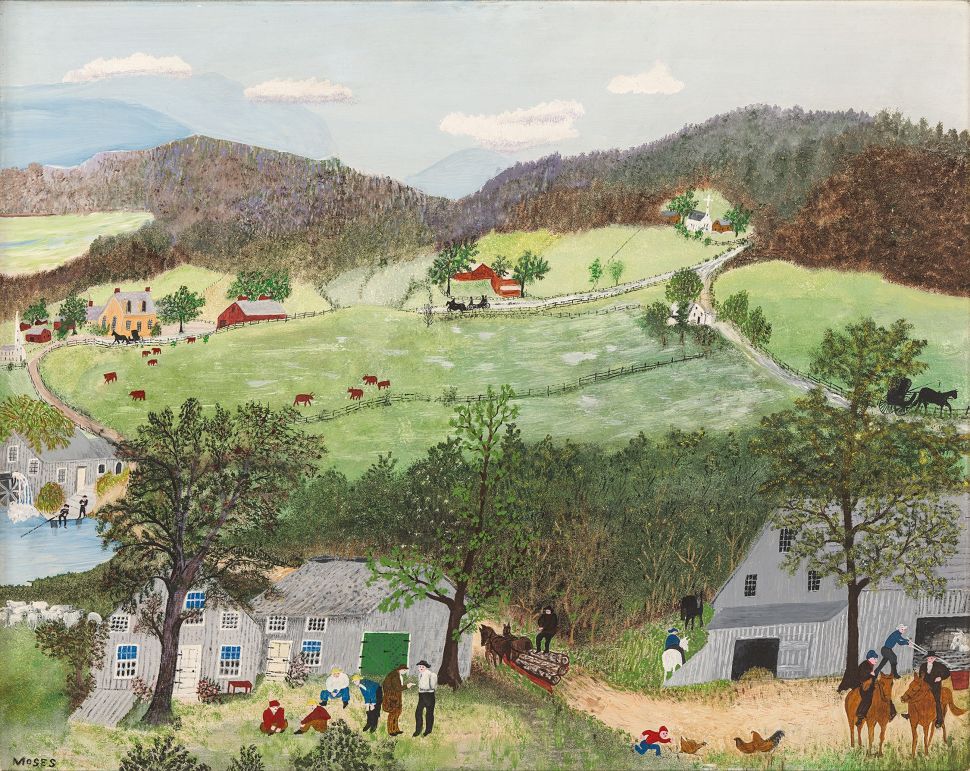
“Grandma Moses: A Good Day’s Work” at the Smithsonian American Art Museum is the institution’s bid to drag Anna Mary Robertson Moses (1860-1961) out of the greeting-card rack and back into some arguments. Anchored by 33 works from SAAM’s own decade-long collecting spree and organized by Leslie Umberger and Randall Griffey, it makes the case for Grandma Moses as a breakthrough figure. Here’s an unschooled farmwife who picked up a brush in her late seventies, was 80 when the émigré dealer Otto Kallir gave her a first show in 1940. She became the most famous American woman painter of her day—adored by the public, marketed onto cigarette tins and Hallmark cards. She was despised by Clement Greenberg’s New York, which pitted her against Jackson Pollock for the title of top celebrity artist and lost. Staged in Washington against the 250th anniversary of the Declaration of Independence, it frames a life spanning Lincoln to Kennedy as a parable of the nation.
“Grandma Moses: A Good Day’s Work“
Artist: Grandma Moses
Venue: Smithsonian American Art Museum
Address: G Street Northwest &, 8th St NW, Washington, D.C.
Through: July 12, 2026, after which it travels to the Crystal Bridges Museum of American Art in Bentonville, Arkansas
Maybe she was the kind of artist that we deserve. She was very simple, after all. Take Calhoun (1955), which shows the Dudley farmhouse where the Moseses lived for eight years in Virginia, with the neighboring farm of the title just across the road. On a green field drained of enthusiasm it shows 12 white farmhands picking and processing cotton with a late-model gin. Moses and her husband went south in 1887 because there were jobs to be had after emancipation. Another artist might have shaded some darker overtones into this work, but there’s little to indicate that these horrible men are working hard for the first time in their life. The cotton springs from the ground begging to be picked, while pleasant trees and varied homes of the farm conjure prosperity. This isn’t propaganda, it’s just how she and many people saw the world.
The subject matter may be similar in The Plantation (1952) but it has more three-dimensionality and a different feel. It would mostly be made of rolling green hills, were it not for the black holes in each building that suck your eye in with their mystery. This likely shows Selma, a Greek Revival plantation house she could see from her last Virginia farm, whose owners reported a resident ghost, a Confederate soldier killed inside by a Yankee. Moses painted it for Harry Truman and gave it to him personally when he left office. “Truman is a country boy like my own boys,” she said, of the only person to authorize the use of nuclear weapons, twice.
Yes, it’s possible she knew more than she let on. A Fire in the Woods (c. 1940) is a remarkable, expressionist take on the subject matter. She captures the chaos of the event through detailed attention to the different kinds of fire, the orange that licks the undergrowth, the blood red that devours the monoliths. She pays no less attention to the kinds of smoke. It’s some of her best work, and remarkable in her oeuvre for having no people in it. Perhaps she would have been more universally adored if she’d built her career out of painting angry large trees.
