
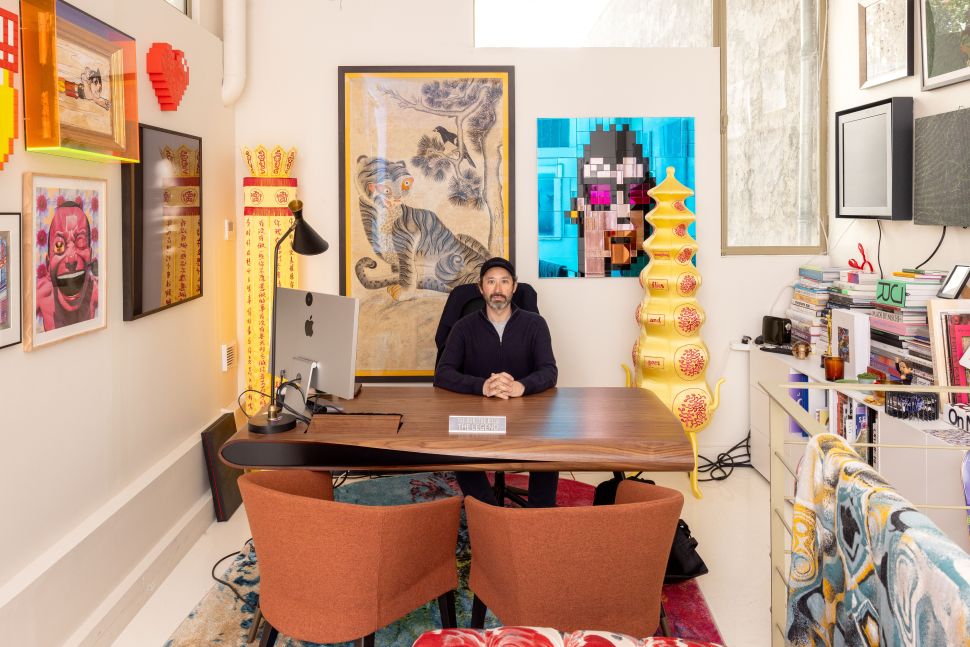
Entrepreneur Sébastien Borget found his way to art and collecting via a parallel but perceptually faraway universe: gaming and Web3. “My background is more in technology, an industry where I’ve been for over 20 years,” he told Observer during a conversation in the office above his latest venture, ArtVerse, a Paris gallery dedicated to the convergence of contemporary art and new technology. “My first startups were more in the realm of video games, then I progressively evolved it into a virtual world game where people could make things, sort of like Roblox or Minecraft, called The Sandbox.”
That would become one of the emblematic Web3 gaming companies of the NFT boom: a decentralized metaverse where users create, own, govern and monetize experiences using NFTs and the SAND token. The company was valued at $1 billion in June 2024, when it raised $20 million in convertible debt led by Kingsway Capital and Animoca Brands, with participation from LG Tech Ventures and True Global Ventures. Today, Borget is president of the Blockchain Game Alliance, a group of more than 90 companies that promotes blockchain in gaming.
It was while developing The Sandbox experience that Borget first got close to art—while creating a virtual world, he didn’t want to neglect culture. “We invited content creators, brands and celebrities—Snoop Dogg, Gucci, TIME, DJs and others—and we also started collecting art from this digital art movement, essentially connected with blockchain and NFTs, to display it inside the virtual world early on.”
But he didn’t want to bring art into The Sandbox simply to replicate the white-walled museum model. “We felt that in a virtual world, the possibilities had to be better than reproducing the physical world,” he explained. The point was to expand not only what people could do inside the virtual world but how art could help them shape their own symbolic universes. “We saw art as a form of expression. We displayed it in the social hub of the game and in many other experiences. In a way, it is like bringing art into the street instead of putting it somewhere inaccessible, so it can speak to people and inspire them.”
He eventually took that logic from the virtual world into physical space. “We wanted to do the same thing in our office, to inspire employees and everyone who came to visit us when we had events in Paris, and then in other cities,” he said. When the offices ran out of space, the idea expanded into a gallery, which became a way to continue exhibiting art, discovering artists and connecting people around art and culture.
As he collected NFTs and digital art and then more traditional contemporary pieces, Borget realized that art could add a new dimension to his entrepreneurship and work in tech by helping him see the world differently. “I started to become more and more involved, first publicly speaking about my role as a collector and most recently as someone actively supporting artists who are in my collection.”
Borget’s collection is very personal, as he generally tries to connect with the artist before actually purchasing a work. “I like to learn more about their vision, their practice, their framework and their concept,” he said, adding that while there is of course an attachment to the aesthetic, it’s not the be-all, end-all for him. “I try to see how those artists will evolve, and whether what they are thinking about and talking about resonates with me.”
Four years ago, Borget opened ArtVerse with his co-founder at The Sandbox, Arthur Madrid, to support artists working at the intersection of art and tech who, he saw, were not receiving much attention or exposure. ArtVerse, which is located in Paris, has a very diverse program, with artists coming from Hong Kong, Korea, the U.S. and around the world. Some artists whose work he has collected have become part of the gallery’s program, helping introduce them to a broader audience.
Before opening ArtVerse, Borget helped found NFT Factory, a project located in front of the Centre Pompidou until 2024, when it closed its physical location. That space, however, didn’t fully align with his vision. In his view, it became too focused on showing blockchain art and selling NFTs, rather than supporting artists through solo exhibitions and more sustained programming. He also felt there was a mismatch between the location and the audience. NFT Factory had strong visibility and steady foot traffic but was still too tied to the NFT bubble. ArtVerse, by contrast, supports a broader and more nuanced conversation around art, technology and artists’ practices.
For Borget, the question is no longer whether a work is “digital art” in the narrow sense. “It’s not about the medium. The art here can take different forms: paintings, sculpture, tapestries, video, sometimes blockchain. It is more about the depth of the concept,” he argued. “The artists that I’m collecting and we are showing are solid in their conceptual framework, so whether they use technology or how they use technology is not just about surfing some kind of hype market.” To him, good digital art is made by artists who think rigorously through science and technology to explore new forms of cultural production attuned to our time, whether ultimately screen-based or not.
He believes the landscape is changing; collectors and audiences like him, born in the 1980s and 1990s, carry a different cultural DNA. Video games, anime, manga and film were part of their formative environment, so it is natural that the art they look at and collect might engage gaming, film, science or technology more directly than previous generations did. “There is not necessarily resistance to the use of technology as a medium anymore, because it has been integrated into our culture for 40 years,” he said. “We grew up with it.”
Still, he admits that France has been much slower in accepting these new artistic forms, mostly because of its deep heritage and weighty artistic traditions. “I feel there is still a bit of resistance because there is such a rich art history in France, and so many important movements to know and collect, that this kind of art can feel more niche and not yet fully established.”
Yet this is also what makes education and physical exhibitions especially important in his eyes. According to Borget, digitally or technologically engaged art needs to be experienced beyond the screen, in a dedicated space where visitors can encounter it in person. ArtVerse is a commercial space, yes, but also a place where artists can develop ambitious presentations, educate curious visitors, appear in the right Parisian gallery district and elevate their work through installation, documentation and visibility.
Asked whether he intends to open a foundation, Borget says he prefers to focus on the platform he has as building a foundation in France can be complicated. “It is not the easiest structure to create properly here,” he explained. In the meantime, he is actively involved in supporting artists working at the intersection of art and technology by contributing to books, speaking publicly, co-organizing events and symposiums, and joining museum patron groups such as the Digital Council at LACMA.
Notably, Borget’s background gives him a different understanding of the infrastructure behind digital ownership, creator economies and virtual worlds, as well as the alternative value chains and sustainability models that many digital artists have already developed—and that could prove increasingly useful for the broader art world today.
While art and gaming are often perceived as worlds apart, there is something inherently artistic and creative about gaming, and many artists working today apply gaming aesthetics and dynamics in their processes. Borget is especially interested in these exchanges between video games and contemporary art. He points out that video games are built through creative labor, even if much of that work has not traditionally been treated as collectible by museums. “Everything that goes into the preconception of a video game includes drawings of characters, landscapes and so on,” he argued. “Nowadays, a lot of it is replaced by A.I., but it is still very much a creative industry, with many creative jobs involved.” Game art books sell well, and it is widely accepted that games shape culture.
Borget has seen a bridge forming between the world-building practices shared by the two fields in recent years. “There are more and more artists around the world using video game tools and techniques as a medium of expression and to create works of art that are interactive, but still have a lot of depth to them. They may use gaming to make you think about the state of the world or human nature,” he explained. Many of those works are commissioned by or for museums, however, which present them directly, not as traditional game cartridges or mobile apps and not for commercial reasons, meaning they still belong to a separate sphere of circulation.
At the institutional level, Borget acknowledged that progress has been made but still sees many limitations. “We have seen museums like the Centre Pompidou show good sensitivity to it. It was among the first to collect NFTs, but it is still not enough.” He feels somewhat isolated as a supporter of digital art. Globally, physical spaces and galleries dedicated to this corner of the art world are scarce, and some online marketplaces have closed. While initiatives such as Zero10 at Art Basel or digital sectors in Paris have brought visibility, he worries that digital art is still often kept apart from the main fair or made overly performative, as happened in Miami.
“I do not think art has to be controversial or create that much hype in order to be valued and paid attention to,” he concluded. “I am trying to give a voice and a place to artists without necessarily creating a big, provocative hype around them every time. What we want is for people to feel the progression.”
