
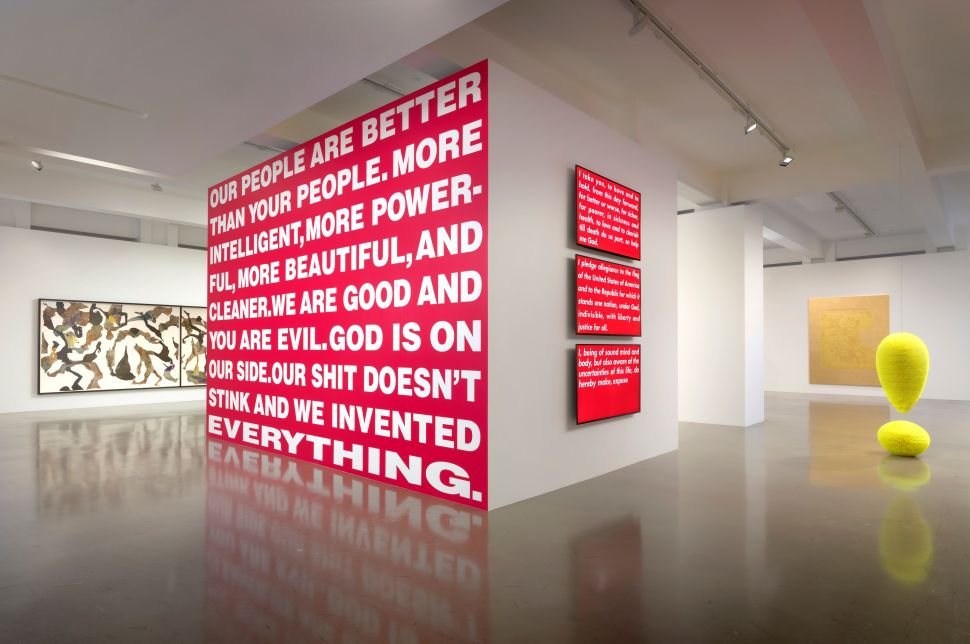
When Germany-based art gallery Sprüth Magers first set up shop in L.A. in March 2016, their timing was impeccable. They staked out a location directly across the street from the Los Angeles County Museum of Art and opened their doors a few weeks before Hauser & Wirth cut the ribbon on their Arts District location. Both arrived at a time when L.A. was on its way to becoming one of the country’s leading art destinations—only five years after the landmark show “Pacific Standard Time: Art in L.A., 1945-1980” brought the city’s modern art history to the art world’s attention, highlighting L.A.-centric movements like Light and Space and Finish Fetish across some 60 institutions throughout the area.
But Sprüth Magers’ success here didn’t happen overnight. Its founders Monika Sprüth and Philomene Magers spent decades building relationships with artists whose work would go on to define the L.A. scene—John Baldessari, Barbara Kruger, Ed Ruscha, Sterling Ruby and more. Today, Sprüth Magers has spaces in Berlin, London, New York City and Los Angeles, which marked the gallery’s first location in the United States. Celebrating their anniversary is “10 Years in LA!,” a group show of blue-chip artists from all over the world.
“I’m just so happy that the gallery is here,” Barbara Kruger tells Observer. She has three pieces in the show including Untitled (Our people are better than your people) from 1994/2024, Untitled (Hello), a sound installation from 2021, and Pledge, Will, Vow, a three-channel video installation from 1988/2020 that showed at the 1988 Venice Biennale. “The space is beautiful and wonderful. And the location is terrific. They have such an important program, with so many artists that I admire.”
The show includes the above-listed names as well as Kenneth Anger, Gilbert & George, Robert Irwin, Craig Kauffman, Gala Porras-Kim, David Salle, John Waters and many others. Kruger first started showing with Monika Sprüth in Cologne roughly 30 years ago, when women didn’t have a significant presence in the German art world. “Sort of white guys ruled, you know, white guys all liquored up, ruled, whatever. But thanks to Monica, a group of women started showing their work in Germany, in Cologne. And that was incredibly important for me,” says Kruger about her beginnings with the gallery. “Together they formed this incredible roster of artists, both American and European men, women, and engaged issues of gender, but also race. Their program really reflects how the artworld has changed within the past twenty years. A much more inclusive place. When I was coming up, the so-called artworld seemed to be five white guys in lower Manhattan.”
“10 Years in LA!“
Venue: Sprüth Magers
Address: 5900 Wilshire Blvd., Los Angeles
Through: Aug. 8, 2026
One white guy from lower Manhattan in the show is George Condo, who contributed a recent piece entitled War of the Worlds. “Named after the H.G. Wells novel, it turned out to be the world we live in today,” Condo says of his abstract painting. “It represents fear and turmoil, desperation and insanity. It is also, amongst other things, a diagonal abstraction in a format reminiscent of a kind of landslide of humanity.”
Condo’s first solo show at the gallery was in 1984, one of many, including 2016’s Entrance to the Void, inspired by his bout with cancer and, two years later, What’s the Point?, named for a monochrome work depicting a jumble of TVs. “I thought, ‘What’s the point of following the news or thinking that whatever you had yesterday is going to be relevant tomorrow?’ I internalized the idea of it being about the making of art.”
In the early 1980s Condo spent time with his friend Jean-Michel Basquiat in Los Angeles, where the latter had his first show in a club called The Rhythm Lounge. The accompanying music was provided by a new band making their live debut, the Red Hot Chili Peppers. “The early days I spent in Los Angeles were hysterical, having to get a job selling pens in some crazy pen sales office on Hollywood Boulevard to make enough money to get back to New York. And while I was doing that, Basquiat did that painting Hollywood Africans out there when Rammellzee and Toxic and all these graffiti guys came. He was preparing for his first show at Larry’s [Gagosian],” Condo recalls.
“He’s an artist with broad cultural knowledge, and broad knowledge about European art history,” Sprüth said of Condo at the time of Entrance to the Void. “He manages, with his knowledge and intellect, to bring it into a new form.”
Another white guy in the show is Sterling Ruby, whose SP is a new work that revisits his spray paint canvases from 2008-11, atmospheric abstracts reminiscent of the Color Field works of Mark Rothko. Confronted every day in his studio by the earlier canvases, Ruby was inspired by the ongoing war in Iran to revisit them. “I kept looking at these, thinking of this flat wasteland, these two kinds of eyes, these opposing zones and tears, kind of like rain falling, and wanting to allude to this spiritual aspect of it, not really heavenly, but maybe environmental.”
What first inspired him to use spray paint rather than oil was the street art and graffiti of L.A. Growing up in New Freedom, Pennsylvania, he yearned for a place like California, drawn to the Gold Rush of the 1860s, the rise of the entertainment business in the early part of the century, the hippie movement of the 1960s and the punk scene of the 1970s and ’80s.
“As an artist, I came out here because the art that was being made here seemed a lot more psychological and pathological,” he says, noting movements like Light and Space, and figures like Barbara Kruger, Chris Burden and Nancy Rubins. “Philomena and Monica, they’ve championed a lot of this particular art from this particular region. And I don’t think that that’s always been easy. To be part of that roster that shows and champions artists like Rosemarie Trockel, Jenny Holzer, Kara Walker, Robert Morris, I think it’s historical, what they’ve built, and it’s very unique.”
Sprüth expressed a similar sentiment in a recent email, noting that such names are part of the reason they first decided to open a space in L.A., while Magers celebrated new developments in their mid-Wilshire neighborhood, including the newly opened David Geffen Galleries at LACMA. “New museums, new museum buildings, a new subway line,” she wrote. “You can really feel a different energy just walking down the street from the gallery.”
