
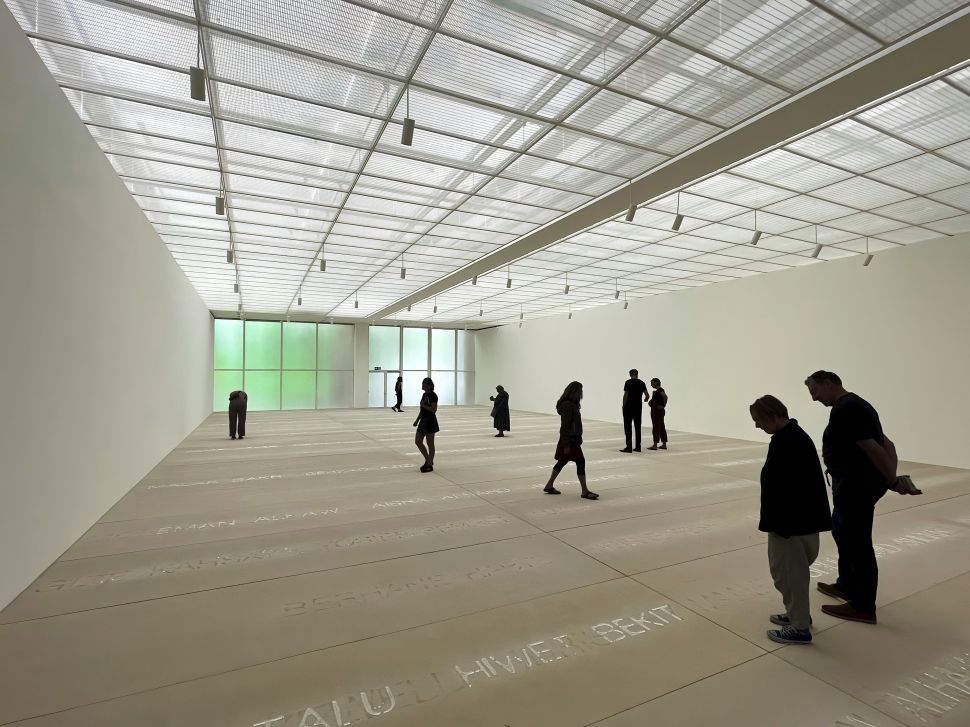
In recent months, the idea that museums are in crisis has become almost a consensus. The debate has appeared across journals, newspapers and institutional forums such as ArtReview, The Art Newspaper, the Financial Times and here in Observer. ArtReview even organized The Museum in Crisis: A Symposium, bringing together a range of voices diagnosing the institution’s problems from different angles.
Some see it as a political crisis, with museums caught in culture wars and ideological battles (Jonathan T.D. Neil). Others interpret it as a restitution and postcolonial crisis centered on repatriation, ownership and the legacy of imperial collections (Sarah Jilani). For some museum directors, the problem is a crisis of financial and structural sustainability that calls into question the traditional building-based museum model (Jorrit Britschgi). Others describe it as a gender and leadership crisis, pointing to the growing number of women museum directors who have been forced out of their positions or pushed to resign under political or institutional pressure (Charlotte Burns). The crisis has also been described as a technological transformation, with digital technologies, data governance and artificial intelligence reshaping how museums operate and make decisions (Shauna Lee Lange). In other contexts, the museum has been presented as a civic and social institution under pressure to respond to political polarization and social conflict (Mary Ceruti).
Added to this are increasing financial pressures, political scrutiny and threats to public funding, particularly in the United States, where cultural institutions have faced growing pressure and funding uncertainty in the wake of the political climate and cultural policies associated with Donald Trump and the MAGA movement. Professor Alan Wallach, a leading scholar and author of Exhibiting Contradictions: Essays on the Art Museum in the United States (1998), frames the tensions within a neoliberal mindset. Wallach reminds us that, “Beginning with Reagan in the 1980s, the U.S. government’s neoliberal economic policies pitched toward austerity and privatization have increasingly undermined public support for the arts,” resulting in “museums’ increased reliance on admission fees and private donations.” He concluded that, paradoxically, “we face a future in which the larger museums survive and often thrive while smaller institutions are forced to close their doors. In a word, austerity and elitism represent the U.S. art museum future.”
Taken together, these diagnoses point to a deeper structural problem. They describe the visible symptoms, but they do not address the invisible structural causes.
The Barr problem
Alfred H. Barr Jr.’s Museum of Modern Art (MoMA) represents the apex and template of the modern art museum. Based on the German experiments between 1924 and 1928 in cities such as Essen, Hamburg, Berlin, Frankfurt, Cologne, Munich, Darmstadt and Mannheim, which Alfred H. Barr Jr. had the opportunity to see in person during his two trips to Europe (in 1924 and again in 1927-28), he pushed the stripping or purification of the “white cube” even further, turning it into the most sophisticated museum of modern art between the 1930s and the 1950s. During his long tenure between 1929 and his retirement in 1967, Barr produced awe-inspiring concept-based exhibitions—including “Machine Art” (1934), “Cubism and Abstract Art” (1936), “Fantastic Art, Dada and Surrealism” (1936), “Bauhaus, 1919-1928” (1938) and “Picasso: Forty Years of His Art” (1939)—which, according to Alice Goldfarb Marquis in her well-documented Alfred H. Barr, Jr.: Missionary for the Modern, sealed his “reputation as the world’s leading historian of modern art.”
According to art historian Mary Anne Staniszewski, author of The Power of Display: A History of Exhibition Installations at the Museum of Modern Art (1998), Barr was so successful because in his “neutral” exhibition mode, the “viewing subject was treated as if he or she possessed an ahistorical, unified sovereignty of the self,” creating an “extremely accommodating ideological apparatus for the reception of modernism” that mirrored the American dream’s “liberal democratic ideal of the autonomous, independent individual.” While Barr eliminated any political, social or psychic trace of the artwork, he also endeavored to create different kinds of installations for different types of audiences.
What happened to MoMA after Barr? Due to a mix of political and social factors—think of the Vietnam War and May ’68—MoMA became increasingly disconnected from society’s zeitgeist, and between 1968 and 1972 directors Bates Lowry and John Hightower resigned in rapid succession. Society demanded from MoMA a political stance, which its politically conservative trustees were not willing to concede, causing it to gradually lose relevance. On an art historical level, Barr’s canon had culminated with abstract art and Pollock’s Abstract Expressionism. All the movements that came after, from Pop Art to Minimalism, Land Art, Performance Art and Conceptual Art, simply did not fit into Barr’s canon of modern art. In other words, while MoMA was the undisputed temple of modern art, it never really succeeded in becoming a disruptive or avant-garde contemporary museum.
Crucially, MoMA’s erosion of epistemic authority became particularly evident under Glenn Lowry’s tenure between 1995 and 2025. Over those three decades, he oversaw major expansions, the merger with PS1 and the expansion of the collection—almost absurdly—to around 200,000 artworks. Yet MoMA’s art historical record during this period pales in comparison to Barr’s. The problem is twofold. First, the nature and background of museum directors have changed in recent decades, with large museums opting for a more managerial profile, like Lowry, capable of securing major funding and important artworks. Second, the profile of leading curators and chief curators has also become less art historically ambitious while often displaying superficial foundations in terms of museology and exhibition design. What are the groundbreaking exhibitions that define Lowry’s and Klaus Biesenbach’s MoMA? Knowledge gave way to spectacle and celebrity culture; design, architecture, decorative arts and furniture disappeared, turning MoMA from a Bauhaus-inspired interdisciplinary museum into a more traditional visual arts institution; and concept-based exhibitions gave way to less demanding one-person shows. Marina Abramović’s “The Artist Is Present” (2010) and “Björk” (2015) are the exhibitions that inevitably come to mind.
And what did Tate Modern offer in return for Barr’s derided canon? The opening exhibition, “Tate Modern: Collection 2000,” curated by Iwona Blazwick and Frances Morris, was presented as a “radical break” with curatorial tradition. Yet it pivoted around rather traditional academic genres: landscape, still life, nude and history painting. Unlike Barr’s MoMA, epistemic knowledge never really entered Tate Modern’s factory—we recall some site-specific installations in the Turbine Hall, such as those by Juan Muñoz, Olafur Eliasson and Doris Salcedo—giving way instead to spectacle and privileging predictable one-person shows and unimaginative collection displays.
The problem was that Barr did not only define the canon of modern art; he also defined the way modern art would be displayed, the way it would be viewed and, ultimately, the type of spectator the modern museum would produce. Barr simply set the bar too high in too many ways.
The failure of the white cube
If Barr defined the canon of modern art and the exhibition model that would dominate museums throughout the 20th Century, he also consolidated the exhibitionary device that would become the unquestioned norm of modern and contemporary art: the white cube. The white cube, understood as a supposedly neutral, timeless, contextless space, was extraordinarily successful. It allowed artworks to be isolated from the world, from history and from social and political context, presenting them as autonomous objects that could be contemplated in silence.
This model proved extremely efficient for the display of modernist painting and sculpture, particularly abstract art, which benefited from the absence of visual noise and contextual information. The white cube created an environment of concentration and contemplation that reinforced the idea of art as an autonomous sphere separated from everyday life.
However, what was once its greatest strength has now become its greatest weakness. The white cube was conceived for a specific type of art, a specific type of spectator and a specific type of society. Contemporary art is no longer predominantly formalist or medium-specific; it is often contextual, political, social, participatory, research-based or process-oriented. Many contemporary artworks cannot be understood without context, documentation, archives, testimonies or spatial and social references. At the same time, audiences have changed. Visitors are no longer the silent, disciplined, contemplative, heteronormative, educated viewers imagined by the modern museum. They are mobile, distracted, visually saturated, accustomed to screens, multimedia environments and interactive experiences. Even so, the white cube still assumes a slow, attentive and almost religious mode of viewing that no longer corresponds to contemporary visual culture. Finally, society itself has changed. Museums are no longer seen only as temples of culture but increasingly as contested social, civic and political playgrounds. They are expected to address issues of identity, gender, race, colonial history, climate change, migration and social inequality. Nevertheless, these topics are often presented within the same neutral white rooms that were designed to remove art from politics, history and society. The contradiction is evident: museums try to decolonize narratives and collections while maintaining an exhibition model that was historically designed to neutralize context and difference.
Consequently, the crisis of the museum is not simply a financial, political, social or technological crisis. It is a spatial and exhibitionary crisis. The problem is not only what museums show but how they show it. And this “how” is still largely determined by a model developed in the early 20th Century for a very different kind of art and a very different kind of spectator.
Precisely because of its success, the white cube has become invisible, naturalized and unquestioned on a global scale. Museums have changed their collections, their programs, their educational departments, their communication strategies and their public missions—but they have not changed the space in which art is displayed. The container has remained unchanged, and this is precisely where the structural problem lies.
The six phases of the white cube (1900-2020s)
Much has been written about the white cube; little has been thought about it. Brian O’Doherty came up with a catchy concept—German scholars traditionally referred to die Weiße Wand, or white wall, never to the white cube—but his critique was ahistorical, ignoring its Germanic origins and genealogy. He and others, such as Elena Filipovic, Charles Esche, Bart De Baere, Igor Zabel and WHW, criticized the white cube yet never proposed an alternative. Ironically or paradoxically, they all—O’Doherty included—curate(d) white cube style exhibitions only.
Basically, we can chart six phases in the development of the white cube, from its origins in Austria and Germany in the early 1900s, later in the United States in the 1930s and globally from the 1990s until today, phases that coincide with the advent, rise, triumph and failure of the white cube.
The first phase (1900-1914) revolves around the Vienna Secession and the original experiments carried out by Joseph Maria Olbrich, Joseph Hoffmann and Koloman Moser, held within the premises of the Secession building (and also in international exhibitions throughout Germany and France), which incorporated movable walls, allowing the exhibition designer to conceive a different layout each time.
The second phase (1906-1930s) was spearheaded by the Nationalgalerie Berlin with avant-garde displays carried out by Peter Behrens starting in 1906 on the occasion of the exhibition celebrating 100 years of German art from 1775 to 1875: the “Jahrhundertausstellung deutscher Kunst” or Centenary Exhibition of German Art. This design was, according to Professor Charlotte Klonk, the first museum exhibition with fully white walls. This exhibition and later experiments by curators Hugo von Tschudi and Ludwig Justi would inspire other white wall displays between 1907 and the 1920s, including Kunsthalle Mannheim (1907), Moderne Galerie Berlin (1911), Sonderbund Ausstellung Cologne (1912), Galerie van Diemen (1922) and Museum Folkwang in Essen (1929). The experiments at the Nationalgalerie Berlin and other German museums had international repercussions, particularly in the United States, influencing Alfred Barr’s MoMA from 1929 onward.
The third phase of the white cube (1919-1932) is articulated through the Bauhaus under the leadership of Walter Gropius and Mies van der Rohe, which had the greatest impact on the configuration of the modern museum and the future white cube. Through its interior designs, architectural projects and the design of stands for World Fairs, commercial exhibitions and art exhibitions—in which the white wall played a relentless role—the museum began to mimic the rational, aseptic modern Bauhaus interiors later known as the “International Style.” It is no coincidence that Le Corbusier, Mies van der Rohe and Walter Gropius had worked around 1910 in Peter Behrens’ studio.
Commenting on an exhibition by Max Beckmann, curated by Ludwig Justi in 1932-1933 at the Berlin Kronprinzenpalais on a monochromatic white wall, Professor Charlotte Klonk in her essay “Myth and Reality of the White Cube” (2016) asserts convincingly that “The room was indeed a white cube, yet the template was not the neutral museum space, but the tasteful contemporary Bauhaus-style interior that Justi had first seen in his friends’ and fellow collector’s homes that accommodated modern art—for example, in the house that Marcel Breuer designed for von der Heydt at the golf course at Wannsee in Berlin or in Mies van der Rohe’s Haus Lange in Krefeld. Both the banker Eduard von der Heydt and the entrepreneur Hermann Lange were at the time active supporters of Justi and the Nationalgalerie in Berlin.” If we look at an image of the ladies’ sitting room of Haus Lange from 1927 and another from the 1950s of the same room, but converted into an exhibition space, there is no doubt that today’s museum is still the literal recreation of the bourgeois patriarchal 1920s Bauhaus apartment.
Phase four of the white cube corresponds to Alfred H. Barr Jr.’s tenure (1929-1967) at MoMA, whose “modern museum” embodied, according to Carol Duncan, “the autonomy and universality of art” based upon the “familiar narratives of unfolding genius and formal development.” Under Barr, the museum became the ultimate symbol of bourgeois white cube museology, which largely catered to the wishes of its wealthy trustees. On May 7, 1939, just two days before the official opening of the new building on 11 West 53rd Street, Paul J. Sachs, one of MoMA’s founders, who had personally promoted Barr for the director’s position, assured the trustees that “in serving the elite, the museum will reach better than in any other way, the great general public.” Barr was also of the unpopular opinion that “modernist art should be difficult.”
We can be very brief about the last two phases. Phase 5 is heralded by the Guggenheim Museum (1959-1990s), which coincides with the white cube’s international triumph in North America and Western Europe between the 1960s and the 1990s. Frank Lloyd Wright’s curving building became a major pole of attraction. And with the inauguration of the Guggenheim Bilbao in 1997, designed by Frank Gehry, the “Guggenheim effect” amplified its leading role, inspiring many cities across the globe to build iconic architectural museums. The sixth and last phase of the white cube belongs to Tate Modern (2000-2020s), the most visited museum of modern and contemporary art in the world, with 4,514,266 visitors in 2025, whose architecture has (in)directly inspired many other museums, including Zeitz MOCAA Africa Cape Town (2017), M+ in Hong Kong (2021) and Istanbul Modern (2023).
The six phases of the white cube can ultimately be condensed into three major museum paradigms: the Germanic-Barr epistemic museum (phases 1-4), the Guggenheim architectural museum (phase 5) and Tate Modern’s spectacular museum for mass audiences (phase 6). The chart does not analyze exhibitions or institutions individually, but attempts to map the structural evolution of the modern and contemporary museum and the white cube as a system over more than a century. The museum moved from knowledge to architecture to spectacle. The history of the white cube is not only a stylistic evolution but also a geographical shift: from Vienna to Berlin, from Berlin to New York, from New York to Bilbao and London, and from there to the global museum system.
The never-ending formalist unconscious
The triumph of formalism and the white cube in the United States between the 1920s and the 1950s cannot be explained exclusively by Alfred Barr’s exhibitions and the formalist mindset of North American academia and art criticism—Ives Gilman, Bernard Berenson, Charles Rufus Morey, Frank Jewett Mather, Clement Greenberg and Harold Rosenberg. In the well-rehearsed art historical, museological and curatorial narratives, the pivotal role of banker and art collector Paul J. Sachs is still largely absent.
There exists a global invisible condition that pervades the minds and hearts of art professionals: the “formalist unconscious,” a totally automated, unconscious and uncritical use of the white cube. It’s like a Pavlovian reflex: art professionals automatically and exclusively associate modern and contemporary art with the white cube. In other words: a kind of involuntary response elicited by a centenary disciplining in formalism, whose teachings continue to rule classrooms, art magazines and galleries, divulged by scholars such as Michael Fried, Rosalind Krauss and Barry Schwabsky.
Paul Sachs’s famous year-long course “Museum Work and Museum Problems”—simply referred to as the Museum Course or the Fogg Method—at Harvard, taught between 1921 and 1948, trained generations of museum directors, curators and trustees such as Alfred H. Barr Jr., James J. Rorimer, Lincoln Kirstein, John Walker, Perry Rathbone, Beaumont Newhall and Charles Parkhurst, who would go on to lead major American museums, including MoMA, the Metropolitan Museum of Art, the National Gallery in Washington, SFMOMA, the Minneapolis Institute of Art and the Nelson Gallery of Art.
Sachs shaped the ideology of the museum profession to this day. His approach emphasized connoisseurship, attribution, collection building, display and relations with trustees, collectors and art dealers, while explicitly avoiding the social, political and ideological implications of museums. The result was the consolidation of a museum culture that understood art primarily in formal and aesthetic terms and conceived the museum as an elite institution rather than a civic or political one. His students occupied major American museums, from where they spread the formalist credo and functioned as transmission belts. After Sachs retired from teaching, the course was offered in a modified form by his protégés for another three decades, until 1982, amounting to almost a century of influence. What is fascinating is that today’s museum courses and curatorial studies—from Harvard Museum Studies and Bard College to the Royal Academy of Arts—are educating future museum professionals and curators as social activists while, paradoxically, clinging to yesteryear’s formalist, heteronormative, bourgeois, Western white cube ideology that counteracts their non-aesthetic predicaments. These are precisely the issues many museum directors are facing today, yet remain ill-equipped to address.
The persistence of the white cube is therefore not merely a spatial problem, but one that profoundly affects visuality, technology and participation in the museum of the 21st Century, as we shall now see.
A museum to read or a museum to see?
One of the major problems associated with the bourgeois museum is its innate textual nature, which is a reflection of society and its political and academic intelligentsia, whose power and authority, while inhabiting a hyper-visual culture, still derive from the written and spoken word.
Society has basically shifted from a text-based culture to an image-based culture. We can situate this shift somewhere in the late 1960s. The advent of hyper-consumerism, pop culture, mass media (especially television together with the already existing film and radio cultures), celebrity politics and entertainment industries signal this new paradigm that challenges the hegemony of modernism among the ruling class and intellectuals. Pierre Bourdieu acknowledged in 1984 the intellectual preference for print-based culture rather than televisual culture through which the ruling class deploys cultural capital. Fredric Jameson expressed in 1991 the need for the “establishment of a whole new media-lexicological subdiscipline.” And, as a last example, Régis Debray also argued in 1996 that the “videosphere” (mediasphere) had succeeded the “graphosphere” in which print-based media was predominant.
Not for nothing, Jürgen Habermas’ whole bourgeois public sphere was based on the textual nature of society. This point is clearly articulated by Dr. Jon Simons when he affirms that “critical appraisal and ‘truth’ were the result of written and verbal reasoning, of contrasting the ‘truth’ of information with other texts or even discussing it face-to-face. Power was based on a reasoned critique exerted by a limited, bourgeois and male-reading public that debated about matters of culture and politics in a public, local sphere.” Think now of all those humanist circles, gentlemen’s clubs, historical societies and related institutions only accessible to white upper- or middle-class male members. Additionally, if we recall the museum’s origins and the transition from private to public in the Renaissance, from studio to galleria, the premises of a collection not only showed objects to the visitor, being more important the very conversation about those objects that contributed to “the formation of Renaissance civil society,” as Jeffrey Abt wrote in his essay “The Origins of the Public Museum” from 2006.
Is it any different today? If we apply this logic to the museum, one of the pivotal educational structures of bourgeois society, it translates into introductory texts, wall texts and explanatory labels, audio guides, tour guides, catalogs and leaflets. The whole museological and display apparatus makes looking at a picture an exercise in reading rather than seeing: not only because we read the accompanying texts along the exhibition, but even more so because when faced with a picture, we explain it to ourselves or to others, an interaction that is profoundly social. Danish researcher Martin Brandt Djupdræt convincingly argued in his 2025 PhD thesis, “The Museum Visit: An Investigation of Use, Outcomes and Perceived Value,” that one of the major motivations for people to visit a museum is social togetherness, alongside learning, enjoyment and reflection.
We do not simply look at paintings; we read them as if they were texts. The museum is not only a visual space but also a literary machine inherited from Renaissance humanism. This literariness has very concrete consequences: we tend to read paintings from left to right, as if they were texts, even when the visual logic of the painting suggests the opposite direction. Picasso’s Guernica (1937) is a well-known example, and one that is still today not only read but even installed in a way that reinforces this misreading at the Museo Nacional Centro de Arte Reina Sofía (MNCARS) in Madrid. The narrative structure of the painting—and Professor Emerita in Literary Theory and cultural theorist Mieke Bal agrees—actually unfolds from right to left, beginning with the explosion and the falling figure on the right and culminating with the bull on the left. Yet most visitors position themselves in front of the painting and start looking from the left, scanning the composition toward the right as if they were reading a page. In other words, even when we are looking at images, we often behave as readers rather than as viewers.
But how does the textual nature of bourgeois society interfere with or contradict today’s visual culture? Text-based culture requires concentration, memorization, linearity and literacy. Visual-based culture, in turn, is characterized by short attention spans, multitasking, non-linear navigation, global communication and forms of understanding that are more emotional and less dependent on literacy, while truth becomes more and more a question of credibility or a simple matter of faith. In other words, it’s not only that the museum insists on a highly literate and knowledgeable spectator—as Carol Duncan argued—but it also imposes a way of reading the artwork that no longer seems to respond to the neurological qualities of a large majority of visitors.
Nevertheless, this transformation may not be purely cognitive but also motivational. Neuroscientist Marco Iacoboni, author of Mirroring People: The New Science of How We Connect with Others (2008), suggests that the shift from observation to participation “is a shift in motivation, not so much in cognitive terms. People are now less motivated to simply observe and want to actively engage. Whether this active engagement is more or less mindful than sustained focus and contemplation, it’s another story. I have the feeling it goes both ways. For some, it generates more attunement, for others, it is more like avoidance of a more contemplative stance.”
As a vital institution of the bourgeois public sphere whose walls are filled with images, the museum’s textual logic alienates the majority of visitors, and especially the social media generations whose cognitive disposition no longer easily aligns with the demands of “concentrated” viewing imposed by artworks such as Guernica or Las Meninas. Here too, the abandonment of reading and the loss of literature haven’t, paradoxically, given way to a more widespread command of visual literacy in a hyper-saturated society. The use of technology has had contradictory results, and its incorporation in the museum has been slow, problematic and unsatisfactory.
Technology 1.0, or can the museum learn faster?
The introduction of technology in the museum world has always been problematic. Bourgeois society has traditionally been suspicious of technology in the sphere of knowledge and culture—as we see now with A.I.—and museums have generally incorporated digital tools slowly, cautiously and often unimaginatively. Restricted budgets, institutional inertia and the persistence of the traditional exhibition textual model largely explain the limited and frequently superficial use of apps, screens and digital devices in many museums today. And yet, a number of projects and artworks developed within museum and public contexts demonstrate that technology can profoundly transform the relationship between artwork, space and spectator.
French interdisciplinary artist Jeanne Susplugas has recently been exploring how technology can modify the relationship between artwork, space and spectator inside the museum with her Virtual Reality (V.R.) installation I Will Sleep When I Am Dead (2023-26): a fascinating dive into her brain’s neurons and synapses, constructed through drawings and pictograms that allow the spectator unusual access to her most intimate dreams. When asked how museums could enrich the visitor experience, Susplugas suggested that “Museums could introduce installations that engage multiple senses at the same time, spaces where sound, scent or touch would be incorporated to create more encompassing experiences, rather than ones that are purely visual and frontal.” In Susplugas’s installation, the spectator transforms from an external observer into an internal participant.
Another perspective comes from WonderWay, an A.I.-based conversational audio guide that allows visitors to interact with museum knowledge through dialogue rather than fixed interpretation. Hélène Alonso, founder of WonderWay and a museum innovation professional, suggests that with her app, “What changes is access. Instead of being fixed on a wall label or buried in a catalog, it becomes responsive, fluid and shaped by each visitor’s curiosity. Where it becomes transformative is in how that relationship unfolds. The traditional museum experience is largely one directional. The institution speaks, the visitor receives.” Alonso remarks that with the introduction of conversation, the dynamic shifts: “Visitors can ask, challenge, follow their own path and connect ideas across objects, time periods and cultures. It turns the visit into something closer to a dialogue than a lecture. It also subtly shifts authority. Not by removing it, but by redistributing how it is experienced.”
Nicola Verlato, Nuit Blanche Toronto, 2016.”>
Another possibility is what Italian artist Nicola Verlato accomplished with the site-specific installation The Merging (2016-2026): consisting of a combination of a 20-foot-wide physical painting and an Augmented Reality (A.R.) experience. Spectators downloaded a custom app on their iPads or mobile phones that allowed them to explore the three-dimensional interior of the artwork by accessing additional visual layers, animations and narrative elements superimposed on the static two-dimensional painting. In this case, technology did not create an immersive environment but introduced a new relationship between image, time and viewer, suggesting that traditional media such as painting can be expanded rather than replaced through digital tools.
For Alonso, the perfect museum interface is one that almost disappears. “If the goal is a more active and engaged relationship, the interface should keep your eyes on the work, your body in the space, and your attention anchored in what you’re experiencing. That’s why I believe so strongly in voice.”
The combination of Augmented Reality and conversational interfaces could allow visitors to explore artworks layer by layer while interacting with museum knowledge through dialogue. Such tools could also promote slow looking and a more democratic relationship between the visitor and the institution: each spectator decides how deeply and for how long they wish to engage with the artwork, choosing their own path through the information rather than following a single institutional narrative.
Technology could help transform the museum experience from a space of instruction into a space of exploration—and perhaps eventually into a space of participation, the true Trojan horse of the white cube.
The spectator remains silent
Both museum directors and academics have embraced the “participation dogma” with equal fervor against the background of a 21st-century society that demands a more inclusive and diverse museum. However, is the museum of today a truly democratic and accessible institution?
The audience and its relationship to the museum have become, in many of the theories articulated by institutional critique, museum studies or New Art History, one of, if not the main concern. The intriguing idea of an active, participatory, reflexive, emancipated and critical viewer able to negotiate the authority of the museum and its contradictions has become a kind of mantra initiated by artists in the late 1960s and continued by academic scholars and curators to this day. Some of its most iconic theories are institutional critique, new institutionalism, the participatory museum, the new museology, critical museology and post-critical museology. Petra Hanáková, theorist and practicing curator at the Slovak National Gallery, when referring to critical museology, bluntly recalled “the rather scarce real impact of so much verbiage on art museums around the world.”
Which brings us to the quixotic question: why do museums fail while being one of the most visited institutions of bourgeois democracy?
Museums are run by a mix of bourgeois, bureaucratic and intellectual elites, which means that they are undemocratic, as the citizen has no say in the what, the how and the why of its program. Democracy ultimately stands for participation, yet unlike in political elections, citizens cannot vote museum directors in or out of office. As Liam Gillick rightly stated back in 2014, “The question of participation carries with it a complex sequence of power battles that are still being worked out.” The art world runs on power structures and power games, and its trustees, museum directors and curators are not willing to share power.
Recent and less recent bibliography on the topic is quite vocal. In András Szántó’s The Future of the Museum (2020), practically none of the interviewees really cared about participation. In Sam Thorne’s Frieze (December 2015) survey about how the future museum would look in 2040, the idea is totally absent among well-known directors such as Bice Curiger, Yilmaz Dziewior, Lawrence Rinder, Susanne Cotter or Solveig Øvstebø. And in Christina Bechtler and Dora Imhof’s Museum of the Future (2014), the answer to the question “Should museums be places of participation?” provides a perfect picture of the lack of real interest and internalization this issue still generates among most museum directors and curators: Susanne Cotter’s “Museums should be places where people feel that by going they are participating in cultural and civic life”; Michael Govan’s “Museums are places of participation”; Bice Curiger’s “The public of a museum is always participating in a paradoxical experience”; and, lastly, Klaus Biesenbach’s “We have more pictures taken at MoMA every day than pictures on display. That’s participation.” We can counter-argue that museums are physically but not intellectually accessible for the majority of visitors. But access doesn’t mean participation.
We contacted Pablo Helguera, a socially engaged artist who, since 2024, runs The Studio for Education as Art initiative, an alternative school for arts education, to help us understand the complexity of participation. Helguera also served for many years as the director of Adult and Academic Programs in the Department of Education at MoMA and brings a multi-layered perspective to the table. “In Education for Socially Engaged Art (2011), I outlined different forms of social interaction. Most museum experiences still fall into what I would describe as passive or nominal participation: passive, in the sense of simply listening to a lecture or guided tour; nominal, in the sense of being asked to perform minimal or symbolic gestures of engagement, such as moving through an installation without meaningful agency.” For real participation, Helguera stresses, “the goal must be to move toward more substantive forms of engagement. This means granting visitors real agency—inviting them not only to respond, but to shape the experience itself. It also requires that institutions position themselves as listeners, open to feedback, interpretation and dialogue.”
For Iacoboni, however, the tension created by the shift from observer to participant not only affects museums, which should obviously “find ways of making exhibitions somewhat more participatory for the audience,” but he also shares the opinion “that audiences should find themselves ways of interacting with the exhibition, even a more traditionally structured one, in a creative, engaged way.” Andreas Blühm, with long experience directing museums in Germany and the Netherlands, reminds us that, “Engaging new audiences requires a major and profound change of attitude in most museums. Some are open-minded, and a few have incorporated structures that facilitate audience engagement. For many, if not most, however, that is still little more than lip service and a few programs for a target audience. Museums must hire experts in audience engagement and integrate them at eye level with the curators.”
This is a thought-provoking point as it appeals to the very hierarchy and power structures of the museum mentioned before. As of today—and fully agreeing with Helguera—the spectator remains silent. The white cube produces a submissive, dehistoricized and depoliticized spectator, accustomed to accepting institutional narratives without questioning them. For this reason, so many critical programs fail: they talk about conflict, yet they keep addressing a silent spectator.
The over-aestheticization and depoliticization of the artwork
The white cube has shown an extraordinary capacity to absorb its own critique, aestheticize it and present it back to the viewer as just another exhibition. However, we are no longer in the Cold War, when non-formalist art could be rejected on ideological grounds; for four decades or longer, art has engaged with struggles for social justice, inclusivity and diversity.
Whenever non-formalist artworks are placed in a formalist container with a formalist display, the result can only be the neutralization, hygienization, repression or annihilation of the message. Content is forced to give way to form. In other words, two parallel and reinforcing developments take place: (1) over-aestheticization and (2) depoliticization of the artwork. First, even when political works by Santiago Sierra, Adrian Piper or Leon Golub are exhibited in the white cube, the container insists on reducing the image to “art.” The white cube frame creates a timeless, ahistorical void in which the controversial image is reduced to its formal aspects. This effect is further reinforced by the lack of windows, which disconnects the space from the outside world, denying the spectator the possibility of situating the art experience within their own historical context. Second, once the “exorcising” formalist interpretation has been imposed on the image, the process of depoliticization takes over, neutralizing and disguising its potential socio-political functions.
The principal job of the white cube is to deny the image’s potential for engagement, which is achieved not only by the aseptic walls of the white cube, but also by its hang: artworks are shown at eye level while conveniently separated so as not to allow meaningful relationships to emerge when they are placed near each other. Sanitized hospital lighting from above also imposes a severe homogeneity, leveling the images and preventing any of them from standing out. Images that address gender, race, identity and the causes of social justice and democracy become anesthetized in the white cube.
The crisis of the museum is structural: epistemic, spatial, display-related and institutional. The white cube is not the framework of critical discourse, but its buffering system. It allows museums to exhibit works about colonialism, racism, gender, inclusivity, feminism or structural violence merely as a quota or guarantee of political correctness, but not as a vehicle for critical thought. The space absorbs the impact and returns it as a controlled aesthetic experience. In conclusion, the white cube symbolizes the political framework of neoliberalism: in depoliticizing art, it politicizes the museum.
Until the white cube itself is questioned, museum decolonization attempts risk becoming little more than new content layered onto an old structure.
