
The May auctions in New York stand among the most anticipated and defining moments of the global art market calendar. This year, the marquee sales arrive amid renewed geopolitical turmoil and an oil crisis described as the most severe in a decade, yet also against a backdrop of renewed confidence in the art market, following a sequence of strong results as trophy lots and major consignments return to the rostrum.
According to ArtTactic’s Contemporary Art Market Confidence Report, the first quarter of 2026 marked a significant rebound in the global auction market: total sales at Christie’s, Sotheby’s and Phillips rose 64.3 percent year-on-year to $1.70 billion, making it the strongest first-quarter performance since 2016. While this points to renewed confidence after four years of decline, the surge has been driven largely by demand for higher-quality works, with most activity concentrated at the top end of the market.
New York remains the epicenter, where single-owner collections helped lift sales by 89.9 percent, generating $730.9 million alone. The number of major estates and prestigious collections secured for the May sales only reinforces this trend. At the core of this resurgence is a generational transfer: for collectors and dealers alike, the passing of a generation of legendary patrons and gallerists has brought to market exceptional works held for decades, often unseen since their original acquisition.
From Pollock and Rothko to Picasso and Richter, this generational shift brings museum-grade works back to market at Christie’s and Sotheby’s. What follows are the standout eight-figure masterpieces returning to the market this May.
The top lots in the May marquee sales
S.I. Newhouse’s Pollock
Masterpieces: The Private Collection of S.I. Newhouse
May 18, Christie’s
Estimate in the region of $100 million
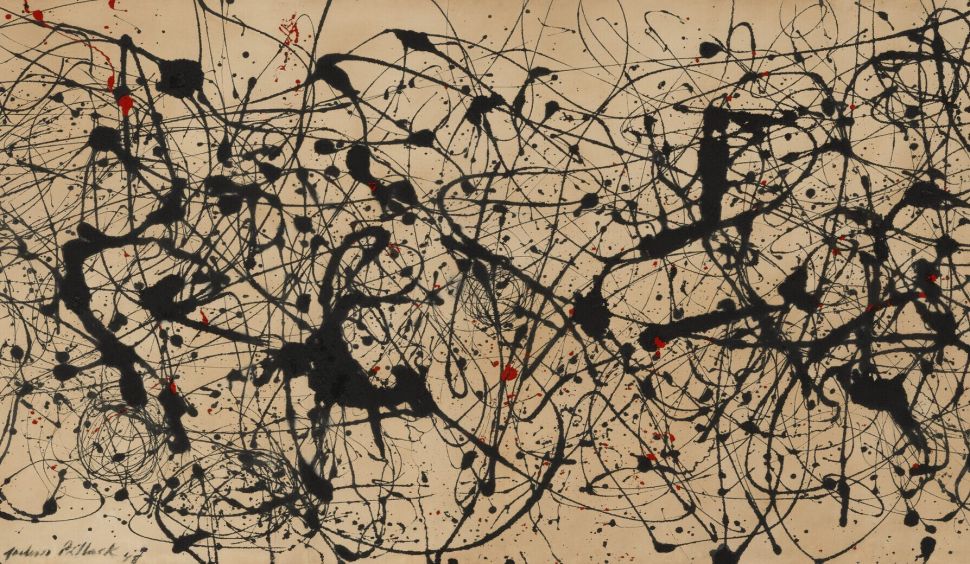
In March, Christie’s confirmed it had secured a tightly curated group of 16 trophy works from media mogul S. I. Newhouse’s collection, expected to generate around $450 million at the low end. Headlining the sale is Jackson Pollock’s Number 7A (1948), enamel on canvas, a monumental 131.5-inch composition executed in his signature drip technique, among the largest of its kind still in private hands and unseen publicly since 1977, offered now with an estimate in the $100 million range.
The long and densely layered canvas becomes a galactic landscape, as the accumulation of dripping threads traces unexpected trajectories that find vitality in entropy. The canvas has a rich provenance, beginning with the photographer Herbert Matter, to whom Pollock gifted the work, and then with renowned collectors Kimiko and John Powers. For nearly half a century, the work has remained unseen by the public, most recently exhibited at the Whitney in 1977. The Newhouse sale brings to Christie’s rostrum $450 million in estimated trophies, including the iconic Gray Target by Jasper Johns from 1958, and Andy Warhol’s Do It Yourself (Violin) from 1962.
Jackson Pollock, Number 7A, 1948. Estimate in the region of $100 million.
CHRISTIE’S IMAGES LTD. 2026
Agnes Gund’s Rothko
May 18, Christie’s
Estimate in the region of $80 million
To headline its New York Evening Sale on May 18, Christie’s secured three masterpieces from the collection of revered arts patron Agnes Gund, expected to fetch $145 million. The top lot is Mark Rothko’s No. 15 (Two Greens and Red Stripe), a monumental late canvas that hung in her apartment until the end of her life. Fleetingly vibrating fields of cold greens, blacks and deep indigo are traversed by a single red band, creating an atmospheric, shifting horizon suggestive of forest or northern lights—a luminous threshold between night and day.
Painted six years after Rothko turned toward darker tones, this masterpiece is among the largest works from this period still in private hands and one of the few acquired directly from the artist—purchased by Gund during a 1967 studio visit and held ever since. Estimated at around $80 million, it will likely set a new auction record for the artist.
Rothko, No. 15 (Two Greens and Red Stripe), 1964. Estimate in the region of $80 million.
CHRISTIE’S IMAGES LTD. 2026
Roy Lichtenstein, Anxious Girl (1964)
May 18, Christie’s
Estimate in the region of $100 million
One of the last lots announced, but among the most coveted in next week’s 20th Century Evening Sale, this iconic Roy Lichtenstein resurfaced from the storied collection of Horace and Holly Solomon, where it has remained for the past three decades. The work belongs to Lichtenstein’s most celebrated 1960s series, drawing on the visual language of mass-produced comics and centered on lovelorn heroines.
Here, a young woman with blonde curls, piercing blue eyes and skin rendered through a field of Ben-Day dots—a 19th-century printing technique Lichtenstein translated into painting to forge his now unmistakable style. Dated 1964, a key year for Pop art, the vibrant contrast between the yellow background and the bold black marks tracing the figure makes it a true Pop art icon. One of just 10 paintings in the series to isolate a single female figure in a tightly cropped composition, the work heightens both psychological intensity and formal clarity, distilling the artist’s exploration of femininity between desire and the image-making dynamics of mass society.
A painting from the exceptionally rare Girl series has not appeared at auction in more than a decade. The last record came in November 2015, when Nurse sold at Christie’s New York for $95 million, setting the current auction benchmark for the artist. This example could set a new one.
Roy Lichtenstein, Anxious Girl, 1964. Estimate: $40-60 million.
CHRISTIE’S IMAGES LTD. 202
Picasso, Arlequin (Buste) (1909)
May 19, Sotheby’s
Estimate in excess of $40 million
A lot to keep an eye on in Sotheby’s Modern Evening Auction is Pablo Picasso’s Arlequin (Buste) (1909), a significant early Cubist work coming to market for the first time from the collection of Enrico Donati—often described as “the last Surrealist”—and his wife. Their deeply personal collection was assembled through Donati’s active role within the inner circle of Surrealism and his close friendships with many of its leading artists. With an estimate in excess of $40 million, the painting revisits one of Picasso’s recurring motifs, the carnivalesque figure of the harlequin, here fractured and reconfigured through the emerging language of Cubism. The figure is segmented into shifting planes, creating a dense, prismatic composition in warm, earthy tones that both constructs and destabilizes form.
Painted in the spring of 1909, at a pivotal moment in Picasso’s career, the work stands among his most complete early formulations of what would soon be defined, together with Braque, as Cubism. Here, the artist uses the harlequin as a vehicle for his new pictorial idiom, producing not only one of his most sensitive treatments of the subject but also one of his most revelatory early Cubist portraits. As Theodore Reff has observed, the harlequin’s costume—with its flat, brightly colored patterns—mirrors the logic of Cubism itself, fragmenting and masking underlying forms while simultaneously transforming them into a decorative surface of striking brilliance. In this interplay between concealment and revelation, where familiar forms dissolve and hidden structures emerge, the harlequin becomes inseparable from Cubism as both subject and method. Discovered by Donati in Paris and acquired through the dealer Daniel-Henry Kahnweiler, the painting remained in his collection for more than six decades.
Pablo Picasso, Arlequin (Buste), 1909. Estimate in excess of $40 million.
Sotheby’s
Alberto Giacometti,
La Clairiere (1950/1960)
May 19, Sotheby’s
Estimate in the region of $18-25 million
Headlining the 50-lot, $53 million trove Sotheby’s secured this season from the David and Shoshanna Wingate collection is one of the most important multi-figural works by Alberto Giacometti, La Clairière (Composition avec neuf figures). Conceived in 1950 and cast in 1960, the sculpture belongs to a trio from his postwar production that marked a true turning point in Giacometti’s practice, as he began to introduce elongated, totemic figures that would define his meditation on the fragility of postwar humanity. The work was featured in the large artist survey “Giacometti 1901-1966” in 1988-89 at the Hirshhorn Museum and Sculpture Garden in Washington, D.C., and the San Francisco Museum of Modern Art.
The piece first debuted at Pierre Matisse’s gallery in 1950. In a letter to Matisse, Giacometti explains how it all originated in a progressive attempt to eliminate and consume the figure, reaching toward the essence of a trace in space. “They are nine studies of figures which found themselves together by accident and formed a composition, a composition which I was vaguely looking for… as if involuntarily I came to realize impressions felt long before and which I saw in the sculpture only when done… If one thinks, regardless of oneself, of a forest or a room or of sand, it is all very well, but one must not say it in advance, as it falsifies and limits. One should be able to think of anything,” he wrote.
Alberto Giacometti, La Clairière (Composition avec neuf figures), conceived in 1950 and cast in 1960. Estimate $18-25 million.
Courtesy Sotheby’s
Pierre-Auguste Renoir, La Femme aux lilas (1876/1877)
May 18, Christie’s
Estimate in the region of $25-35 million
Held by the same family for 87 years, this luminous Renoir carries with it the legacy of one of the most distinguished collecting dynasties of 20th-century New York. Over the course of four decades, Joan Whitney Payson—a formidable businesswoman who co-founded the New York Mets in 1962, becoming the first woman to own and operate a major American sports team—and her husband, Charles Shipman Payson, assembled an exceptional collection centered on works by Renoir, Cézanne, van Gogh, Gauguin and Picasso, while also encompassing Old Masters such as Rembrandt, Holbein and El Greco, alongside key American painters from Homer to Wyeth. Joan Whitney Payson later bequeathed a significant portion of the collection to the Metropolitan Museum of Art, where several galleries are named in her honor.
First acquired by the Paysons in 1929 for $100,000, the painting now returns to the market with a $25-35 million estimate—one of the finest Renoirs to appear at auction in the past century. It is being consigned by their daughter, who is heir to this legacy of exceptional collectors and prominent New Yorkers, and a member of the Whitney Payson family, as well as a great-niece by marriage of Gertrude Vanderbilt Whitney, founder of the Whitney in New York.
The painting carries all the signature grace of Renoir’s celebration of female beauty and gentle presence. The subject is Nini Lopez, a young actress from Montmartre and one of Renoir’s favored models between 1874 and 1877, captured in a moment of quiet introspection, clutching a voluminous bouquet of lilacs in full bloom, their delicacy and luminosity echoed in her youthful presence. Nini appeared in more than 20 of his works in various guises, including the iconic La Loge (1874), now held at The Courtauld Institute in London. The figure and her interior setting are rendered with the same rapid, delicate brushstrokes, as Renoir achieves a masterful synthesis of light and harmonious color across the canvas.
Pierre-Auguste Renoir, La femme aux lilas (Portrait de Nini Lopez), 1876-1877. Estimate: $25-35 million.
CHRISTIE’S IMAGES LTD. 2026
Donald Judd, Untitled (1969)
Defined Space: The Collection of Henry S. McNeil, Jr.
May 20, Christie’s
Estimate: $10-15 million
Part of a group of 20 major Minimalist works from the collection of Henry S. McNeil Jr., a Philadelphia-based collector and early supporter of the movement, is one of the most coveted Donald Judd stacks to appear at auction: a towering copper and red Plexiglas work that anchored the living room of his five-story residence in Rittenhouse Square. Composed of 10 cantilevered rectangular units rising in a vertical column, it combines two of Judd’s most celebrated materials—glowing copper and translucent red/fuchsia Plexiglas—creating shifting visual effects that infuse a sensorial, almost sensual quality into the otherwise austere geometry of its industrial structure, giving it a presence that resonates with contemporary design sensibilities.
The complex interaction between the work’s 10 units, with light reflecting off the copper and refracting through the translucent Plexiglas, produces a simultaneous sense of solidity and void, powerfully articulating Judd’s belief that color not only defines volume but becomes volume itself. As Richard Slifkin observed, the technical precision and serial regularity of the structure allow light to dissolve the Plexiglas surfaces, creating an almost hologrammatic effect. Proving Judd’s ability as a colorist, the work exemplifies the Minimalist ambition to “paint” space through the phenomenology of minimal material interventions. One of only two stacks in this material combination, and the only example in private hands, it is expected to set a new record price for the artist—and for the movement itself.
Donald Judd, Untitled, 1969. Estimate: $10-15 million.
CHRISTIE’S IMAGES LTD. 2026
Gerhard Richter, Kerze (1982)
Marian Goodman’s Richters & 21st Century Evening Sale
May 20, Christie’s
Estimate: $35-65 million
When Christie’s secured the personal collection of pioneering gallerist Marian Goodman following her passing last January, a tightly focused group of exceptional works by Gerhard Richter, one of the central figures of contemporary art whom Goodman championed early, headed to market. The paintings will be presented in a dedicated single-owner session opening the 21st Century Evening Sale—a session the auction house named in her honor, centering on the period from the 1980s to the present, which she actively helped shape. Leading the group is Kerze (Candle) (1982), one of Richter’s early photo-based images and a defining example of his practice from this period.
With an estimate of $35-50 million, the luminous and quietly mesmerizing canvas presents a solitary flame flickering against a dusky ground, a vanitas-like meditation on the transience of all things. Among the finest examples from his celebrated candle paintings of 1982-1983, works from this series are held in major international collections, including The Art Institute of Chicago, the Institut d’art contemporain in Lyon, Museum Frieder Burda in Baden-Baden and the San Francisco Museum of Modern Art. Here, Richter captures a fleeting instant of light and transforms it into something enduring, his signature blur dissolving the boundary between photographic source and painted surface.
Both profoundly romantic in their presentation and rigorously conceived, these paintings have come to define Richter’s sustained exploration of perception and time. In Kerze, he achieves a rare equilibrium, translating a momentary spark of combustion into a serene, almost transcendental presence that hovers between image and abstraction—a tension he has navigated throughout his career, continually oscillating between the two.
Gerhard Richter, Kerze (Candle), 1982. Estimate: $35-50 million.
Photo by Max Touhey. Courtesy Christie’s
