
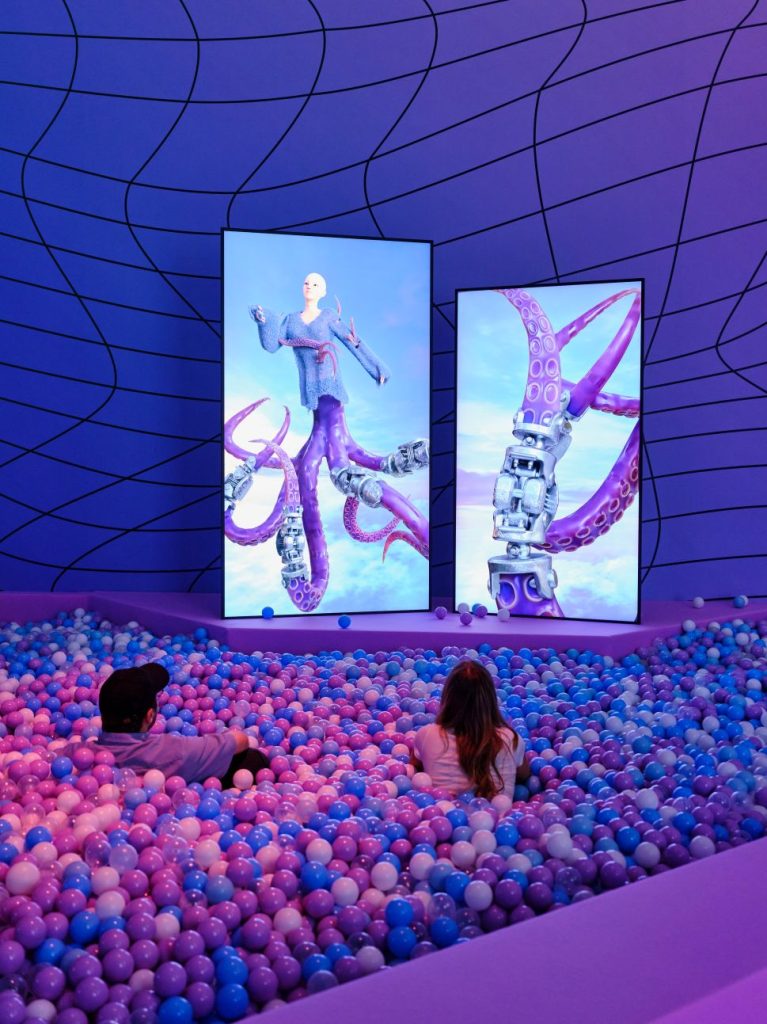
The OG Art Basel remains the most business-minded edition of the fair’s ever-expanding global portfolio and the one least inclined to let you forget why everyone is there. Basel, Switzerland, after all, is not Miami Beach, Paris or Hong Kong. The city offers fewer distractions from the main event, and despite the constellation of satellite fairs and offsite programs that has grown up around the main fair, most of the oxygen still flows toward the Messeplatz.
This year, June Art Fair appears absent from that orbit, with no 2026 updates posted as of publication. Liste, meanwhile, returns as the essential satellite for emerging galleries, younger artists and discoveries, while Basel Social Club, now in its fifth edition, offers an even more casual counterpoint, with its no-booth, social gathering format staged inside a vacant multi-story office building. It also has the advantage of being the week’s de facto after-hours headquarters, open until 3 a.m. with parties, drinks and DJ sets.
Still, Basel is worth returning to year over year in part because of the city’s first-rate institutions and museums—37 of them, which is an absurdly high number for a city of its size. This year, you’ll find exhibitions of artists working in speculative, experimental realms and engaging with technology to imagine alternative futures at the center of Basel’s institutional programming. (The emphasis on tech and the digital world aligns neatly with Art Basel’s digital sector, Zero 10, which makes its Basel debut next week after headline-generating editions in Miami and Hong Kong, curated by Eli Shein with art/tech pioneer Trevor Paglen.) Here are our picks for the shows to add to your Basel itinerary:
Six must-see museum shows in Basel
Cao Fei’s “Testimonies to the Near Future”
Kunstmuseum Basel; through October 11, 2026
The largest European survey of pioneering Chinese digital artist Cao Fei, “Testimonies to the Near Future” transforms the museum’s Gegenwart building into an alternative virtual city that brings together three decades of the artist’s expansive worldbuilding across installations, films, virtual worlds and game-based works. Spread over four floors, the labyrinthine exhibition translates Fei’s immersive parallel reality into a highly theatrical setting, where interactive elements from everyday city life become part of a speculative fiction and role play that encourages a more critical reading of the rapid technological, urbanistic and semiotic changes that, in just a few decades, have completely overturned the rhythms and habits of daily existence. Her videos and partly game-based environments are situated in factories, dreamscapes and visions of the future, inviting audiences to explore labor, transformation and the peculiar beauty of a globalized world while addressing questions of identity, embodiment and memory raised by these new dynamics. Since the 1990s, Cao Fei has pursued a relentless exploration of today’s “liquid society,” questioning modes of production, communication and experience in the new global media and technological age. While Fei’s work has long focused on the accelerated modernization of China, which she experienced firsthand growing up, her commentary now extends to a reality shared by society. This show follows her largest survey in China, hosted in 2024 at the Pudong Art Museum in Shanghai, and runs in parallel with Fei’s current show at Fondazione Prada in Milan.
Installation view: Cao Fei’s “Testimonies to the Near Future” at Kunstmuseum Basel.
Photo: Samuel Bramley | Courtesy of the artist, Creative Vitamin Space, and Sprüth Magers
“Pierre Huyghe”
Fondation Beyeler; through September 13, 2026
This highly anticipated exhibition brings together new works, recent films and select earlier pieces by one of the most innovative artists of his generation. Huyghe’s first museum exhibition in Switzerland, it unfolds as a site-specific “soulscape” conceived for the museum’s architecture, where each work and the spaces between them form ambiguous thresholds—a polyphony composed of multiple temporalities, voices and states without hierarchy between fiction and reality, the living and the artificial, the human and the nonhuman. Through the interplay of shifting works that combine moving images, sound, objects, living organisms and machine learning, Huyghe continues his exploration of possible continuities between life forms, technology and biological and inert matter. For the artist, “fictions are vehicles that give us access to other possible worlds, to a counterfactual imagination. Such fictions, separated from the known, unconstrained by the here and now, are open to speculation, to other roads not taken. They make it possible to experience ourselves from the outside.” Building speculative, symbiotic ecosystems that constantly learn, modify and evolve, Huyghe has pioneered a possible integration and synchronization of the human and the nonhuman, nature and technology, while embracing uncertainty and instability as conditions for continuous exchange, transformation and evolution, opening onto alternative dimensions of reality. The exhibition follows the widely acclaimed, similarly immersive solo show at Pinault’s Punta della Dogana in 2024.
Installation view: “Pierre Huyghe” at Fondation Beyeler.
Photos: Ola Rindal
“New Rituals [for the End of the World]”
HEK (House of Electronic Arts); through August 9, 2026
Well ahead of other European cities, Basel launched its own museum dedicated to digital and new media art in 2011. HEK (House of Electronic Arts) is the key institution in Switzerland for contemporary media art and digital cultures, exploring how art can interact with emerging technologies while preserving these digital creations and building a corresponding collection of software- and web-based art. On view during Art Basel is another speculative, future-forward show, “New Rituals [for the End of the World],” which gathers an international group of artists looking at newly emerging social strategies and rituals for confronting today’s difficult global situation, reconnecting with our core and finding in creativity the force to resist an impending sense of doom and catastrophe. At the center of this group show is an attempt to build, partly through the imaginative and speculative power of new technologies, new mythologies that can help survive—and transform—the end of the world into new beginnings. Artists in the exhibition include Zach Blas, Sofia Braga, Stefanie Egedy, Sian Fan, Teresa Fernández-Pello, Anan Fries, Dorota Gawęda and Eglė Kulbokaitė, Auriea Harvey, Maya Hottarek, Etsuko Ichihara, Christiane Peschek, Skawennati and Robin Meier Wiratunga.
The show’s focus is on the imaginative and speculative power of new technologies.
Courtesy the artista and HEK (House of Electronic Arts)
Monira Al Qadiri’s “BENZENE FLOAT”
Kunsthaus Baselland; through January 24, 2027
Operating in the speculative realm allows artists to use humor and a more playful approach to make some of today’s most complex issues feel closer and more accessible. That is the case with Monira Al Qadiri’s brilliant installation “BENZENE FLOAT” at Kunsthaus Baselland, comprising five larger-than-life inflatable sculptures depicting petrochemical compounds. The work helps visualize the influence and power the petrochemical industry exerts over modern life, especially as these chemicals have become so deeply integrated into our daily routines that they remain largely invisible to us. Hovering at the edge of our field of vision, they fuel our movements while also negatively impacting us and our environments.
Monira Al Qadiri, Five inflatable sculptures, 2023.
Courtesy the artist
Shuang Li’s “Alliance”
Kunsthalle Basel; through September 13, 2026
After debuting at Kim Association during Singapore Art Week earlier this year, Shuang Li’s “Alliance” opens at Kunsthalle Basel, the city’s most avant-garde space for contemporary art. Investigating today’s “contemporary digital landscape,” the young Berlin- and Wuyi-based artist’s work draws attention to the interaction between media, users and the systems that regulate bodies and desire. With installation, video and other mediums, the exhibition begins with Li’s research into extreme weather phenomena and storm chasing, the targeted tracking and observation of severe storms, especially hurricanes and tornadoes. Embedded in global networks where climate volatility, algorithmic systems and capitalist extraction have cross-border consequences, Li sees storm chasing as an expressive metaphor for orienting oneself amid the invasive forces that shape, influence and control the course of human and nonhuman life alike in the digital age. The show is the artist’s first solo exhibition in Europe, but, despite being only in her thirties, Li has already been included in the 2024 Whitney Biennial, the 59th Venice Biennale in 2022 and the Shanghai Biennale in 2023. She also staged a well-received 2024 solo exhibition, “Distance of the Moon,” at Prada Rong Zhai in Shanghai.
Shuang Li, Alliance, 2026. Video still.
Courtesy the artist and Antenna Space, Shanghai
“Laboring Bodies” and Nicolas Darrot’s “Fuzzy Logic”
Museum Tinguely; through November 8, 2026 and March 7, 2027
As a pioneer of multimedia and multidisciplinary approaches, Tinguely, in his artistic career as much as in his life, was one of these disruptive creatives, able to look deep inside and beyond his own time. “He constantly tried to reach beyond it—to connect with people, to expand his audience and to make his work relevant to everyday life,” director Roland Wetzel told Observer in an interview on the occasion of the museum’s 100th anniversary. This season, the museum is doubling down on exhibitions dedicated to our evolving relationship with technology. The first, “Laboring Bodies,” explores the interdependence of body and machine from a feminist perspective, examining how the human body, especially the feminized and marginalized body, has been shaped and controlled by machines since the dawn of the modern age while also remaining a site of resistance. Tracing the close connection between humans and machines in the industrial era, the show brings together historical and contemporary works by 36 artists that make visible the mechanization of the body across contexts of labor, exploitation, resistance and care. A concurrent show of works by Nicolas Darrot explores the notion of fuzzy logic, a form of artificial intelligence that enables computers to process concepts that cannot be reduced to the strictly binary terms of 1 or 0, yes or no, true or false. Mimicking human meaning-making, fuzzy logic embraces gradations and describes states and elements linguistically rather than strictly mathematically. Darrot has transformed Basel’s smallest exhibition space, a former telephone booth at the museum, into a stage for automated figures that come to life when visitors scan the barcode on a custom-designed playing card.
Ernestyna Orlowska, Make Your Body Your Machine, 2021.
© Ernestyna Orlowska. Photo: Margot Roth
