
Every summer, New York’s wealthiest residents migrate east to Long Island to spend the season in the Hamptons. Yet the area’s artistic history long predates its current identity as a luxury enclave. Beginning in the late 19th century, Hudson River School painters helped establish the East End as a seasonal artists’ colony, drawn by its pastoral landscape, coastal scenery and distinctive light. By the early 20th Century, the South Fork had become an established summer retreat for artists, writers and affluent New Yorkers.
The region became even more central to American art after World War II, when artists moved east in search of cheaper housing, larger studios and distance from the city. In 1945, Jackson Pollock and Lee Krasner settled in a modest farmhouse in Springs, then a rural hamlet north of East Hampton, purchased with financial assistance from Peggy Guggenheim. They were followed by other Abstract Expressionists, including Willem de Kooning, Elaine De Kooning, Franz Kline, Robert Motherwell, Helen Frankenthaler and Adolph Gottlieb.
Today, the Hamptons are far more closely associated with wealth and luxury, and few artists can still afford to live there. The area has shifted from an affordable artists’ colony into a seasonal marketplace and concentrated extension of the New York art world. That transformation accelerated during the pandemic, when many galleries and all three major auction houses opened East End outposts to serve the collectors who had relocated there. Although several of those spaces have since closed, the Hamptons still offers plenty of exhibitions worth seeing each summer. Here are this season’s must-see shows.
The best art in the Hamptons
“
Sanford Biggers: Drift”
Parrish Art Museum, Water Mill
Through September 13, 2026
Operating at the intersections of African diasporic history, spirituality, mythology and popular culture, Sanford Biggers engages both creatively and semiotically with symbols of power, race and the ways they have been historically narrated. Through appropriation and fluid remediation, he embraces an idiosyncratic hybridity that reflects centuries of cross-cultural exchange, building a symbolic vocabulary attuned to today’s global culture. Clouds are a recurring motif in Biggers’s practice and the central element of his exhibition at the Parrish Art Museum in the Hamptons. Suspended from the ceiling and drifting through the gallery, they create a shifting environment that suggests relentless adaptability and fluctuation, resisting stable or singular forms. Titled Unsui (Cloud Forest) (2025), the monumental installation draws simultaneously on Japanese, European and American art traditions, becoming a visual metaphor for the Zen Buddhist principle of moving through the world without attachment or resistance to change. The illuminated cloud sculptures enter into a dynamic choreography with quilt works from Biggers’s Codex series, which feature spray-painted cumulus forms in a nod to his teenage years as a graffiti artist. Other works from his Chimera, Mirror and Codex series complete the ensemble, evoking a reality in constant drift and transformation that resists fixity and instead encourages multiple perspectives.
Installation view: “Sanford Biggers: Drift.”
Photo: Jenny Gorman
Damien Davis’s
“Hedges & Edges”
“Hedges & Edges”
Southampton African American Museum
Opening July 18, 2026
Presented by the Hamptons Black Arts Council, founded by independent curator and gallerist Storm Ascher, this new solo exhibition by Damien Davis explores the intertwined aesthetics and social histories of Black barbershops and community gardens as spaces of care, maintenance, ritual and collective gathering. Drawing on the museum’s own history as a former barbershop serving Southampton’s Black community, Davis reactivates the space through a series of large-scale mirrored acrylic works, sculptural interventions and live barbering activations. The exhibition’s title points to the shared visual language of grooming and cultivation. Throughout the show, Black barbers will periodically cut hair in the gallery, transforming everyday acts of touch, conversation and aesthetic labor into a public ritual. The barbershop emerges not as a nostalgic reconstruction, but as an active architecture of social exchange, where vulnerability, masculinity, queerness and care remain in constant negotiation.
Damien Davis,
Barbershop Index (Variation Set).
Photo by Carlos Hernandez Studios | Courtesy Superposition Gallery
Alan Ruiz’s “De sol a sol”
Dia Bridgehampton
Long-term view
Inspired by the building’s past and present lives, Ruiz is presenting a site-specific installation at Dia Bridgehampton alongside new works and an essay examining the creation and maintenance of the site within the context of local labor conditions and the broader history of work in the United States. The project continues his investigation of architecture not as a neutral container, but as a system that organizes behavior, visibility and power. Rather than placing autonomous objects inside a gallery, Ruiz often treats the gallery itself as his material, using institutional critique to destabilize the space and reveal how its structure serves particular functions, power dynamics and underlying ideologies. Born in Mexico City and raised on Long Island, Ruiz engages here with the social, political and psychological dimensions of the site’s former lives as a fire station and Baptist church. The works in De sol a sol point to the layered sociopolitical conditions of Long Island’s East End, moving between sites of leisure and the realities of the working day.
Alan Ruiz, WS-H2AB (detail), 2026.
© Alan Ruiz. Photo: Bill Jacobson Studio, New York
“THIS LAND: Considering the American Landscape”
The Church
Through September 6, 2026
Founded by artists Eric Fischl and April Gornik and housed in a deconsecrated 19th-century Methodist church, The Church is a nonprofit arts and cultural center in Sag Harbor. Its mission is closely tied to the town’s identity as a historic “maker village,” combining exhibitions, residencies, education, collaboration and community outreach while bringing together visual artists, writers, performers, musicians and other creative practitioners. Curated by Donna De Salvo and Seph Rodney, its current summer exhibition asks the timely question, “What is the American landscape?” on the occasion of the nation’s 250th anniversary. Staging an intergenerational conversation, the show brings together important works by artists associated with the Hudson River School, including several from Sol LeWitt’s personal collection, alongside contemporary practitioners such as Sky Hopinka, An-My Lê, Zoë Leonard, Lucy Raven and Meg Webster. In doing so, the exhibition examines the mythology and ideology constructed around the American landscape. Tracing the evolving history of the sublime, it moves from idealized visions of nature to the contradictions shaping contemporary American geographies, from the Hudson River Valley and Los Angeles’s urban sprawl to increasingly gentrified metropolises such as New York City.
Installation view: “THIS LAND: Considering the American Landscape.”
Photo: Lena Yaremenko
“Betty Parsons/Carla Accardi” and Robert Nava
Peter Marino Art Foundation, Southampton
Through October 3, 2026
The Peter Marino Art Foundation in Southampton is presenting an unprecedented dialogue between Betty Parsons and Italian postwar artist Carla Accardi. Taking over the double-height Cathedral Gallery, the exhibition pairs Parsons’s bold, playfully vibrant abstraction with Accardi’s luminous exploration of light, sign and color through compositions that combine gestural marks with hard-edge forms. Also on view throughout the summer are ten new large-scale electric paintings by American artist Robert Nava. Working with an uninhibited freedom that moves between gesture and imagination, Nava continues his mythmaking through fantastical characters set within unconventional scenes. Running in parallel is a focused presentation of work by Iranian American, New York-based artist Y.Z. Kami, featuring eighteen paintings and photographic works, including introspective portraits and architecturally inspired Dome paintings. The foundation is also presenting more than 100 Tiffany mixed-metal works from the late 19th Century, highlighting the craftsmanship and technical refinement that made the brand so distinctive.
A work by Robert Nava, on view at Peter Marino Foundation through October 3, 2026.
Courtesy Peter Marino Foundation and the artist
Dennis Oppenheim’s “Wishing the Mountains Madness”
Parrish Art Museum, Water Mill
Through September 14, 2026
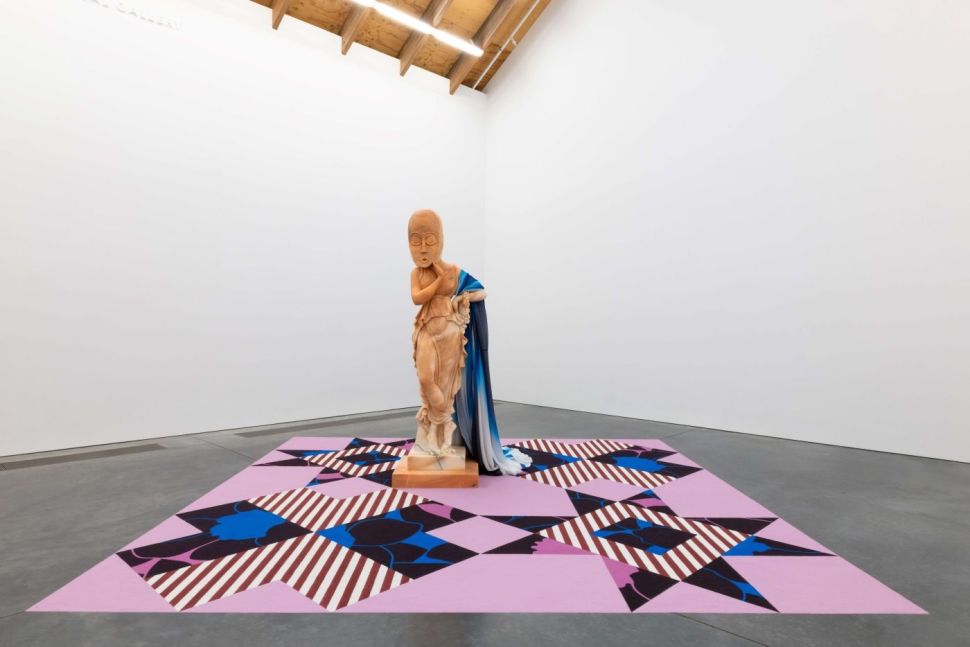
In tandem with Biggers’s exhibition, the Parrish Art Museum is also restaging Dennis Oppenheim’s epic earthwork Wishing the Mountains Madness in the Parrish Meadow, with related documentation—including aerial photographs and maps—displayed in the museum lobby. Oppenheim was a pioneering American conceptual artist whose restless practice spanned Land Art, performance, body art, photography, film, installation and large-scale public sculpture. In the late 1960s, he became closely associated with Land Art, working directly in fields, snow, soil and other outdoor environments to create temporary interventions that often survive only through photographs, maps and films. First realized in 1977 as an ephemeral intervention during a visiting artist workshop at the University of Montana, the original work consisted of 54-foot-wide plywood stars distributed across a grassy, two-acre hillside. Some were painted white, while others appeared in pale shades of red or blue. While nodding to the nation’s bicentennial the previous year, the work also suggests a cosmic upheaval in which the stars have fallen to earth. The title refers to what Oppenheim saw as a jarring contrast between Montana’s “very beautiful and serene” natural landscape and the diversity and energy of New York City in the late 1970s—a kind of creative “madness” he felt was missing from the region’s bucolic lifestyle. On June 14, during Community Day, which also coincided with Flag Day, visitors were invited to participate in the reenactment by freely placing sculptures referencing the current fifty-star flag across the museum’s meadow. The project was conceived to celebrate “the expanse of the sky above earth, freedom in general, and freedom of expression—values and aspirations embedded in the spirit of the nation,” according to Amy Oppenheim, who now leads the Dennis Oppenheim Estate.
Dennis Oppenheim with star unit, Wishing the Mountains Madness, Missoula, 1977.
© Dennis Oppenheim Estate
Robert Wilson’s Watermill Center and “The Disappearance of the Landscape”
The Watermill Center
August 29, 2026 – March 20, 2027
An absolute must-see in the Hamptons, for those lucky enough to secure access, is Robert Wilson’s Watermill Center, which recently hosted the inaugural edition of NOMAD, the itinerant boutique fair for art and design. In addition to its internationally renowned residency program and rich lineup of performance events, the Center houses the eclectic, multilayered collection Wilson assembled over decades, now displayed throughout the campus and in his former living spaces. Its upcoming exhibition, “The Disappearance of Landscape: Oakleyville, 1964–2022,” brings together paintings, photographs and sculptures by Sheyla Baykal, Peter Hujar, Matthew Leifheit and Paul Thek, all of whom lived and worked between New York City and Oakleyville, an isolated Fire Island community accessible primarily by boat. Beginning in the 1960s, Oakleyville became a gathering place for an interconnected network of queer Downtown artists. The exhibition considers Fire Island not simply as a backdrop, but as an active collaborator in both the artists’ practices and their lives, tracing a symbiotic relationship in which climate, ecology and nonhuman life shaped the work. The project also connects directly to The Watermill Center’s stewardship of Paul Thek’s legacy. Thek left his estate to Robert Wilson in 1988, and the Center now holds the most comprehensive collection of his works and papers. The exhibition follows solo presentations of Thek’s work at Pace Gallery and Galerie Buchholz, while its title derives from Marcelo Gabriel Yáñez’s forthcoming book on artists working on Fire Island from the 19th through the 21st Centuries.
Peter Hujar, Paul Thek, Oakleyville, Fire Island, 1966.
Courtesy the artist
Sean Scully “48”
LongHouse Reserve, East Hampton
Through December 24, 2028
Created by artist, collector and internationally renowned textile designer and weaver Jack Lenor Larsen (1927-2020), LongHouse Reserve is a 16-acre integrated environment in East Hampton featuring more than 60 outdoor works. Conceived as a “sanctuary” for Long Island and beyond, its program brings together art, nature and wellness, while opening the grounds to the public for education and enjoyment. Its next chapter will include activating Larsen’s home, a modernist structure inspired by the Shinto shrine at Ise, and displaying his extensive craft and design collections. Its latest addition is Sean Scully’s 48 (2024), a stacked, multicolored sculpture first shown in his 2024 New York exhibition “Sean Scully: Broadway Shuffle.” The work epitomizes Scully’s deliberate use of stripes and color, with gestures toward land, sea and sky. Through it, he transforms the rigid geometry of the stripe and grid into a visual language charged with emotion, history and light.
Sean Scully’s 48 at LongHouse.
Courtesy LongHouse
“La Monumental”
The Ranch, Montauk
Through November 15, 2026
The Ranch is one of those hybrid, always-interesting art spaces: a 26-acre working horse farm in Montauk that operates across a converted barn, outdoor sculpture installations, exhibitions, horses and artist-centered programming. To make it even more context-specific, its own site describes it as a private operational horse farm that continues to train and breed competition-grade cutting horses while also functioning as an exhibition venue. Behind it is New York art dealer Max Levai, the former president of Marlborough Gallery and a third-generation art dealer. This summer, The Ranch is hosting a show of truly monumental outdoor sculptures—an ambitious, decidedly less commercial operation that has already grabbed headlines after Matt Johnson’s 60-foot shipping-container sculpture Meditating Figure prompted East Hampton officials to pursue legal action over permitting and safety approvals. Levai has argued that the work is art, not a structure requiring a building permit.
Matt Johnson, Meditating Figure, 2026.
Courtesy The Ranch
“36 Paintings”
Harper’s, East Hampton
Through August 5, 2026
Among the galleries that retained their Hamptons outposts, Harper’s is arguably the one bringing the freshest material. This month, it is staging a classic summer group exhibition: 36 paintings, spanning a wide range of narratives and aesthetics, by some of the most interesting voices that have been emerging and rising in the past years. Featured artists include Sarah Aibel, Akiyo, Imogen Allen, Marcus Brutus, Ricky Burrows, Matteo Callegari, Hyegyeong Choi, Lenna Christakis, Ray Ciarrocchi, Mary Corman, Cooper Cox, Noel De Lesseps, Marc Dennis, Bobbi Essers, Nick Farhi, Nicasio Fernandez, Eliot Greenwald, Daniel Heidkamp, Soren Hope, Noa Ironic, Aaron Johnson, Eleanor Johnson, Yongjae Kim, John Hyen Lee, Nianxin Li, JJ Manford, Tomona Matsukawa, Tommy May, Matt McCormick, Lizbeth Mitty, Iréne Norén, Gwen O’Neil, Enoc Perez, Maïa Régis, Nathalie Shepherd, Aliza Stone Howard, Nick Weber, Angela Witmore, Guy Yanai and Yesiyu Zhao.
Aliza Stone Howard,
Will This Déjà Vu Never End?, 2026.
Courtesy the artist
“Earth, Wind and Fire”
Eric Firestone, East Hampton
Through August 9, 2026
Eric Firestone has been one of the more enduring commercial presences in East Hampton, where it operates spaces on Newtown Lane. Its latest exhibition at the East End location centers on nature, bringing together 23 artists from different generations whose work addresses the land, rewilding, traces of the natural world and its intersections with the body, consumerism and the urban environment. Many of the artists incorporate found or organic materials into their work, treating the creative process as a form of collaboration with nature rather than an act of imposition. Their practices often place human intervention within existing natural structures and cycles, exploring how the anthropic and the organic can coexist. That tension between city life and the natural landscape is one of the exhibition’s central concerns. It reflects a broader condition of contemporary life, in which the growing distance between people and their surroundings has produced an increasingly unsustainable relationship. By bringing these forces into dialogue, the exhibition encourages viewers to reconsider how they inhabit, use and alter the environments around them.
“Earth, Wind, and Fire” at Eric Firestone, Through August 9, 2026.
Courtesy Eric Firestone
