
The entrance of “Passion is Volcanic: Desire in Southeast Asian Art” is covered in bright red tape, playfully warning viewers of its explicit content. In entering the museum’s first-ever exhibition to receive an R18 rating, those who cross this dramatic threshold might expect to encounter works that force them to avert their eyes. Instead, what they find invites them to look more closely. With roughly 70 works spread across three chapters, the show is modest in scale but highly ambitious in its material, geographic and historical scope, with paintings, sculptures, installations and works on paper by artists from across Southeast Asia. Pre-modern objects are also presented alongside modern and contemporary works, allowing visitors to trace how artistic expressions of desire have evolved throughout the centuries.
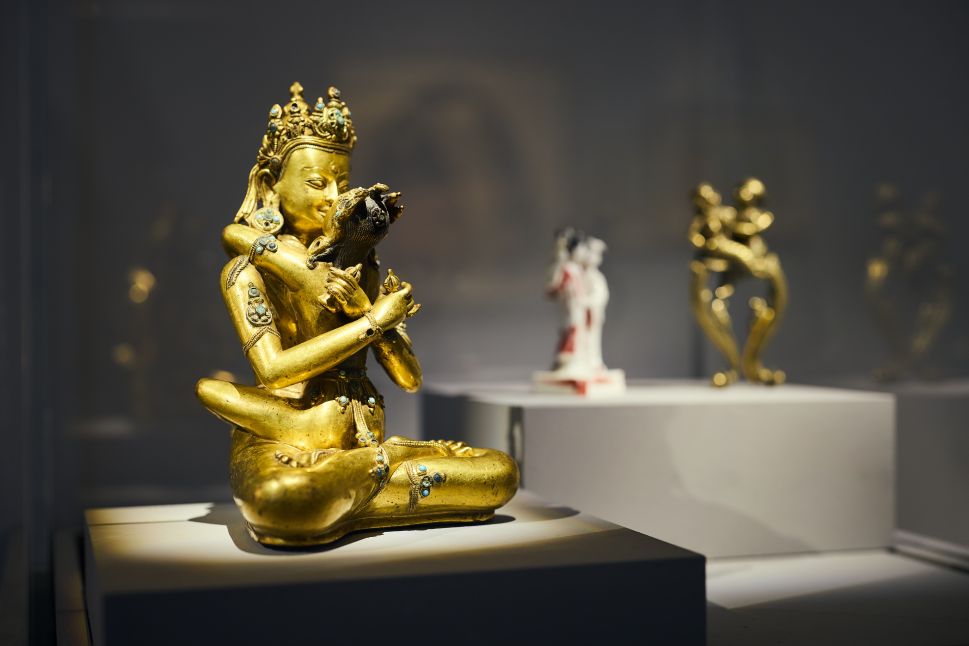
In the first chapter, viewers encounter Vajradhara and Prajnaparamita (c. 14-15th Century), a sculpture that reveals the long relationship between the erotic and the cosmic within the region’s visual culture. Nearby, Haliya Bathing (1983) by Agnes Arellano reinterprets Philippine mythology, foregrounding the connections between motherhood, femininity and the divine. Together, these works establish the importance of narrative in the understanding of eroticism. “These stories galvanize us, whether they be high history or common folklore,” the exhibition’s co-curator Adele Tan told Observer. Myths, folklore and religious stories, she explained, are the “bedrock of desire,” providing the cultural frameworks through which bodies and relationships gain meaning.
“Passion is Volcanic: Desire in Southeast Asian Art (R18)“
Artists: Various
Venue: National Gallery Singapore
Address: Singapore 178957
Through: August 30, 2026
The second chapter shifts to representations of the body, exploring how artists have reimagined the figure in postcolonial Southeast Asia. Rather than treating the body as a fixed subject, the exhibition interrogates familiar visual motifs, encouraging visitors to reconsider them through close looking. This leads into the final chapter, where bodies navigate private and public spaces, revealing how sociopolitical forces have shaped expressions of desire. In TV for Everyone, for example, Tan Peng—one of Singapore’s first openly queer artists—depicts a gay couple concealing their intimacy inside their home. In front of them, a television screen broadcasts the passionate kiss of a man and woman. Reflecting on this work, Tan noted: “I think it’s important for us to remember what the ’90s was like in Singapore. There were pockets of possibilities, even 30 years ago. We shouldn’t forget that.”
The invitation to look carefully extends past the individual works and into the exhibition itself. “We are manipulating the way people encounter the works, how they see, how the works also see each other,” said Tan, who while researching the museum’s collection became fascinated by objects with descriptions that failed to capture what was actually depicted. “Being the Freudian that I am,” she added with a laugh, “I love looking at these junctures and slippages.” The process of sustained looking proved to be generative and productive, and it was those moments that became the starting point for an exhibition that allows audiences to do the same. “There isn’t always a lot of space for that in our society,” co-curator Kathleen Ditzig added, “because of how cybernetically trained we are by technology and the social media environment we occupy.”
One notable set of works in the show that warrant fresh eyes is that of the Singaporean performance artist Grace Quek, better known internationally as Annabel Chong. Active in Los Angeles during the 1990s, Quek became infamous after appearing in The World’s Biggest Gang Bang, a pornographic film in which she has sex with hundreds of men. The exhibition’s inclusion of her artist archive not only reclaims her work as performance art but also invites viewers to reflect on cultural values and stigmas surrounding sex, particularly within the digital sphere. In speaking about Quek’s practice, Ditzig said, “It anticipates some of the viral media critiques that we actually are making now about digital culture.”
Despite Southeast Asia’s largely conservative views surrounding sex, the exhibition has been surprisingly well-received. In part, that success lies in the way that it invites curiosity rather than focusing on provocation or shock value. “I would just say that it’s a very comfortable erotic exhibition,” Tan said. “We’ve actually made great efforts to make the exhibition as accessible as possible. We tried not to play into the usual conventional assumptions about what eroticism and desire should look like.”
The curators also prioritized making the exhibition an accessible and comfortable space for the artists themselves. They collaborated closely, for instance, with conceptual photographer Lavender Chang, who revisited a body of work that she had originally created for a Viagra advertising campaign in Shanghai. Due to the fact that direct pharmaceutical marketing was prohibited in China, the campaign relied on implication instead of overt product placement. Using long exposures, Chang photographed three couples over several hours of intercourse, producing blurred images that centered on intimacy rather than explicit sexuality. For the show, one of these photographs was even translated onto a long rice paper scroll, simulating a lightbox effect and echoing how the composition features figures in front of a window. As Tan explained, “We’re playing a lot with visual patterns here,” adding that inviting artists to think through the exhibition design alongside the staff was crucial to the success of the project.
For an exhibition that is ostensibly about sex, “Passion is Volcanic” is ultimately more interested in changing how audiences look at art rather than testing the limits of what they can see. “You’re starting to see what people expect of the way we write our history,” Ditzig said. “And you can see people start to think about the way they look and talk about art… This is one of the beautiful things to come out of the show.”
