
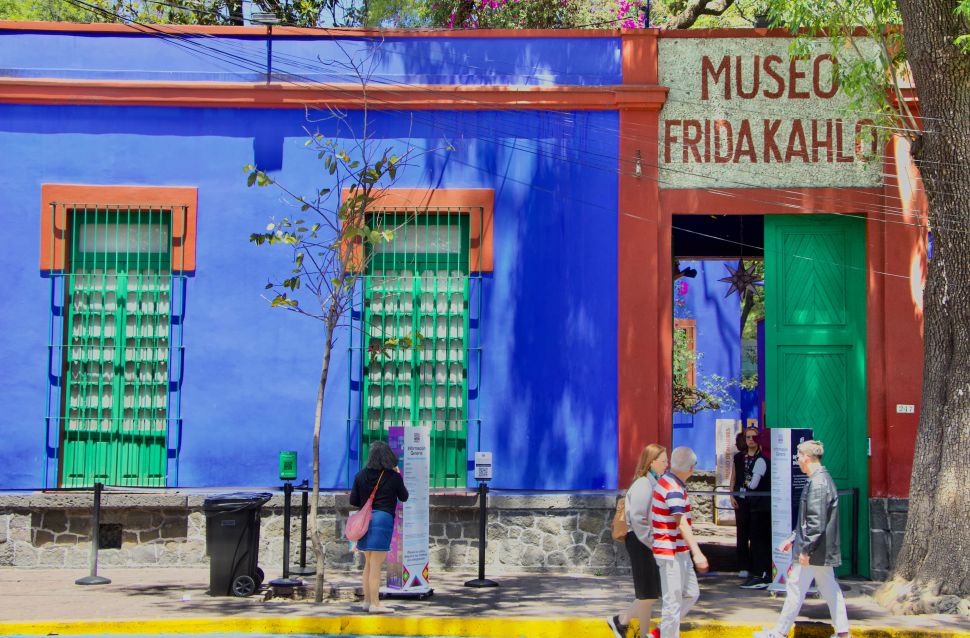
Frida Kahlo with green doors and window bars, a red border, and visitors walking outside.” width=”970″ height=”639″ data-caption=’Casa Azul, where Frida Kahlo lived for more than 40 years, draws art lovers from around the world. <span class=”lazyload media-credit”>Photo: Jordan Riefe for Observer</span>’>
For three generations, art lovers have been drawn to a residential corner in the Coyoacán section of Mexico City to visit Casa Azul, the house where Frida Kahlo was born, lived, loved and painted for over 40 years. Witness to a vibrant past, its cobalt walls enclose a courtyard and garden cooled by fountains and shady pathways. Its rooms contain a museum dedicated to the beloved artist, with family photos and memorabilia, as well as the bed where she spent so much time painting while recovering from a horrifying streetcar accident in which she was impaled on a metal pole. White with yellow and blue tile, the kitchen includes the names of herself and the love of her life and bane of her existence, Diego Rivera, spelled out on the walls. Her studio is decorated with artworks and supplies, as well as an easel and wheelchair.
But while Casa Azul remains a bucket list destination for any Kahlo enthusiast, a second museum dedicated to the artist, just a few blocks away, opened last September. Casa Roja pulls back the curtain on Kahlo’s family life and, perhaps, introduces a new work to her oeuvre—a kitchen mural, El mesón de los gorriones (“The Table of the Scroungers”). It features the branches of a grapefruit tree like the one growing in the house’s courtyard, bougainvillea and a banner inscribed with the title held aloft by sparrows. While the mural is unsigned, it is believed by the family to be the work of Kahlo, despite French newspaper Le Monde citing both German art historian Helga Prignitz-Poda and biographer Luis-Martín Lozano, specialists in Kahlo’s work, insisting she did not paint it. They also assert that the basement could hardly have been the artist’s private redoubt, as claimed, on account of her limited mobility due to polio and her debilitating accident.
“Polio never stopped her, not even the accident stopped her. She would climb on top of the fridge and say you didn’t clean here,” Adán García Fajardo, director of the new museum, tells Observer, while also conceding that there is no proof of authorship.
Kahlo’s grandniece, Mara Romeo Kahlo lived in Casa Roja up until 2023. “I don’t care if they say it was or it wasn’t,” she says of Le Monde’s reporting. “I was eight or nine years old, I always saw those paintings on the wall. It’s just a weird thing to do without backing it up with at least some scholarly research or something. My mother and my grandmother always talked about the mural, they say that it was from Frida.”
Romeo’s daughter, Frida Hentschel, recalls one of Kahlo’s students visiting the house and confirming that he and his classmate did not paint it, saying he remembers the mural from visits dating as far back as the late 1940s. While Christina, Frida’s younger sister, also liked to paint, neither Romeo nor Hentschel believe it’s her work.
“There is no doubt it was in the imagery of the Kahlo family,” Fajardo insists, noting that Kahlo featured grapefruit in her 1928 still life, Portrait of Cristina, My Sister. “There’s a signature that was blurred out, and you have bougainvillea and the sparrows are representative of an open house where everyone can come. It might be Frida, I don’t say it’s hers. We think it was painted around 1938. Legally, the mural can’t be traced to Frida.”
Casa Roja is filled with ephemera, letters, postcards, a dark room and photos taken by the artist’s father, Guillermo Kahlo, a German immigrant who adopted the Spanish for his given name, Wilhelm. A successful photographer in turn-of-the-century Mexico City, he spent his free time painting still lifes and outdoor scenes, sometimes finding his missing supplies in the hands of his third daughter, Frida. When she was old enough, he employed her to tint his photos, teaching her lessons on composition and color.
Ironically, the streetcar accident likely played a big role in Kahlo becoming an artist. She was attending medical school at the time and had planned to become a doctor. But the accident left her bedridden with few options to dispel boredom but to paint. It also accounts for the proliferation of self-portraits throughout her career (over 50), since there were so few paint-worthy subjects at hand.
Kahlo married Diego Rivera in 1929, and he paid off the mortgage on Casa Azul in 1931 when Guillermo and Matilde (who died in 1932) moved to Casa Roja. There, Kahlo sought refuge from her tempestuous marriage from 1934-35 after discovering an affair between her beloved younger sister, Christina, and Rivera.
“We don’t have evidence of that,” counters Fajardo. “But what we know about the relationship between the two sisters, it never ceased. They never broke or separated. Frida always thought of Christina as the other half of her heart. Every letter she wrote to her was full of love. So, for someone who was betrayed by a sister, it doesn’t seem for this to be real.”
Following Kahlo’s death in 1954, Rivera was instrumental in authoring the mythos surrounding his wife, but it wasn’t until his death in 1957 that she became a feminist icon. “She started growing in the mind and heart of the people who saw her art,” says Fajardo, who sees the 1983 biography by Hayden Herrera as pivotal to the public’s perception of Kahlo, followed by the 2002 movie starring Salma Hayek. “The family wants to show that Frida was also a really lively persona. This space speaks about the intimate life of Frida when she was a child and afterwards, the circle of affection that was close to Frida though there were those who tried to monopolize the story.”
The gift shop at Casa Roja features all things Frida, ranging from replicas of her clothing to stationery inspired by her childhood photographs. Open to question is whether Kahlo—an anti-capitalist who joined the Mexican Communist Party in 1927 and hosted (and slept with) Leon Trotsky at Casa Azul—would approve.
“You won’t see an exploitation of Frida imagery,” Fajardo says about the gift shop. “Transforming a Barbie to Frida, I wouldn’t do that. It’s without any respect for the family.” He’s alluding to an ongoing court battle pitting Frida Kahlo Corporation against Familia Kahlo, specifically Romeo, filed in 2018 after the former sold the rights of Kahlo’s image to Mattel who then produced a Frida Kahlo-inspired Barbie doll. After years of legal wrangling, in April the U.S. 11th Circuit Court of Appeals reinstated the corporation’s lawsuit against Romeo, suing the family for tortious interference, potentially exposing them to millions in damages. Proceedings will likely take place later this year.
“This is the final fight, and we are positive that this is going to come our way. They’ll have to rule in our favor,” says Hentschel, with Romeo adding, “They can’t steal my history, my life, my everything. I believe that the world is going to say that we are in the right part, because it’s ours, no?”
