
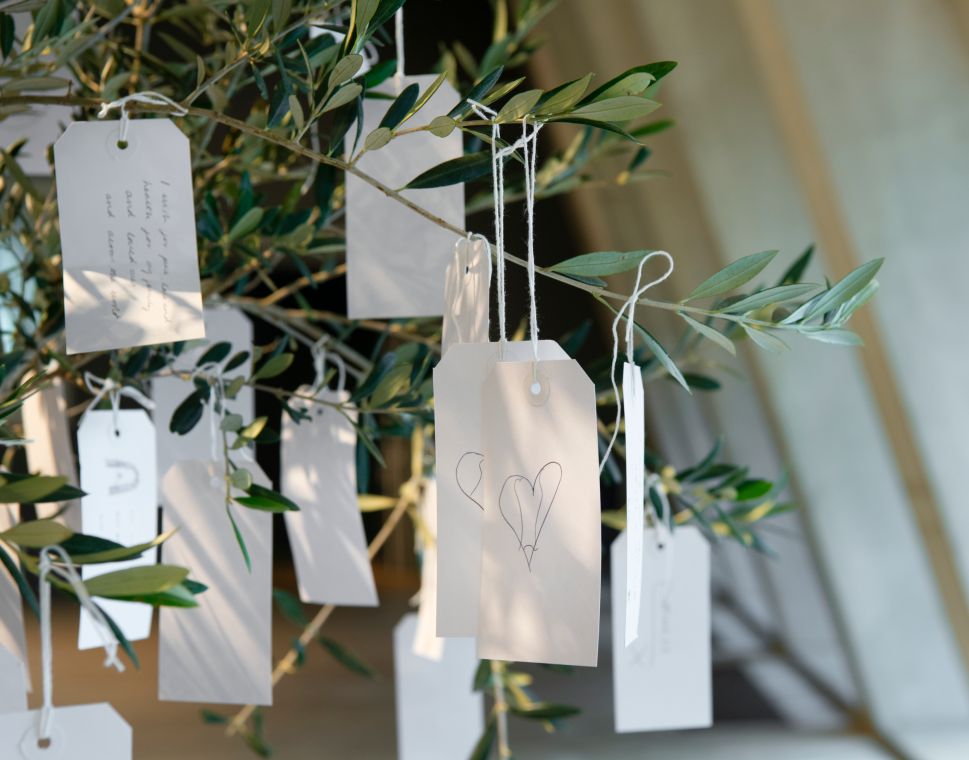
The key collaborator in any artwork is the viewer, a point foundational to Yoko Ono’s practice. We first encounter this notion just outside the door of The Broad in L.A., where “Yoko Ono: Music of the Mind” runs through Oct. 11. There, from the limbs of the century-old Barouni olive trees, hundreds of white tags hang like fruit. On them are written the wishes of passersby, completing her work, Wish Tree (1996), in which viewers are invited to draw inspiration from the messages or add their own to uplift others.
“There are through lines from the very beginning where she’s asking us to look internally and find a sense of self, a sense of centeredness, and act from there with compassion towards others,” The Broad curator and exhibitions manager Sarah Loyer tells Observer of the show, which originated at the Tate Modern in 2024, noting that Ono sees the artist’s role as one of transforming consciousness.
Most famous in many circles for being John Lennon’s wife, Ono had a noteworthy career as an artist long before she met him. A fixture in New York’s avant-garde scene since the mid-1950s, her loft on Chambers Street was known for a series of concerts she curated with composer La Monte Young, attended by such luminaries as John Cage (with whom she toured Japan) and Isamu Noguchi. In 1961, her first major performance, at Carnegie Recital Hall, attended by Young, Richard Maxfield, Jonas Mekas, Yvonne Rainer and others, preceded her first solo art show, “Paintings & Drawings by Yoko Ono,” at AG Gallery owned by Fluxus guru George Maciunas, an early champion of her work.
Cut Piece (1964), first staged at Kyoto’s Yamaichi Hall, was a major breakthrough and remains her most resilient piece. In it, she sat on a stage beside a pair of shears while audience members were invited to cut away pieces of her clothing. “It was a form of giving, giving and taking,” she said of the work, which will be performed, along with Sky Piece to Jesus Christ, at L.A.’s REDCAT by artist MPA July 18 and 19. “It was a kind of criticism against artists, who are always giving what they want to give. I wanted people to take whatever they wanted to, so it was very important to say you can cut where you want to.”
“Cut Piece has been interpreted in a wide range of ways, often through aspects of identity—race, sex, gender, as well as nationality,” says Loyer, noting Ono staged it again in 2003 at age 70, commenting on ageism. “She first performed it in a sort of key post-war period, so it’s been read in relation to the traumas and after effects of World War II or the Vietnam War.”
“Yoko Ono: Music of the Mind“
Venue: The Broad
Address: 221 S Grand Ave, Los Angeles
Through: October 11, 2026
In the first gallery at The Broad is Lighting Piece, a short black-and-white film taking a cue from Ono’s 1964 book Grapefruit, a collection of 200 avant-garde “instruction pieces,” which says “light a match and watch till it goes out.” Her practice is mainly split between performance pieces like Cut Piece, Wrapping Piece and Shadow Piece, opposite works like White Chess Set (also known as Play It by Trust) (1966), a chess set with no black pieces, negating the concept of war and conflict and promoting cooperation between both sides. A Box of Smile (1967), a small sterling silver box with a mirror on the bottom, is related to an unrealized film meant to capture the smiling face of almost every person on the globe so that world leaders would see those who would be affected by declarations of war.
Other pieces straddle both sides of her practice, like Acorn Piece (1968), when Ono and Lennon planted two acorns (one facing East, one facing West) at Coventry Cathedral in England. Expanding the concept a year later, they mailed boxes containing acorns to 96 prominent world leaders, asking them to grow trees. Briefly banned by the British Board of Film Censors, her Film No. 4 (often referred to as “Bottoms”) (1967) is an 80-minute black-and-white piece consisting entirely of close-ups of human posteriors. “It would be very helpful if people started to take off their pants before they fight—that’s the sort of destruction I’m interested in,” Ono said at London’s 1966 DIAS (Destruction in Art Symposium), sponsored by avant-garde guru Gustav Metzger.
It was a pivotal time and place for her where she presented “Unfinished Paintings and Objects” at Indica Gallery, for which Maciunas provided mechanical designs and crucial support. That’s where she first met John Lennon, who asked to hammer a nail into her piece, Painting to Hammer a Nail. She initially refused because the exhibit hadn’t officially opened yet, but after some coaxing, she agreed to let him do so for five shillings. Lennon answered, “Well, I’ll give you an imaginary five shillings and hammer an imaginary nail in.” At the same show, he climbed the ladder of her piece Ceiling Painting, also at The Broad, and peered through a magnifying glass suspended on a chain to read the word “Yes” printed in tiny letters on the ceiling.
Collaborations between the two were mainly in the realm of protest and music. Their first, Unfinished Music No. 1: Two Virgins, was released with a nude photo of the couple on its cover and was sold in a brown paper sleeve. Recorded at Lennon’s home studio while his wife at the time, Cynthia, was vacationing in Greece, it marked the end of his first marriage when she returned home to find Ono wearing her bathrobe and was greeted by her husband with the words, “Oh, hi.”
Revolution 9, on the Beatles’ White Album, was largely a collaboration between Lennon and Ono, along with George Harrison. Although it’s contractually credited to Lennon-McCartney, McCartney chafed at the song’s inclusion on the album. Ono is seen by many fans as the cause of the band’s breakup after Lennon insisted a bed be brought into Abbey Road studios so she could provide input after being immobilized during a car accident. But experts maintain the band was well on the way to dissolution despite Ono’s presence.
“It was like somebody who is in prison without having done anything wrong,” she said at the time. “I finally came to the conclusion to use that big energy of hatred that was coming to me and turn it around into love.”
“Together, they really focused on humanitarianism and peace efforts during the Vietnam War,” says Loyer about the pair’s ‘bed-in’ following their marriage in 1969, a nonviolent protest against war over a two-week period in Amsterdam and Montreal hotels in which the press was invited into their bedroom. While in Montreal, they recorded “Give Peace a Chance,” an anthem adopted by Vietnam War protesters, followed by their campaign War Is Over If You Want It, propagated through advertising and mass media in 12 cities internationally, and repeated around L.A. in conjunction with The Broad show.
Ono’s musical output was also prolific in the late 1960s and early 1970s, recording as a solo artist and with Lennon in the Plastic Ono Band. In addition to songs like “Sisters, Oh Sisters” and “Women Power,” her career continued long after Lennon’s death in 1980 with 16 solo albums to date.
At age 93, there’s no telling whether or not there will be a 17th, but coinciding with The Broad show is a September 19 workshop of a new musical, I Am Yoko, co-produced by Yuka Honda of the band Cibo Matto and artist Glenn Kaino. They will be accompanied by vocalists Theo Bleckmann, Ono’s granddaughter Emi Helfrich and cellist Maggie Parkins.
“Peace is the most difficult and complex state for humanity to achieve, as we live among an overwhelming number of people with whom we cannot agree,” Honda, a longtime friend of Ono’s, said in an Instagram post reflecting the artist’s career. “The challenge becomes unbearable when force is involved. Still, I hope we never take our eyes off this goal.”
