
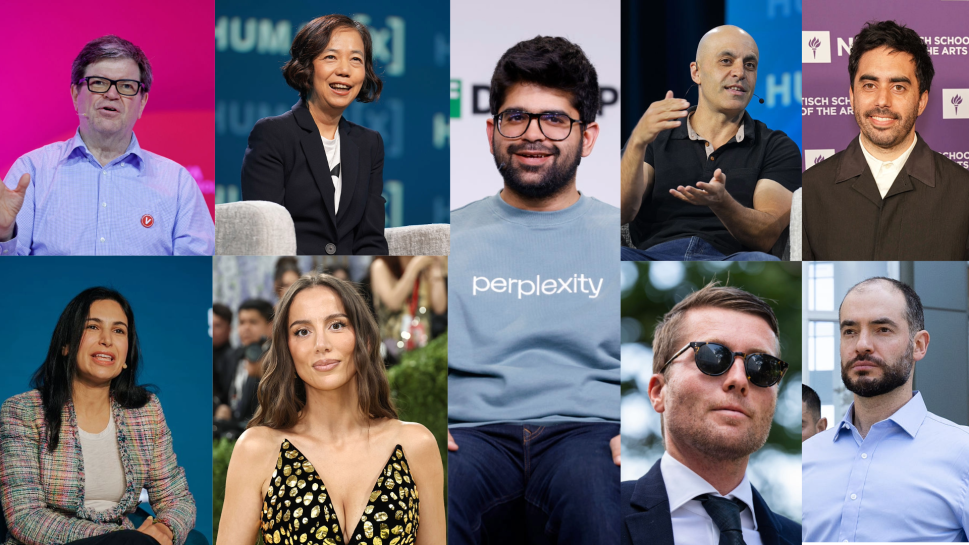
For all the talk of A.I. as a Silicon Valley arms race, many of the companies driving the industry were built by founders whose stories began outside the U.S. Some—like Elon Musk and Ali Ghodsi—now lead companies valued at more than $100 billion. Others, including Fei-Fei Li, Yann LeCun, and Daniela Rus, helped pioneer the research now fueling multibillion-dollar startups. Together, the 12 founders on this list lead companies worth at least $470 billion, underscoring how much of the A.I. economy is being shaped by people who first came to the U.S. as students, researchers, refugees, and entrepreneurs.
Elon Musk, founder of xAI; co-founder of OpenAI and Neuralink
Path to the U.S.: Born in Pretoria, South Africa, in 1971, Musk moved to Canada at age 17 and attended Queen’s University before transferring to the University of Pennsylvania in the U.S., where he studied physics and economics. He moved to Silicon Valley in 1995, briefly enrolled in a Stanford Ph.D. program, but left after two days to co-found Zip2, an early internet startup. He later co-founded X.com, the online banking company that became part of PayPal, and became a U.S. citizen in 2002.
Why he matters in A.I.: Musk helped launch OpenAI in 2015 as a nonprofit counterweight to Google’s DeepMind, but left the organization in 2018. He later sued OpenAI, accusing the company of abandoning its original mission; that case has since been dismissed. In 2023, Musk founded xAI, which launched the ChatGPT rival Grok. The company, worth $250 billion, is now part of SpaceX, giving Musk a way to tie A.I. to his larger empire of rockets, satellites, social media and payments. Neuralink, meanwhile, reflects his longer-running interest in linking machines more closely with the human brain. On a broader level, Musk is not building a single A.I. startup so much as folding the technology into his wider “X” ecosystem.
Ali Ghodsi, co-founder and CEO of Databricks
Path to the U.S.: Born in Tehran in 1978, Ghodsi fled Iran with his family as a child and grew up in Sweden, according to Forbes. He moved to the U.S. in 2009 as a visiting scholar at the University of California, Berkeley, where he worked on Apache Spark, the open-source data processing project that later became the foundation for Databricks. He co-founded the company in 2013 with several Berkeley researchers.
Why he matters in A.I.: While Databricks is not a consumer-facing chatbot company, it sits at the center of the enterprise A.I. boom. Its unique “lakehouse” platform helps companies organize, manage and analyze massive amounts of data, the raw material needed to build and run A.I. systems. That has made Ghodsi one of the industry’s most important infrastructure founders: less visible than some CEOs, but essential to the companies trying to turn A.I. from a demo into a business. More recently, Databricks has reportedly discussed a new funding round that could value it between $165 billion and $175 billion, according to The Information.
Ilya Sutskever, co-founder and CEO of Safe Superintelligence
Path to the U.S.: Born in 1986 in what is now Nizhny Novgorod, Russia, Sutskever was raised in Israel and moved to Canada as a teenager. At the University of Toronto, he studied under “Godfather of A.I.” Geoffrey Hinton and helped develop AlexNet, the breakthrough neural network that helped kick off the modern deep learning boom. He later worked at Google Brain before joining OpenAI.
Why he matters in A.I.: Sutskever co-founded OpenAI in 2015 and later became its chief scientist. He was a key developer of OpenAI’s GPT models. He was also central to the failed effort to oust Sam Altman in late 2023. After leaving OpenAI in 2024, Sutskever launched Safe Superintelligence with Daniel Gross and Daniel Levy. Despite having no near-term consumer product, the startup has a staggering valuation of $32 billion, reflecting Sutskever’s reputation and investor appetite for the next major bet on A.I.
Aravind Srinivas, founder and CEO of Perplexity AI
Path to the U.S.: Born in 1994, Srinivas was raised in Chennai, India, the same hometown as Google CEO Sundar Pichai. He moved to the U.S. in 2017 to pursue a Ph.D. in computer science at the University of California, Berkeley. Before co-founding Perplexity in 2022, he interned at Google-owned DeepMind, worked as a research scientist at OpenAI and later joined Google.
Why he matters in A.I.: Srinivas is now building one of the most serious challengers to Google Search. Perplexity bills itself as an “answer engine,” giving conversational, source-backed responses rather than a traditional list of links. The company has since pushed into agentic browsing with Comet, its A.I.-powered web browser, while reaching a $20 billion valuation in September. It has also drawn lawsuits from publishers that accuse it of misusing their content. Srinivas has said Perplexity is planning a 2028 IPO.
Mira Murati, founder and CEO of Thinking Machines Lab
Path to the U.S.: Born in Vlorë, Albania, in 1988, Murati left her home country as a teenager to study in Canada before attending Dartmouth College in the U.S., where she studied engineering. In 2013, she joined Tesla as a senior product manager on the Model X. She later worked at Leap Motion, now UltraLeap, before joining OpenAI as head of applied A.I. and partnerships in 2018.
Why she matters in A.I.: Rising quickly to become OpenAI’s chief technology officer, Murati helped turn research into products used by millions, overseeing work on ChatGPT, DALL-E and Sora. After leaving the company in 2024, she launched Thinking Machines Lab, which closed a staggering $2 billion seed round in June 2025, valuing the company at $12 billion. The company is building “interaction models” designed to collaborate alongside humans and process audio, text and video at the same time.
Cristóbal Valenzuela, co-founder and co-CEO of Runway
Path to the U.S.: Born in Chile in 1989, Valenzuela began making home videos as a teenager in Santiago and later funded his education by creating websites and promotional videos. In 2016, he moved to New York to enroll in the Interactive Telecommunications Program at NYU’s Tisch School of the Arts. There, he co-founded Runway in 2018 with classmates Anastasis Germanidis and Alejandro Matamala Ortiz.
Why he matters in A.I.: Valenzuela turned an early fascination with video into Runway, valued at $5.3 billion after its February 2026 funding round. The company first gained traction with tools for filmmakers, designers and artists, including editing features like background removal, before moving into text-to-video generation. It is now expanding into world models, putting Runway at the center of the race to build A.I. capable of generating and simulating 3D environments.
Clément Delangue, co-founder and CEO of Hugging Face
Path to the U.S.: Born and raised in France, Delangue built his career across the French and U.S. tech scenes before co-founding Hugging Face in New York in 2016 with Julien Chaumond and Thomas Wolf. The company started as a chatbot app before evolving into an open-source machine learning platform now used by 13 million people.
Why he matters in A.I.: Hugging Face, often described as “Github for A.I.,” has become a key place for developers to share models, datasets and applications. Its open-source approach has made Delangue one of the vocal advocates for democratizing A.I., arguing that its future should be shaped collaboratively rather than controlled by a few companies. Hugging Face was last valued at $4.5 billion after its $235 million Series D in 2023 and has not raised venture funding since; the company turned down a $500 million investment from Nvidia last year.
Yann LeCun, founder of Advanced Machine Intelligence (AMI) Labs
Path to the U.S.: Born in France in 1960, LeCun immigrated to the U.S. in 1988 to work at AT&T Bell Labs, which sponsored his visa. He later joined New York University as a professor and, in 2013, went to Facebook to launch what became Facebook A.I. Research, or FAIR.
Why he matters in A.I.: LeCun is one of the “Godfathers of A.I.,” alongside Geoffrey Hinton and Yoshua Bengio, with whom he shared the 2018 Turing Award for breakthroughs in deep neural networks. After 12 years at Meta, including almost eight as chief A.I. scientist, LeCun left in November to become executive chairman of Paris-based AMI Labs. The startup is building “world models,” or A.I. systems designed to understand and interact with the real world, reflecting LeCun’s view that large language models alone are not enough to reach greater machine intelligence. AMI Labs announced a $1 billion seed round in March, the largest ever for a European startup, valuing the company at $3.5 billion.
Daphne Koller, founder and CEO, Insitro
Path to the U.S.: Born in Jerusalem, Koller studied at Hebrew University before moving to the U.S. for her Ph.D. at Stanford in 1989. She later became a Stanford computer science professor, co-founded Coursera with Andrew Ng and served as chief computing officer at Alphabet’s Calico, a longevity research company, before founding Insitro in 2018.
Why she matters in A.I.: Koller has spent decades working at the intersection of machine learning, education and biology. At Insitro, reportedly valued at about $2.5 billion, she is applying A.I. to one of the field’s biggest real-world tests: drug discovery. The company uses large-scale data to make drug development more predictive, arguing that biotech needs datasets built specifically for A.I. Its partnerships with Eli Lilly and Bristol Myers Squibb further reflect Koller’s push to rethink how drugs are discovered.
May Habib, co-founder and CEO of Writer
Path to the U.S.: Born near the Lebanon-Syria border during Lebanon’s civil war, Habib fled with her family to Canada in 1990. The oldest of eight children, she became the family’s English-language interpreter, an experience that later informed her career in language technology. She later graduated from Harvard and built her career, co-founding Qordoba, an A.I.-driven content localization startup, before launching Writer with CTO Waseem Alshikh in 2020.
Why she matters in A.I.: Habib is building Writer, valued at $1.9 billion in November 2024, around a more practical version of generative A.I. for large companies. Its Palmyra family of large language models and Writer Agent, a platform for multi-step tasks, are designed for enterprise workflows rather than consumer chatbots. The company says more than 300 enterprise customers, including Salesforce and Airbnb, have deployed over 15,000 agents, putting Writer in the middle of the push to turn A.I. into more of an operating layer for businesses.
Daniela Rus, co-founder of Liquid AI
Path to the U.S.: Born in Cluj-Napoca, Romania, Rus grew up under Nicolae Ceaușescu’s regime before moving to the U.S. with her family in the early 1980s. She studied computer science and mathematics at the University of Iowa, earned graduate degrees at Cornell, and later became director of MIT’s Computer Science and Artificial Intelligence Laboratory, or CSAIL.
Why she matters in A.I.: Rus has spent her career building machines that can move through and act in the physical world, seeing robotics as a way to give people “superpowers.” At Liquid AI, an MIT spinout, she is expanding that work into foundation models, helping build smaller, more efficient A.I. systems that can adapt without relying entirely on the cloud. The company raised $250 million in an AMD-led round in December 2024, valuing it at $2.3 billion.
Fei-Fei Li, co-founder and CEO of World Labs
Path to the U.S.: Born in China in 1976 and raised in Chengdu, Li moved to the U.S. as a teenager, knowing little English. She later studied at Princeton and Caltech before building a career at Stanford, where she directed the A.I. Lab, and at Google, where she served as chief scientist of A.I./ML.
Why she matters in A.I.: Often called the “Godmother of A.I.,” Li helped teach machines how to see by leading the development of ImageNet, the 14-million-image database that helped accelerate modern computer vision. With World Labs, she is now pushing A.I. toward spatial intelligence, or systems that can better understand and generate the physical world. In November, the startup released Marble, a world model that can create 3D environments from text, images, video and layouts. World Labs launched in 2024 with $230 million in funding and a reported valuation above $1 billion, then announced $1 billion in fresh funding in February without disclosing its latest valuation.
